

Sanota
Sanota · Writing
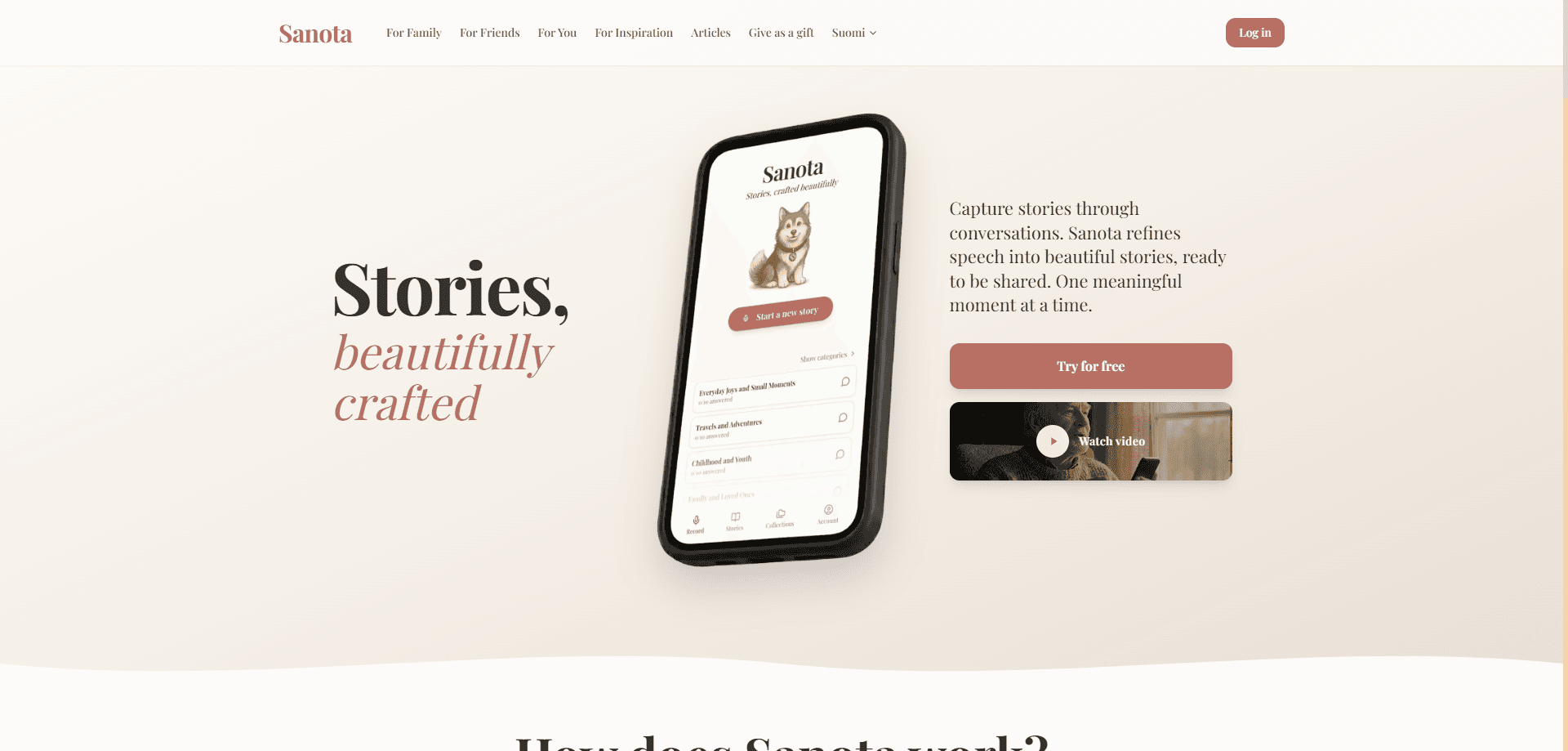
Sanota is an AI voice-to-story app that turns spoken memories into polished written narratives. You talk, the app listens, asks follow-up questions, and hands back a story you can read, share, or print as a hardcover book. It's built for families, friends, and anyone who wants to keep their own stories from slipping away.
About Sanota
What Is Sanota
Sanota is an AI storytelling app that captures memories through conversation rather than typing. You speak about a moment, a trip, or a person, and it uses AI to turn speech into text that keeps your voice and rhythm.
The idea targets a real gap. Most people never write their memories down, and the ones who try often quit after a page or two. Sanota removes the blank page entirely. You just talk, and the writing happens on its own.
There's a social angle too. You can collect stories from loved ones through story requests, and they don't need to download the app or create an account. They open a link and speak.
The main limit is scope. Sanota focuses on personal storytelling, not transcription for work, interviews, or note-taking. If you want a meeting transcript, this isn't that tool.
Getting Started
- Sign up at sanota.app and pick a plan.
- Tap record and start talking about a memory in your own words.
- Answer the follow-up questions Sanota asks to fill in forgotten details.
- Review the written story in the app or your inbox, then edit or share it.
- Order a hardcover book from your collected stories whenever you're ready.
Product Information
A quick look at Sanota's pricing, supported platforms, and performance.
Best for
The users, tasks, and scenarios where this tool fits best.
Users
- Families who want to preserve a parent's or grandparent's memories before they fade, using story requests and a printed book as the end product
- People who think better out loud than on paper
- Anyone recording their own life story for children or grandchildren, with the option to compile it into a hardcover keepsake
Tasks
- Turning a spoken trip story into a shareable written piece you can send to relatives by email or link
- Collecting memories from several family members into one shared narrative through story requests
- Writing a memoir chapter by chapter without hiring a ghostwriter, then ordering the finished set as a book
Scenarios
- A family gathering where you want to record everyone's version of an old story before people head home
- A quiet evening when a memory surfaces and you want it captured in the moment rather than forgotten by morning
- Long-distance family life
Key features
Voice-to-Story Conversion
The core of Sanota is simple to describe and hard to get right. You speak naturally, and the AI shapes your words into coherent written prose instead of a raw transcript. It keeps your phrasing and rhythm, so the result reads like you wrote it well, not like a machine cleaned it up. This is the feature that separates Sanota from a dictation tool.
Follow-Up Questions
Sanota doesn't just listen. It asks. After you pause, the app poses follow-up questions that pull out details you forgot to mention: the name of the village, what the weather was like, who was standing next to you. Those prompts are what turn a thin memory into a story with texture. For people who don't know where to start, the questions do the work of an interviewer.
Story Requests
Think of it as an AI memoir writer that works from your voice. You can gather stories from other people without asking them to install anything. Send a story request, and the person responds by phone or through a link. Your grandmother records her memory, you get the written version. This is how Sanota turns a single voice into a family archive, and it's the feature most likely to get used around holidays and reunions.
Style Choices
Sanota writes in the style you pick rather than forcing one tone on every story. A wistful memory and a funny one don't read the same way. If you care about how your story sounds on the page, the style setting gives you some control over the final voice.
Shareable Output and Printed Books
Every finished story lands in the app and your email, ready to share by link or message. The bigger option is the hardcover book. Collect enough stories and Sanota will print them as a physical volume, which turns a pile of recordings into something you can hand to someone. The book is the reason many people stick with the app past the first story.
Pros and cons
Pros
- The voice-first flow removes the intimidation of a blank page, so people who never write things down actually finish a story
- Story requests let relatives contribute without downloading an app or logging in, which lowers the barrier for older family members
- Follow-up questions add specific detail that most people would otherwise leave out
- The hardcover book option gives the collected stories a physical endpoint worth paying for
Cons
- There's no free plan, so you can't test the writing quality with a single story before subscribing
- Collection is limited to personal storytelling, which rules out work transcription or research interviews
- No public API means you can't pull your stories into other tools or automate anything
Frequently asked questions
It captures spoken memories and turns them into written stories. You talk, the app asks questions, and you get back a polished narrative you can share or print.
Related content
Explore related tools, skills, and articles for Sanota.
Sanota Alternatives

Claude for Google Workspace
Anthropic · Writing · Productivity · BusinessClaude for Google Workspace puts Claude in a sidebar inside Google Docs, Sheets, and Slides, where it reads the file you have open and edits it in place.

Claude Haiku 5.5
Anthropic · Writing · Coding · ChatbotClaude Haiku 5.5 is Anthropic's fastest and cheapest small model, built for high volume tasks at $0.10 per million input tokens with a 1M token context window.
NoteWorthy
Suman Hansada · Writing · Productivity · AI AssistantNoteWorthy is a notes app for iPhone, iPad and Mac that writes titles, tidies formatting, summarizes long notes and files each one with on-device AI. No account, no upload, no network requests.