

Scira
Zaid Mukaddam · Coding
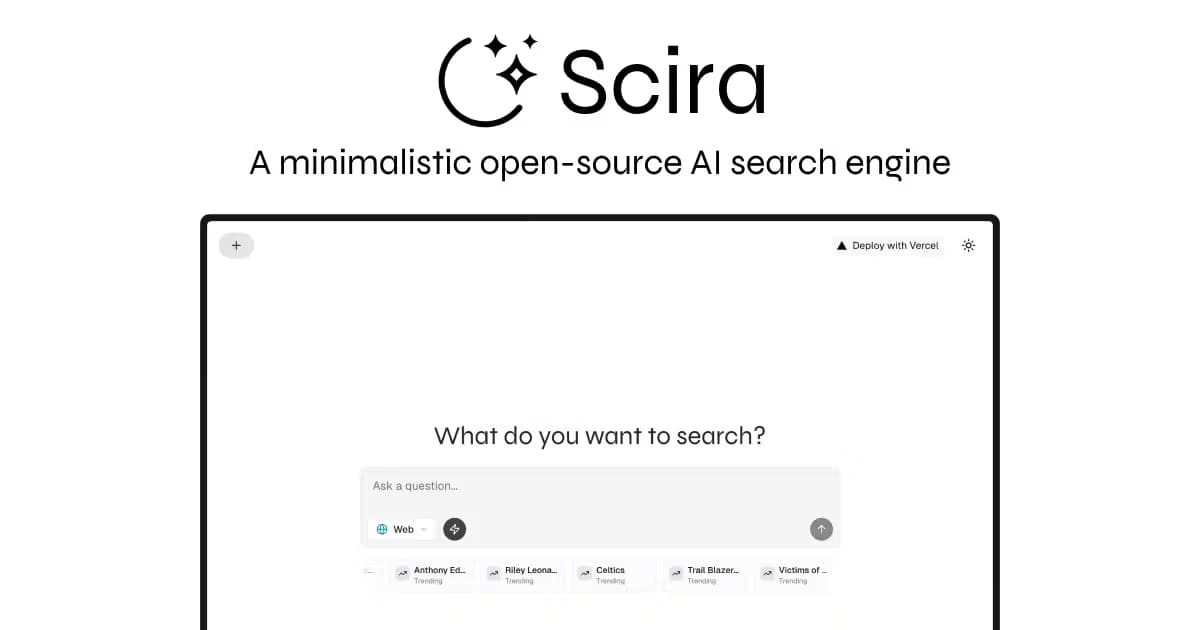
Scira is a minimalist AI search engine that plans a question into sub-tasks, reads live sources, and returns an answer with clickable citations.
About Scira
What Is Scira
Scira answers questions the way a careful researcher would. You type a question, and instead of returning a page of links, it breaks the query into smaller parts, reads the pages and posts that matter, and writes a single answer with a citation beside every claim. It started life as MiniPerplx, a side project by Mumbai developer Zaid Mukaddam, and now handles millions of searches with a small team behind it.
The draw is the paper trail. You can open any step of a run and see the exact queries, sources and reasoning that produced the line above it. When two sources disagree, Scira says so rather than quietly picking the friendlier one. That transparency is what separates it from a chat assistant that guesses and from a classic search engine that just lists links.
The biggest limit is scale. Scira is a smaller operation than Perplexity or Google, so heavy model use is capped through weekly and monthly quotas that reset on a schedule. The free tier is generous enough to try, but anyone who researches all day will feel the caps on the stronger models.
Getting Started
- Open scira.ai and type a question, upload a PDF, or paste a URL. No card is needed for the free tier.
- Pick a mode if you want one, such as Web, Academic, Reddit or X, or let Scira choose for you.
- Watch the run plan itself out. Open any step to check the sources it pulled.
- Connect an app like GitHub, Notion or Slack if you want Scira to act on what it finds, and approve any write action.
Product Information
A quick look at Scira's pricing, supported platforms, and performance.
Best for
The users, tasks, and scenarios where this tool fits best.
Users
- Students and researchers
- Developers and analysts
- People wary of black-box AI
Tasks
- Deep research on a hard question
- Verified fact-finding
- Monitoring a topic over time
Scenarios
- Checking a claim before you repeat it
- Researching across scattered sources
- Turning findings into action
Key features
Agentic planning and retrieval
Scira turns a question into a set of sub-questions, assigns each one the model and the source that fit it, and runs them in parallel where they don't depend on each other. Results are deduplicated by canonical URL before anything is written, so you don't get the same page counted three times. This is what makes a run feel like research rather than a single lookup.
Cited answers you can audit
Every claim carries an inline citation linked to the retrieved source, and you can open any step of the run to inspect it. When sources conflict, Scira flags the disagreement instead of smoothing it over. For anyone who has been burned by a confident but wrong AI answer, this is the feature that matters most.
18 built-in search modes
Modes cover Web, Chat, X, Reddit, Academic, GitHub, Code, YouTube, Spotify, Stocks, Crypto, Prediction markets, Extreme, Memory, Voice and more. Each one pulls from a different kind of source, so a question about a framework lands on GitHub and a question about a market lands on prediction markets. You pick a mode or let Scira decide.
Scira Apps and 100+ MCP connections
You connect a server once, and its tools become part of every run, with approval required on anything that writes. The list spans GitHub, Notion, Slack, Linear, Stripe, Figma, Google and more. This is what turns a search engine into something that can act on what it finds rather than just report it.
Extreme mode deep research
Extreme mode runs an LLM-driven agent that plans across multiple steps, executes code in a sandbox and stores artifacts as it goes. It is built for questions too broad for one search, like mapping a market or comparing several options across many sources. It takes longer, and that is the trade for the depth.
Lookouts for recurring research
Lookouts schedule a research run on a recurring basis. A Lookout watches a topic, tracks changes and emails you an update. Instead of re-asking the same question every week, you set it once. It suits anyone tracking a competitor, a price or a field that keeps moving.
Open source and self-hostable
Scira ships under the AGPL-3.0 license, so you can read the code, self-host it, bring your own model keys and connect custom tools. The stack runs on the Vercel AI SDK, Next.js and Tailwind. For teams that need data to stay on their own infrastructure, that option is the difference between using Scira and skipping it.
Pros and cons
Pros
- Every answer links to a retrievable source, so you can verify a fact instead of trusting the model.
- Runs stay transparent end to end. You see the queries, pages and reasoning behind each answer.
- 18 modes plus 100+ app connections cover research, coding, markets and social sources in one place.
- Open source under AGPL-3.0 and self-hostable, which suits privacy-minded teams.
- Free tier gives 3 runs a day with no card, enough to judge the tool.
Cons
- Model quotas on Pro and Max reset weekly or monthly, so intensive users hit caps on the stronger models.
- No free tier for the premium models, so the full lineup starts at $15 a month.
- It is a smaller operation than Perplexity or Google, which shows in the pace of new features.
- There is no public API for developers, so you cannot build on it the way you can on some rivals.
Frequently asked questions
Scira works as an AI research assistant and citation-based search engine for work that needs sources you can check. You ask a question, it plans the search, reads live pages and posts, and returns an answer with a citation next to each claim so you can confirm it yourself.
Related content
Explore related tools, skills, and articles for Scira.
Scira Alternatives

Base Code
Base44 (Wix) · Coding · ProductivityBase Code is a shared cloud development environment from Base44. Teammates describe changes to an existing GitHub codebase in chat, preview them live and send them back as pull requests.

Google EmbeddingGemma 2
Google DeepMind · Writing · Image · CodingGoogle EmbeddingGemma 2 is a 740M-parameter open model that turns text, code, images, audio, and video frames into vectors in one 768-dimension space, running on phones and laptops.

GitGlow
GitGlow · Coding · ProductivityGitGlow is a local-first desktop Git client that lets independent developers review their own code and their AI agents' changes in one place before shipping.