

SciSummary
SciSummary · Writing · Business
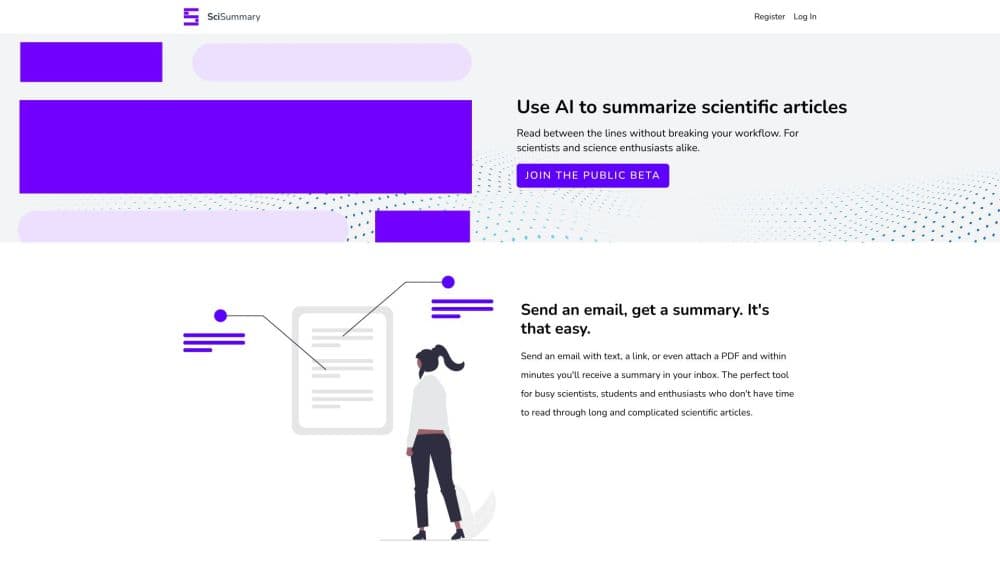
SciSummary is an AI research paper summarizer that turns PDFs, DOIs, and arXiv links into clear, structured summaries with figures and citations attached.
About SciSummary
What Is SciSummary
SciSummary is an AI tool built to make scientific papers readable in minutes instead of hours. You hand it a PDF, a DOI, a PubMed ID, an arXiv link, or a plain URL, and it returns a structured summary with labeled sections instead of a wall of text. The team behind it is made up of PhDs and former Google engineers, and the company says more than 800,000 researchers now use it, including people at Harvard, MIT, and Stanford.
The problem it solves is specific. General chatbots will summarize a paper, but they drop the structure, the figures, and the citations that make a study worth trusting. SciSummary keeps them. You get abstract, methods, results, and conclusion kept apart, plus figure analysis that explains charts and tables you would otherwise skip, and a citation you can copy into your references without retyping anything.
The limits are worth knowing up front. The free plan gives you a taste with a small number of summaries per month, the deeper features like bulk paper synthesis and library-wide chat sit behind the Pro plan, and the REST API is a separate subscription on top. It also reads English-language papers best, so non-English sources may come back thinner.
Getting Started
- Go to scisummary.com and sign up with an email or a Google account; you can summarize one paper before committing to anything.
- Upload a PDF or paste a DOI, PubMed ID, arXiv ID, or article URL into the input box.
- Pick a summary mode: a standard summary, an ELI5 simplification, key points, key questions, future research directions, or the abstract rewritten.
- Set the length and, if you want, a target language from the 100+ options, then run the summary.
- Save the result to a folder, generate a citation, or open the paper in chat to ask follow-up questions.
Product Information
A quick look at SciSummary's pricing, supported platforms, and performance.
Best for
The users, tasks, and scenarios where this tool fits best.
Users
- Students and grad researchers
- Researchers tracking a field
- Curious non-specialists
Tasks
- Triaging a reading list
- Managing an AI literature review
- Extracting key points and methods
- Translating research
- Generating citations
Scenarios
- Prepping for a journal club
- Screening papers for a review
- Keeping up with a fast-moving field
Key features
Structured Multilingual Summaries
As a scientific paper summarizer, SciSummary breaks a paper into labeled sections rather than a single blob, so abstract, methods, results, and conclusion stay where you can find them. Standard, simplify, key points, key questions, and future research modes each serve a different reading goal. Every summary can be tuned for length and translated into more than 100 languages.
Figure and Chart Analysis
Papers bury their most important numbers in figures and tables, and skimming past them loses the point. SciSummary extracts figures, charts, and tables and explains what they show, so a complex plot becomes a sentence you can act on. This is the feature that separates it from a generic text summarizer.
Bulk Summarization and Comparison
Instead of one paper at a time, you can run a batch and have SciSummary synthesize several studies into a single combined summary or a side-by-side comparison. That is what makes a literature review practical when you have dozens of papers and a deadline. The comparison view highlights where studies agree and where they conflict.
Research Library with Semantic Search
Uploaded papers land in a library you can organize with folders and tags, and semantic search finds the relevant study by meaning rather than by exact keyword. You can chat with a single paper or ask questions across the whole collection, which turns a folder of PDFs into something closer to a searchable knowledge base.
Citation Generation
Each paper comes with a ready-to-use citation, so you stop retyping author lists and journal details into your reference manager. It matters most when you are assembling a bibliography and every saved minute compounds.
REST API and MCP Server
A bulk REST API lets you automate summarization from your own code, and the MCP server connects SciSummary to AI agents like Claude and ChatGPT. The API is billed as a separate subscription, so teams building a research pipeline should factor that cost in before committing.
Pros and cons
Pros
- Structured output that keeps a paper's sections, figures, and citations intact instead of flattening everything into prose.
- Over 100 output languages, which is rare for an academic summarizer.
- Bulk summarization and cross-paper comparison make literature reviews far less tedious.
- A real REST API and MCP server for teams that want to automate the workflow.
- Low entry price at $4/mo billed yearly, with a 7-day trial and a student promo.
Cons
- Free plan caps you at a few summaries per month, so it works as a trial rather than a daily driver.
- The API is a separate subscription, which adds up for anyone who mainly wants programmatic access.
- Best results come from English-language papers, so non-English sources may summarize less reliably.
- Summaries are a starting point, not a substitute for reading the papers you plan to cite.
Frequently asked questions
SciSummary is a paper summarizer tool that takes a scientific paper as a PDF, DOI, PubMed ID, arXiv ID, or URL and returns a structured summary with its figures and a citation. People use it to summarize research papers and understand them, not for open-ended chat.
Related content
Explore related tools, skills, and articles for SciSummary.
SciSummary Alternatives

Google EmbeddingGemma 2
Google DeepMind · Writing · Image · CodingGoogle EmbeddingGemma 2 is a 740M-parameter open model that turns text, code, images, audio, and video frames into vectors in one 768-dimension space, running on phones and laptops.

MePersona
MePersona, Inc. · Writing · Productivity · MarketingMePersona is an AI unified inbox for creators. It learns your voice, drafts replies to fan messages from 12 platforms, and sends only what you approve.

Fluence
Yay Software (Yannick Huchard) · Writing · Voice & Language · ProductivityFluence is an Android app that reads PDFs, EPUBs, Word files and web articles aloud, follows each sentence as it speaks, and answers questions about the text on the phone itself.