

Seed Diffusion
ByteDance Seed · Coding
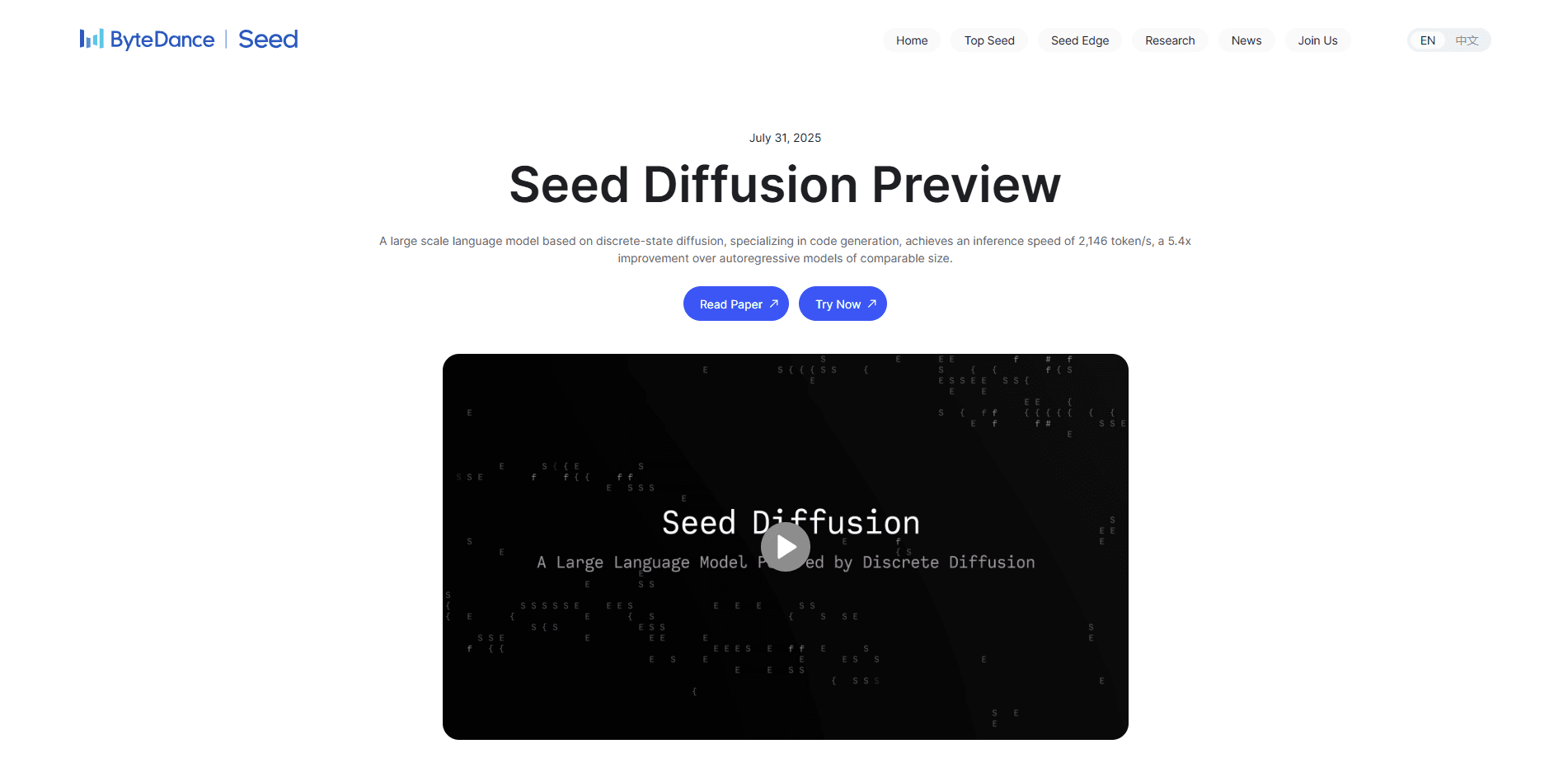
Seed Diffusion is ByteDance's experimental diffusion language model for code generation. It writes code in parallel instead of one token at a time, reaching 2,146 tokens per second.
About Seed Diffusion
What Is Seed Diffusion
Seed Diffusion is a large language model from ByteDance that generates text through diffusion rather than the usual one-word-at-a-time approach. Most language models, including the ones behind everyday chatbots, produce a reply token by token, left to right. Seed Diffusion works differently: it starts from noise and refines a whole block of tokens at once.
The model arrives as Seed Diffusion Preview, a public research release focused on code. ByteDance's Seed team built it with Tsinghua University's AIR lab to test whether a discrete diffusion model can hold up on language tasks, not just images and video, where the method already works well. On an H20 GPU it generates code at 2,146 tokens per second, which the team says is 5.4 times faster than an autoregressive model of comparable size. As an AI code generation model, it trades the usual left-to-right decoder for a parallel one.
The catch is that this is a preview, not a product. There's no pricing, no public API, and no general-purpose chat interface. The goal is to prove the approach works, and the team frames the speed as the most visible benefit of a much longer research road.
Getting Started
- Open the demo at studio.seed.ai/exp/seed_diffusion to try the model on code prompts.
- Read the project page at seed.bytedance.com/seed_diffusion for the technical framing.
- Check the research paper on arXiv (2508.02193) for the method, benchmarks, and training details.
- Compare the reported speed and quality against the code model you already use before assuming it fits a workflow.
Product Information
A quick look at Seed Diffusion's pricing, supported platforms, and performance.
Best for
The users, tasks, and scenarios where this tool fits best.
Users
- AI researchers
- Code framework and tooling developers
- Technical readers tracking model design
Tasks
- Code generation
- Code editing
- Fast prototyping in a demo
Scenarios
- Studying diffusion language models before they reach production
- Evaluating whether speed matters for a code pipeline
- Following ByteDance's research direction
Key features
Parallel token generation
Seed Diffusion drafts many tokens at once instead of one after another. That single design choice is where the speed comes from: the model spends its compute filling in a block rather than waiting on each token in turn. For long code outputs, that changes how long a user waits.
Reported 2,146 tokens per second
On an H20 GPU, the preview generates code at 2,146 tokens per second, a figure the team reports as 5.4 times faster than a same-size autoregressive model. Seed Diffusion speed is the headline finding, and the paper positions it as a new point on the speed-quality frontier for code models.
Competitive quality on code benchmarks
Speed alone wouldn't mean much if the code were poor. According to ByteDance, the model matches same-size autoregressive models on standard code benchmarks, and it pulls ahead on code editing tasks that need a global view of the file.
Two-stage training
The model learns in two passes, ByteDance says. The first fills in masked tokens to build basic completions; the second edits and deletes tokens to force the model to judge the whole sequence, which the team links to a 4.8% gain over autoregressive models on CanItEdit code repair.
Structured order and on-policy tuning
Language and code follow patterns, like declaring a variable before using it. Seed Diffusion trains with a constrained order to respect those dependencies, then tunes itself to converge in fewer steps without losing output quality.
Pros and cons
Pros
- Very fast generation: 2,146 tokens/s is well above same-size autoregressive code models.
- Solid reported quality: matches comparable autoregressive models on standard code benchmarks.
- Strong on code editing: the whole-block view helps on tasks that need a global read of the file.
- Open reference material: a public demo and a published paper let anyone check the claims.
Cons
- Preview only: no pricing, no product, and no general-purpose interface, so it isn't usable in production.
- No confirmed API: teams can't build on it yet, since availability is undocumented.
- Code-focused: the preview was tuned for code, so results on other text tasks aren't established.
- Speed depends on hardware: the headline number comes from an H20 GPU, so real-world throughput will vary.
Frequently asked questions
Seed Diffusion is ByteDance's experimental diffusion language model. Instead of writing one token at a time, it refines a block of tokens in parallel, and it was built to test diffusion on code generation.
Related content
Explore related tools, skills, and articles for Seed Diffusion.
Seed Diffusion Alternatives

Base Code
Base44 (Wix) · Coding · ProductivityBase Code is a shared cloud development environment from Base44. Teammates describe changes to an existing GitHub codebase in chat, preview them live and send them back as pull requests.

Google EmbeddingGemma 2
Google DeepMind · Writing · Image · CodingGoogle EmbeddingGemma 2 is a 740M-parameter open model that turns text, code, images, audio, and video frames into vectors in one 768-dimension space, running on phones and laptops.

GitGlow
GitGlow · Coding · ProductivityGitGlow is a local-first desktop Git client that lets independent developers review their own code and their AI agents' changes in one place before shipping.