

SEO Content Lead
SEO Content Lead · Marketing · AI Detection
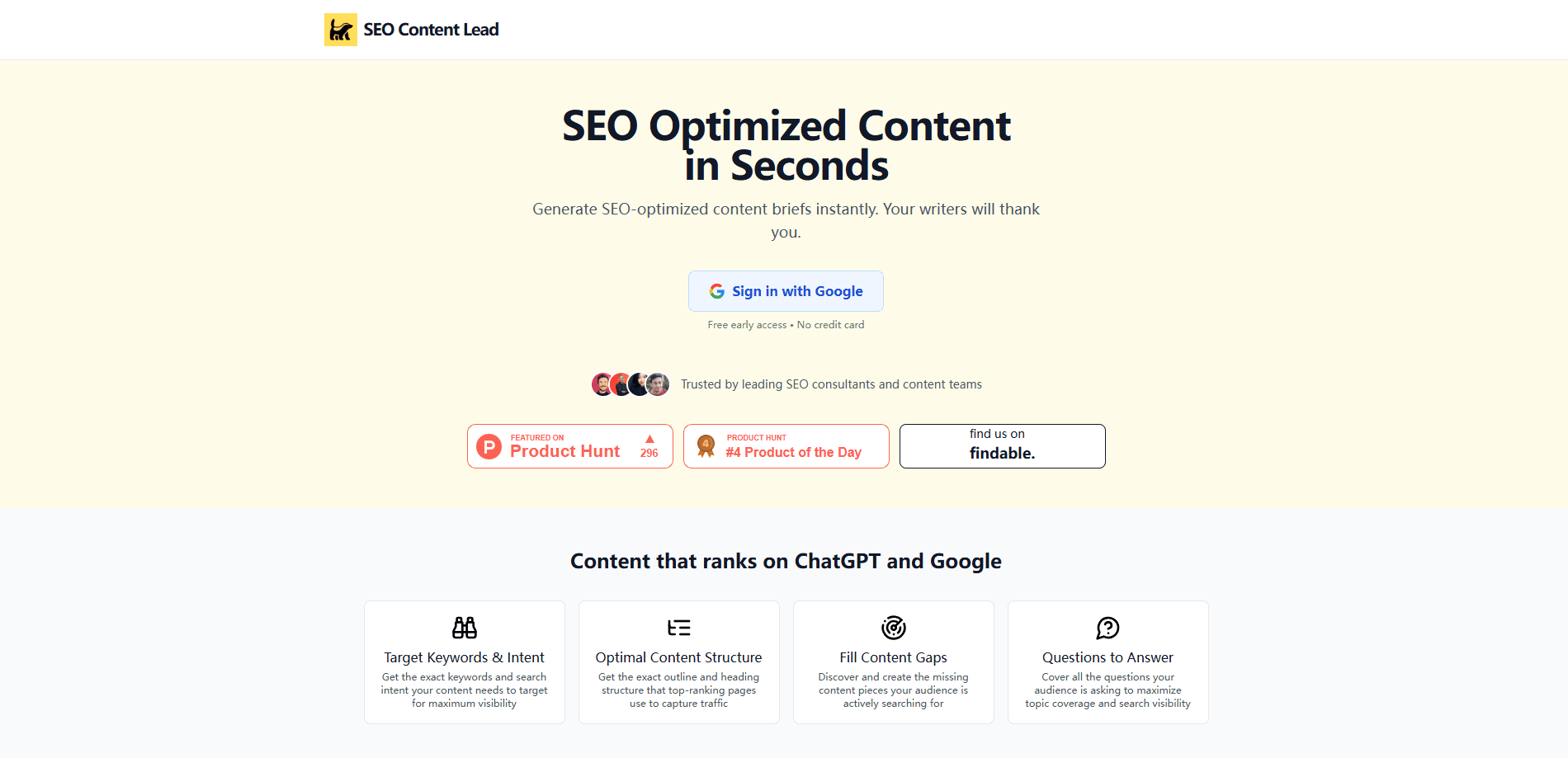
SEO Content Lead is a free AI tool that turns a single keyword into a complete SEO content brief, covering search intent, an outline, target keywords, and the questions a page should answer.
About SEO Content Lead
What Is SEO Content Lead
SEO Content Lead is an AI tool that writes SEO content briefs for you. You give it one target keyword, and it drafts the plan a writer would normally spend an hour assembling: the keywords and intent to target, the heading structure that top-ranking pages use, the gaps your competitors left open, and the questions your audience keeps asking. The output is a brief, not a finished article, which keeps the human writer in control of the final copy.
The pitch is speed for content teams. A content lead or editor often struggles to hand a writer a brief that is clear enough to work from, and vague instructions produce vague drafts. This tool tries to close that gap by generating a structured brief in seconds instead of asking someone to build one by hand. The site lists leading SEO consultants and content teams as users and quotes Peter M. Buch, Head of SEO at Candycat Agency, on how hard clear briefs are to write.
The tool is in free early access with no credit card, and sign-in runs through Google. That means the product is young and some areas are still thin. There is no public API, and the marketing site itself does not yet document detailed pricing tiers beyond a Pro and Enterprise support structure. Treat it as a fast brief generator, not a full SEO suite. It will not audit your site or track rankings.
Getting Started
- Open the site and sign in with your Google account. Access is free during early access, so no card is needed.
- Enter the target keyword you want to rank for.
- Let the AI analyze search intent and the competition around that keyword.
- Review the generated brief: keywords and intent, suggested outline, competitor insights, content gaps, and questions to answer.
- Hand the brief to a writer, or use it yourself to draft an article that matches intent and outranks competitors.
Product Information
A quick look at SEO Content Lead's pricing, supported platforms, and performance.
Best for
The users, tasks, and scenarios where this tool fits best.
Users
- Content leads and editors
- SEO consultants and freelancers
- In-house writers
Tasks
- Writing a content brief
- Mapping search intent
- Finding content gaps
- Building an outline
Scenarios
- Briefing a freelance writer
- Planning a new blog cluster
- Onboarding a junior writer
Key features
Target Keywords and Intent
This is the core of every brief. The tool pulls the keywords a page should target and explains the search intent behind them, so you know whether a searcher wants an answer, a comparison, or a how-to. That distinction shapes the whole article. Getting intent wrong is the most common reason a well-written page still fails to rank.
Optimal Content Structure
The brief includes an outline and heading structure modeled on pages that already rank. You get the sections and subheadings a winning article tends to have, which removes the guesswork of inventing an outline from scratch. For teams that publish often, a consistent structure also makes drafts easier to review.
Content Gap Discovery
The tool points out the content pieces your competitors left out. That is useful because the fastest way to outrank an established page is to cover what it missed. You get a short list of gaps that turns into sections or follow-up articles, rather than a vague instruction to write something better.
Questions to Answer
A brief also collects the questions your audience is asking around the topic. Covering them widens topic coverage and gives the page more chances to match long-tail queries and featured snippets. Instead of hunting through "people also ask" boxes yourself, you get them collected in the brief.
Three-Step Workflow
The product keeps the process to three steps: enter a target keyword, let the AI generate the brief, then use it to create content that ranks. That simplicity is the point. There is little to configure, so a writer or editor can produce a brief without learning a new workflow or setting up a project.
Pros and cons
Pros
- Free during early access with no credit card, so you can test it on real keywords before paying anything.
- Turns one keyword into a full brief with intent, outline, gaps, and questions in seconds.
- Output is a brief rather than a finished draft, which keeps a human writer in control of the final copy.
- Google sign-in makes onboarding fast, with no separate account to create.
Cons
- No public API, so it cannot plug into an automated content pipeline.
- Pricing beyond the free early-access period is not published in detail, which makes long-term budgeting hard.
- It is a brief generator only: it does not audit your site, track rankings, or handle technical SEO.
Frequently asked questions
It generates an SEO content brief from a single keyword. The brief covers target keywords and intent, a suggested outline, content gaps competitors missed, and the questions your audience is asking.
Related content
Explore related tools, skills, and articles for SEO Content Lead.
SEO Content Lead Alternatives

ngram 2.0
ngram · Video · Marketingngram 2.0 is an AI video generator for teams. It turns a prompt, a screen recording, or a product URL into a narrated explainer, product demo, or AI avatar video, and every scene stays editable.

shippedit.me
Krawlup · Marketing · Businessshippedit.me now redirects to Krawlup, a web platform that audits SEO, AEO and page speed every week, then hands the fixes to AI coding agents over MCP.

MePersona
MePersona, Inc. · Writing · Productivity · MarketingMePersona is an AI unified inbox for creators. It learns your voice, drafts replies to fan messages from 12 platforms, and sends only what you approve.