

SEO.ING
SEO.ING, Inc. · Marketing · AI Detection
SEO.ING is an AI SEO writing tool that turns a keyword or a website URL into a finished, search-engine-optimized article. Instead of a single chatbot prompt, it runs a team of AI agents that crawl your source, build an outline, write the draft, and add images, so you can publish a website review article or a top 10 list in minutes. It suits creators, affiliates, and small businesses that need steady multilingual SEO content without hiring a freelance writer for every post.
About SEO.ING
What Is SEO.ING
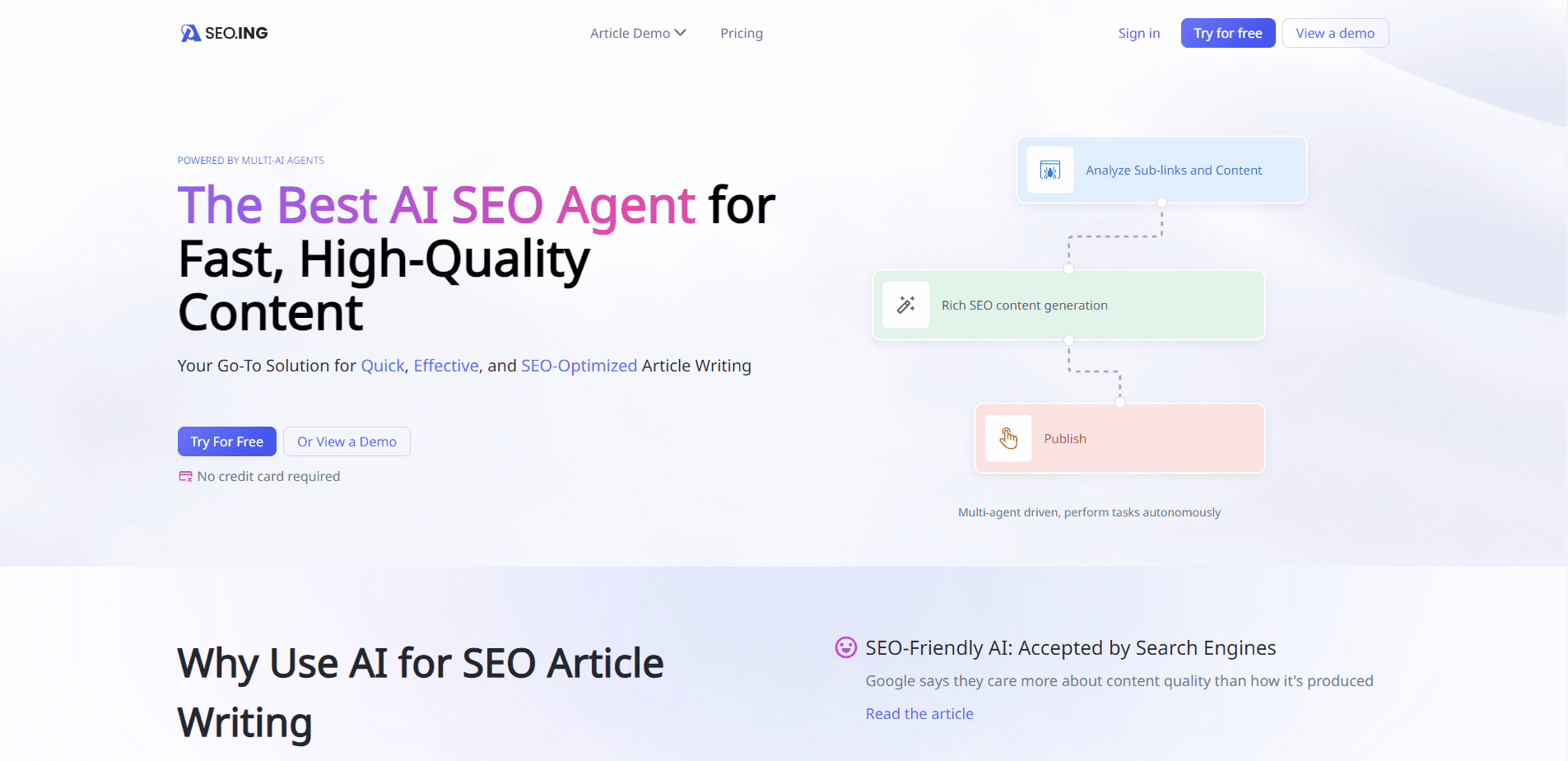
SEO.ING is a web-based content platform built around multi-agent automation. You give it a keyword or a URL, and separate agents handle the heavy lifting: one crawls the source page or competitor list, one proposes titles and outlines, one writes the body, and one generates matching images. The result is a draft you can edit, not a blob of text you have to rebuild from scratch.
The pitch behind this AI writing agent is cost and speed. On its own site, SEO.ING frames the math bluntly: a freelancer charges around $100 for one article, while its agents produce roughly ten articles for $15. That gap is what pulls in affiliate marketers and site owners who need volume. Is it worth it? For high-volume publishers, yes.
The catch is that you still pay per article through a credit system, not a flat unlimited fee. The free tier allows just two articles a month, which is enough to test output quality but nowhere near enough to run a content calendar. And because every agent runs in sequence, the process takes several minutes per piece rather than an instant response.
Getting Started
- Create an account at seo.ing with an email address. No credit card is required to start on the free plan.
- Pick an article type. Website Review builds a single-product review, while Top 10 builds a comparison list from a set of products or URLs.
- Enter your source. Type a keyword, paste a product URL, or feed in a list of websites for a Top 10 style piece.
- Adjust the outline. The agents suggest a title and structure, and you can change the introduction hook, length, and section order before writing begins.
- Generate and edit. The writing and image agents finish the draft, then you review it and publish it to your own site.
Product Information
A quick look at SEO.ING's pricing, supported platforms, and performance.
Best for
The users, tasks, and scenarios where this tool fits best.
Users
- Affiliate marketers
- Solo bloggers and niche site owners
- Small agencies and content teams
Tasks
- Writing website review articles
- Building top 10 listicles
- Producing multilingual SEO content
- Speeding up automated content creation
Scenarios
- Launching a new niche affiliate site
- Keeping an existing blog updated
- Testing content ideas cheaply
- Running a multilingual site
Key features
Multi-Agent Article Generation
SEO.ING doesn't rely on one model doing everything. It splits the work across specialized agents: an Outline Agent, a Content Crawler Agent, a Writing Agent, and an Image Agent. Each agent handles its own step and passes the result to the next. That's why the tool can start from a bare URL and still end up with structured sections and visuals. The upside is less manual prompt-writing. The tradeoff is that the sequential chain makes each run slower than a single-shot chatbot.
Two Core Article Templates
The platform centers on two formats that carry most affiliate and SEO traffic. Website Review converts a product URL into a review article, while Top 10 turns a list of websites into a horizontal comparison piece with anchors, text, images, and tables. Both templates are preset, so you get a predictable structure every time. That consistency is a real help for scaling. It also means the output can feel formulaic if you publish many pieces without adding your own voice.
Editable Outlines and Structure
Before the writing agent runs, you get to shape the article. SEO.ING suggests titles and an outline, then lets you adjust the introduction hook, the target length, and the section order. This is the step that separates a usable draft from a generic one, since you can steer the structure toward your keyword intent before any text is generated. Skip it, and you're stuck editing a finished piece instead of guiding it early. So don't skip it.
Multilingual SEO Content
Every plan includes multi-language support, even the free one. You can generate the same review or listicle for readers in another language instead of translating by hand. For site owners targeting several markets, this is the feature that justifies the subscription on its own. Non-English output still needs a native speaker to check tone and phrasing before it goes live.
Unlimited Anchor Links and Full Templates
Paid plans include unlimited anchor links and the full set of writing styles, which matters for affiliate content where internal and product links drive revenue. The style range also helps you avoid every post reading the same way. On the free plan, anchor links are capped and writing styles are limited, so this is really a paid-tier benefit you grow into as your content needs expand.
Built-In Image Generation
An Image Agent produces visuals to go with each article, so you're not hunting for stock photos after the text is done. For roundups and reviews, having images placed automatically saves a surprising amount of time per post. The images are generic AI output rather than custom photography, so brand-heavy sites may still want to swap in their own screenshots or product shots. Not ideal for everyone.
Pros and cons
Pros
- Cuts content production cost sharply, with the site citing roughly $15 for 10 articles against a $100-per-article freelance rate.
- The multi-agent workflow handles crawling, outlining, writing, and images, so you don't have to prompt each step yourself.
- Editable outlines let you steer structure and length before the draft is written, not after.
- Multilingual support is available on every tier. The free plan has it too.
- Two proven SEO formats (website review and top 10 list) match what affiliate content actually needs.
Cons
- The free plan only covers two articles a month, so it's a trial tier rather than a working plan.
- Credits cap output on every plan, which means high-volume publishers outgrow the tiers quickly.
- Sequential agent processing takes several minutes per article, with no instant turnaround.
- No public API is documented, so you can't plug SEO.ING into your own publishing pipeline.
- Preset templates can produce repetitive structure across many posts if you don't edit them.
Frequently asked questions
It's an AI SEO article generator built for producing optimized articles, mostly product reviews and top 10 roundups. You give it a keyword or URL and its agents draft the content for you.
Related content
Explore related tools, skills, and articles for SEO.ING.
SEO.ING Alternatives

Emailwritr
Emailwritr · Writing · MarketingEmailwritr is an AI email copywriting tool built for affiliates, course creators, and online businesses that want more revenue from the list they already own. Instead of blank pages or generic chatbot prompts, this AI email writer generates welcome sequences, launch campaigns, cart recovery emails, and promo series from frameworks modeled on well-known direct-response copywriters. You connect your autoresponder, answer a few questions about your offer, and it writes the copy for you.

Prosp
Prosp · Writing · Voice & Language · MarketingProsp is an AI LinkedIn outreach tool built for agencies and sales teams, and it writes the message and the voice note in your own voice for each prospect so they actually reply. You connect your accounts, find leads, and let the AI draft and send personalized messages at scale, all from one inbox. It's built for people running outbound at volume. That's the whole pitch. Every touchpoint still has to feel human.

On Model
On Model · Image · MarketingOn Model is an AI fashion model tool that places your clothing on virtual models so online stores can get on-model product photos without booking a photoshoot. It runs as a Shopify app, letting you swap the model in an existing image, change backgrounds, and generate faces for cropped or headless shots. The goal is simple: match your product photos to your customers and stand out from competitors using the same supplier images.