

seospark.io
seospark.io · Marketing
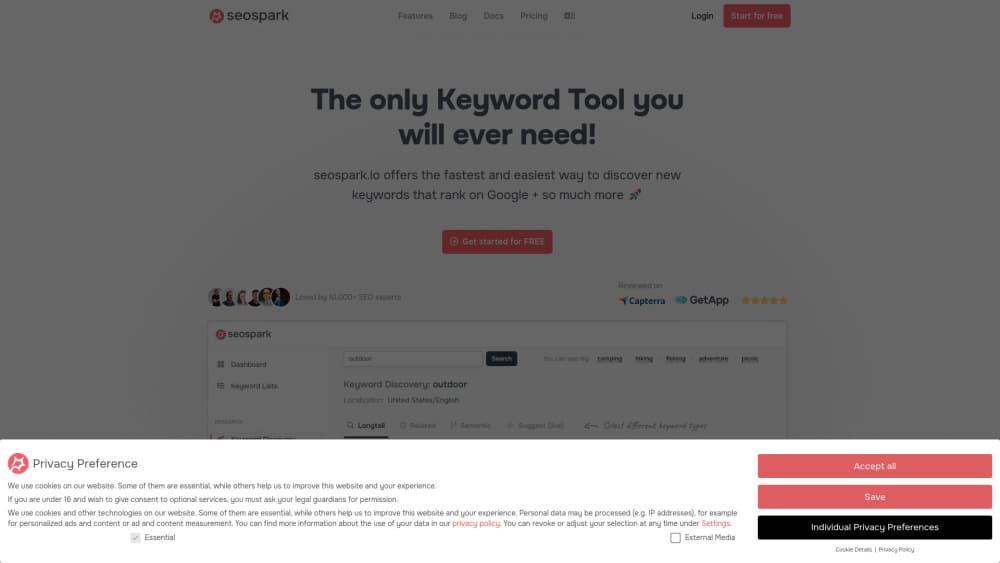
seospark.io is a keyword research suite for SEOs and agencies that clusters keywords by SERP overlap, drafts content briefings, and tracks daily rankings.
About seospark.io
What Is seospark.io
seospark.io, sold as seospark and previously called HyperSuggest, is a browser based keyword research tool built for people who plan content for a living. It bundles five jobs that usually live in separate subscriptions: keyword research, topic clustering, content briefings, People Also Asked question mining, and daily rank tracking. Everything runs from one credit balance per project.
The pitch is speed on the boring part. Pulling keyword lists is easy. Deciding which 40 of 4,000 phrases belong in the same article is the work that eats a week, and seospark answers that with SERP overlap clustering instead of guesswork. Freelancers use it to hand clients a structured brief, agencies use it to keep 50 projects apart, and shop owners use it to find long-tail keywords their competitors skipped.
The limits show up in the same place. There's no free plan, only a trial, so you have to commit before you know how your own niche clusters. Credits are shared across every tool, and one heavy clustering run can burn a large slice of a monthly allowance. Deep technical audits, backlink analysis, and site speed checks aren't here, so it sits next to an audit tool rather than replacing one.
Getting Started
- Start the free trial on seospark.io, confirm your email, and create your first project.
- Paste up to 100,000 seed keywords, or import them from a CSV export, then pick the market you're targeting.
- Run topic clustering and check the suggested blocks. Merge or split groups where the search intent looks off.
- Generate a content briefing for any cluster, review the outline and questions, then export it as a brief for your writer or your AI assistant.
- Add the cluster's main phrases to rank tracking so you can watch movement the next morning.
Product Information
A quick look at seospark.io's pricing, supported platforms, and performance.
Best for
The users, tasks, and scenarios where this tool fits best.
Users
- Freelance SEO consultants
- Agencies and in-house marketing teams
- Shop owners who run their own content
- Content managers who brief outside writers
Tasks
- Turning a raw keyword dump into an article plan
- Building a content briefing in minutes
- Finding question based topics
- Watching rank movement without a separate subscription
Scenarios
- A new niche with no keyword list
- Monthly client reporting
- Handing work to an AI writer
- Cleaning up an existing blog
Key features
SERP Overlap Keyword Clustering
seospark groups keywords by comparing the pages that rank for each phrase, not by matching words. Phrases that share the same top results land in one cluster, which is close to how Google reads search intent. You can push up to 100,000 keywords through a single run on the Agency plan, then merge or split the blocks by hand when the grouping looks wrong.
Content Briefings for AI or Human Writers
Every cluster can turn into a content briefing with an outline, the phrases to include, and the questions a reader will expect answered. The output is built for either a staff writer or a model, so you can paste it into an AI assistant or send it to a freelancer as is. Editing the outline before export is the step that keeps the brief useful instead of generic.
Keyword Research with Search Volume Data
The research module returns suggestions, related phrases, and search volume in one table. It runs on a credit system, and the Professional plan covers about 1,300 researches a month, while the Agency tier covers 6,600. You get the raw material for clustering here, which is why the two tools share a project.
People Also Asked Question Mining
This view pulls the questions Google shows in People Also Asked rich results for a phrase, plus common variants. It's the fastest route to the "what, how, why" sections that make a page feel complete. Useful for FAQ blocks and for spotting the sub topics a competitor covered but you didn't.
Daily Rank Tracking
You add phrases to a tracking list and check positions each day, with 600 tracked keywords on Professional and 3,300 on Agency. History stays in the project, so you can tie a ranking dip to a specific content update. It won't replace a dedicated rank tracker with deep SERP feature data, but for everyday monitoring it does the job.
Project Management and CSV Export
Projects keep client work apart, with 5 on the entry plan and 50 on the top tier. Exports come out as CSV with 20,000 rows per file on Professional and no row cap on Agency, and there's no extra step to get data into a spreadsheet. That matters when a client asks for the raw keyword list behind a recommendation.
Pros and cons
Pros
- Clustering is based on real search results, so the article plan matches what Google already ranks together.
- The five tools share one project and one credit balance, which removes the export and import loop between separate subscriptions.
- Pricing stays well below the big SEO suites: $69 a month covers a solo consultant's full workflow.
- Briefings are practical for AI writers because the outline and phrase list arrive in a format a model can follow.
Cons
- No free plan. You get a trial, then you pay, so testing clustering quality in your own market takes a commitment.
- Credits are shared across all five tools, and clustering large lists can empty a month's allowance fast on Professional.
- Rank tracking is thin next to specialist tools. There's no local grid data, no competitor share of voice view, and no alert rules.
- No backlink analysis, technical crawl, or site audit, so the tool works alongside an audit suite rather than in place of one.
Frequently asked questions
It's a keyword research tool that clusters phrases by SERP overlap, writes content briefings, pulls People Also Asked questions, and tracks daily rankings. The idea is to take you from a seed keyword to a publishing plan inside one account.
Related content
Explore related tools, skills, and articles for seospark.io.
seospark.io Alternatives

ngram 2.0
ngram · Video · Marketingngram 2.0 is an AI video generator for teams. It turns a prompt, a screen recording, or a product URL into a narrated explainer, product demo, or AI avatar video, and every scene stays editable.

shippedit.me
Krawlup · Marketing · Businessshippedit.me now redirects to Krawlup, a web platform that audits SEO, AEO and page speed every week, then hands the fixes to AI coding agents over MCP.

MePersona
MePersona, Inc. · Writing · Productivity · MarketingMePersona is an AI unified inbox for creators. It learns your voice, drafts replies to fan messages from 12 platforms, and sends only what you approve.