

SERPrecon
Ryan Jones and Moonello · Coding · Marketing
SERPrecon is a semantic SEO tool that scores content the way search engines read it, using vectors, BM25 and BERT to show what your page is missing for higher rankings.
About SERPrecon
What Is SERPrecon
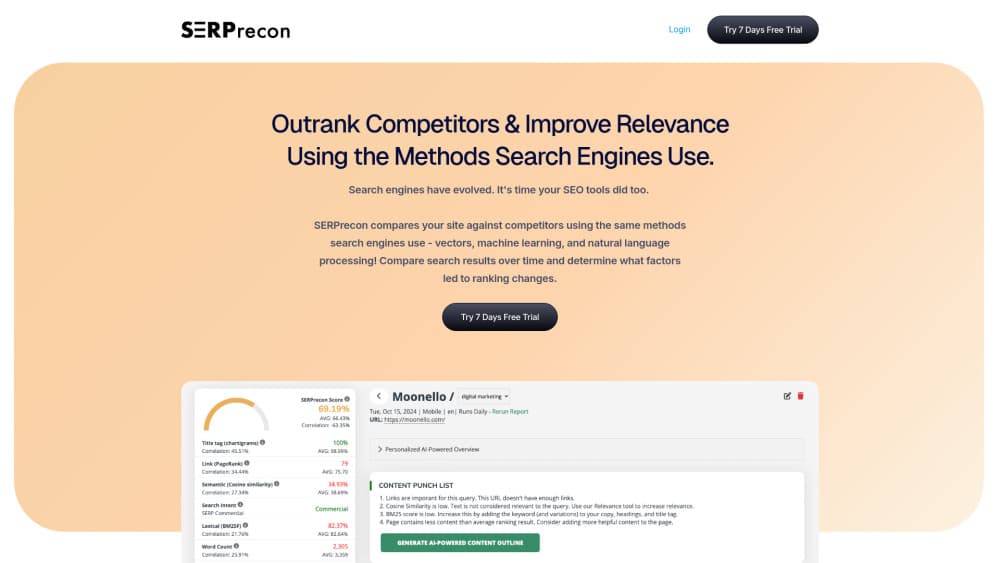
SERPrecon is a web-based SEO and GEO platform built by Ryan Jones and the software studio Moonello. It reads your page and your competitors' pages using the same information retrieval methods modern search engines rely on, then tells you which words, entities and topics you need to add to close the gap.
Most SEO content tools hand you a keyword list and a made-up score. SERPrecon skips the invented metrics and works from BM25, cosine similarity and entity coverage, the signals that show up in real ranking systems. It also extends the same analysis to AI answer engines, so you can see what Google AI Overviews, ChatGPT and Perplexity pull into their replies.
Two things set the ceiling here. Pricing starts at $49 a month, higher than many content tools, and the deeper competitive features live in the Pro and Agency plans. Reports run on a credit system, so heavier research burns through your monthly allowance.
Getting Started
- Start a seven-day free trial and create a project for your site and the competitors you want to track.
- Run a report to pull the top-ranking pages and the semantic, lexical, pagerank and spam metrics behind them.
- Open Check Relevance and edit your copy inside the tool, watching the score move as you add keywords and entities.
- Generate an AI content outline from the SERP data, then publish and track your share of voice over time.
Product Information
A quick look at SERPrecon's pricing, supported platforms, and performance.
Best for
The users, tasks, and scenarios where this tool fits best.
Users
- SEO specialists moving past keyword tools
- Agencies managing several clients
- Content teams watching AI search traffic
Tasks
- Auditing a page before publishing
- Running competitor keyword extraction
- Tracking why rankings moved
Scenarios
- Rebuilding a page that stalled on page two
- Reporting AI visibility to a client
- Exploring long-tail topics for a new article
Key features
Semantic relevance scoring
The Check Relevance tool measures a page against BM25 and cosine similarity, the same information retrieval metrics search engines use internally. You edit your copy in the tool and watch the score move in real time, so you can predict what will rank before you post it. It works on existing pages too, so an older article can be re-scored and repaired.
BERT-based competitor keyword extraction
SERPrecon uses Google's BERT model to pull keywords, entities, related searches and bigrams out of competitor pages. That goes past the words on the surface and captures what a search engine treats as the topic. You see the terms you're missing and their search volumes in the same view.
SERP analysis that explains ranking changes
Beyond who ranks, the platform tracks pagerank, spam scores, title tag rewrites and search intent shifts. Comparing any date against any other shows which metric moved when a site gained or lost a position. This is where SERPrecon differs most from content-scoring tools, which don't measure these signals at all.
Title tag rewrite detection
Search engines often rewrite the title tags you write. SERPrecon shows the original against the version Google chose to display, so you can see how your title gets read and adjust it. It's a small feature that answers a question most SEO tools ignore.
AI optimizer for AI overviews
The AI overview optimization tool breaks down the query fan-out keywords, phrases and questions tied to a search. It's built from published AI overview patents and leaked system prompts, so the advice targets how answer engines assemble citations rather than how a classic results page ranks.
Share of voice across search and AI
The share of voice tool tracks your presence in organic rankings and in AI mentions on Google, ChatGPT, Perplexity and Bing. For each query in a set, it also lists the main topics and themes pulled with BERT, doing query fan-out the way search engines and AI systems do.
AI-assisted content outlines
You can feed the collected SERP data into an AI outline builder and get a content plan aimed at the terms and entities competitors rank for. The outline comes with an actionable checklist, which turns a data pull into a set of next steps.
Pros and cons
Pros
- Scores content with BM25, cosine similarity and entity coverage, so the numbers map to signals search engines actually use.
- Extracts competitor keywords and entities with BERT, which surfaces topics a plain keyword list misses.
- Tracks share of voice across Google, ChatGPT, Perplexity and Bing in one place, covering both organic and AI channels.
- Seven-day free trial with no commitment, so you can test reports on a real site before paying.
Cons
- No free plan. After the trial you have to pay, and the entry Standard plan starts at $49 a month.
- Reports run on a credit system, so heavy competitive research across many domains can exhaust your monthly allowance.
- The strongest features, including unlimited projects and multi-platform share of voice, sit in the Pro and Agency plans, which raises the real starting cost for smaller users.
- It assumes you already know on-page SEO basics. The metrics are aimed at people who can act on a relevance score, not beginners looking for step-by-step guidance.
Frequently asked questions
SERPrecon is used to improve content and analyze search results using the same methods modern search engines apply. You score your copy for an SEO relevance score, extract the keywords and entities competitors use, and track how your rankings and AI mentions change over time.
Related content
Explore related tools, skills, and articles for SERPrecon.
SERPrecon Alternatives

Base Code
Base44 (Wix) · Coding · ProductivityBase Code is a shared cloud development environment from Base44. Teammates describe changes to an existing GitHub codebase in chat, preview them live and send them back as pull requests.

Google EmbeddingGemma 2
Google DeepMind · Writing · Image · CodingGoogle EmbeddingGemma 2 is a 740M-parameter open model that turns text, code, images, audio, and video frames into vectors in one 768-dimension space, running on phones and laptops.

GitGlow
GitGlow · Coding · ProductivityGitGlow is a local-first desktop Git client that lets independent developers review their own code and their AI agents' changes in one place before shipping.