

Sibyl
ndriqa · Other
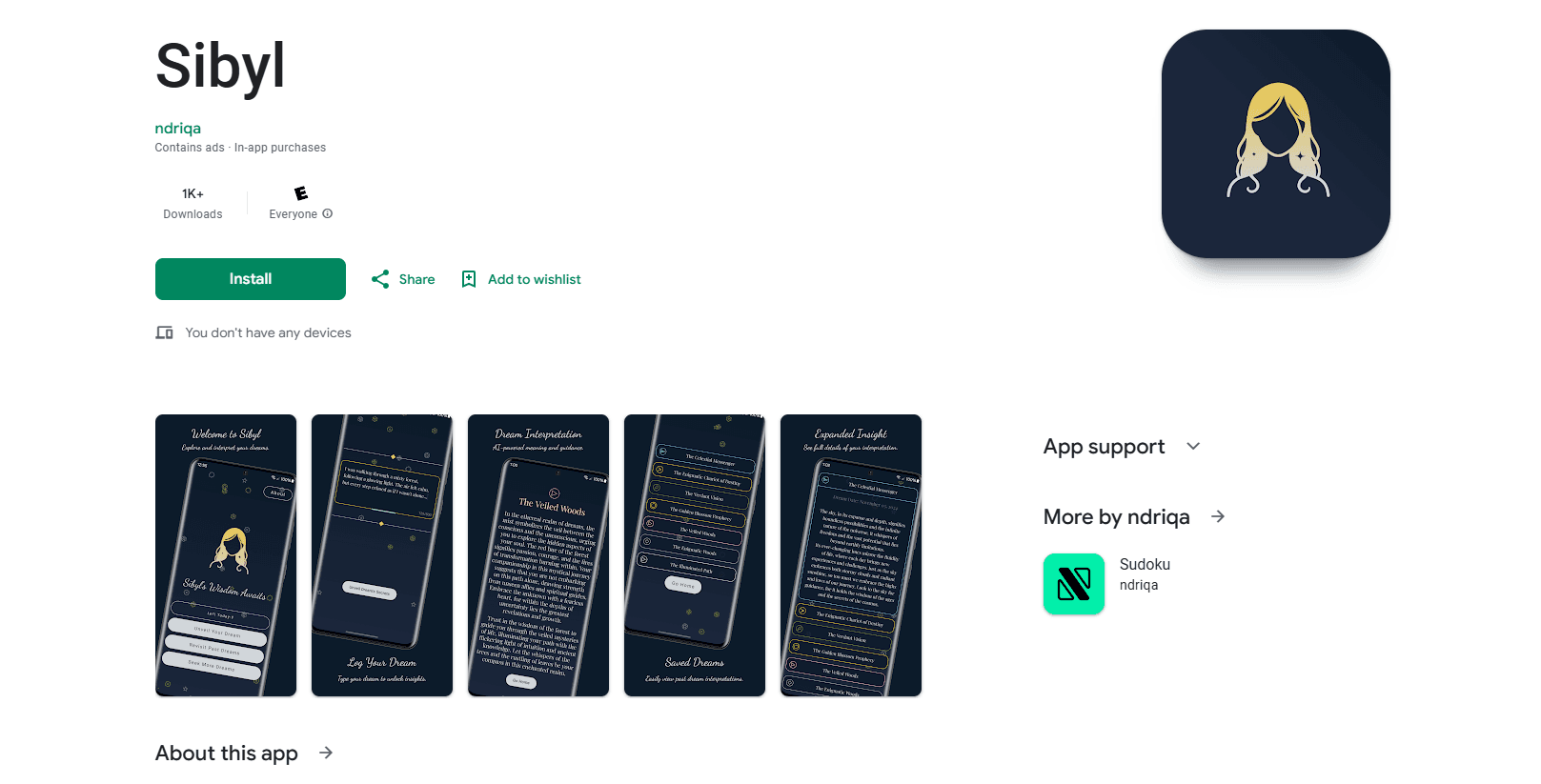
Sibyl is an AI dream interpretation app for Android that reads your dreams and explains what they might mean.
About Sibyl
What Is Sibyl
Sibyl is a dream interpretation app built around a simple idea: you describe what you dreamed, and it hands back a written analysis of what the symbols, people, and emotions in that dream could represent. It plays the role of a dream interpreter, in other words. The app pulls from two traditions at once. One half leans on ancient symbolism, the kind found in old dream dictionaries where water means one thing and falling means another. The other half draws on modern psychology, treating a dream as a window into whatever your mind is working through at the moment.
The core use case is people who wake up from a strange dream and want an answer that's more structured than a random forum thread. Maybe the same nightmare keeps showing up. Maybe a dream felt so vivid it stuck with you all morning. Instead of scrolling through generic lists of meanings, you type out the dream in your own words and get a response tied to what you actually described. You can think of it as a personal dream journal that talks back.
The main limit is scope. Sibyl reads dreams, and that's it. It doesn't diagnose anything, and it won't replace a therapist if you're dealing with recurring distress. Treat the output as a jumping-off point for reflection, not a clinical verdict.
Getting Started
- Install Sibyl on your Android phone from Google Play and open the app. No account setup gets in the way before you can try it.
- Type out a dream in the text box, or tap the microphone and speak it out loud if you'd rather dictate than type.
- Send it in. Sibyl analyzes the dream and returns a written interpretation that names the key symbols and emotions it picked up.
- Save the dream to your journal so you can look back at it later, and watch the insights dashboard build up a picture of your mood and recurring themes over time.
- Share a dream card if you want to post it, since each entry can be turned into a visual card with its own mood-tinted design.
Product Information
A quick look at Sibyl's pricing, supported platforms, and performance.
Best for
The users, tasks, and scenarios where this tool fits best.
Users
- People who remember their dreams in sharp detail and want a quick read on what a dream could mean. Anyone with a phone can use it since there's no sign-up wall.
- Journalers who already write down dreams and want an AI layer on top, the saved entries and insights dashboard fit a nightly habit.
- Anyone noticing a pattern, like the same dream returning, who wants the app to track recurring themes instead of relying on memory.
Tasks
- Interpreting a single vivid dream right after waking up, typing or dictating it and getting an analysis back within minutes.
- Tracking recurring themes over weeks, since saved entries and the mood dashboard show which symbols keep coming back.
- Turning a memorable dream into something shareable. The built-in share cards give each entry a mood-based visual style.
Scenarios
- A nightmare you can't shake, where writing it out and reading an interpretation helps you look at it from a distance.
- Keeping a lightweight dream log, using voice dictation when you're too sleepy to type in the dark.
- Curious reflection, when a strange dream lingers and you want a second opinion before you forget it.
Key features
AI Dream Analysis
This is the whole point of the app. You describe a dream in plain language, and Sibyl returns a dream meaning that names the symbols it spotted and ties them to both ancient symbolism and modern psychology. The result reads like a short written reading, not a keyword lookup, because it responds to the specific details you gave.
Voice Journaling
You can speak your dream instead of typing it, using real-time speech-to-text that turns your voice into a journal entry. That matters if you're half-awake and don't want to fight with a keyboard. It's the fastest way to capture a dream before it slips away.
Dream Insights Dashboard
Sibyl 2.0 added a dashboard that plots your dream history as interactive charts. You get emotion wave charts, a breakdown of your moods, and a list of the symbols that show up most often. Over time, this turns a pile of entries into a view of what your subconscious keeps returning to.
Share Cards
Each dream can be turned into a visual card with custom lighting and a mood-tinted color scheme, ready to share. It's a small feature, but it makes a dream feel like something worth keeping rather than a note you'll never reopen.
Dream Journal
Every interpretation gets saved, so your dreams build into a personal record you can scroll back through. This is what makes the insights dashboard worth checking. Without the log, patterns can't surface.
Ancient Symbolism Plus Modern Psychology
The analysis draws on two frameworks at once, so you don't have to choose between a traditional dream dictionary reading and a more grounded psychological take. The app blends them into one answer instead of making you cross-reference.
Free with No Sign-Up Wall
You can start interpreting a dream right after install, without creating an account first. That keeps the barrier low for anyone curious enough to try it once.
Pros and cons
Pros
- Free to try, and you don't need to make an account before your first dream interpretation.
- Blends ancient symbolism with modern psychology, so the reading is broader than a one-note dream dictionary.
- Voice journaling makes it easy to log a dream the moment you wake up, before the details fade.
- The insights dashboard and recurring-symbol tracking turn scattered dreams into a pattern you can actually see.
- Save and share cards add a reason to come back and keep a dream journal.
Cons
- It's Android only, so iPhone users are left out entirely.
- Interpretations are AI-generated and reflective, not clinical, so anyone dealing with serious or distressing dreams shouldn't treat the output as professional advice.
- There's no public API, which means you can't pull its dream analysis into your own apps or workflows.
- The app is new, with a small review base, so there isn't much long-term community feedback on how well the readings hold up.
Frequently asked questions
Sibyl is an AI dream interpretation app. You describe or dictate a dream, and it returns a written analysis of the symbols, people, and emotions in it, drawing on ancient symbolism and modern psychology. Have you ever woken up from a dream and wondered what it was really about? That's the question it answers.
Related content
Explore related tools, skills, and articles for Sibyl.
Sibyl Alternatives

Odyssey 3
Odyssey · OtherOdyssey-3 is Odyssey's foundation world model. It simulates physics in real time, turns a prompt into an interactive environment, and adapts to robots, cars and games.

JarvisCore
Prescott Data · Coding · Productivity · OtherJarvisCore is an open source Python runtime where AI agents work as equal peers on an agent mesh, claim tasks from a shared ledger, and reach external services through a zero-trust broker.
Clef
Cloudflare · Business · OtherClef is Cloudflare's open-source decision model for Workers AI. It returns calibrated probabilities for typed questions, not generated text, so agents can classify, route, and act fast.