

SimplAI
SimplAI · Coding
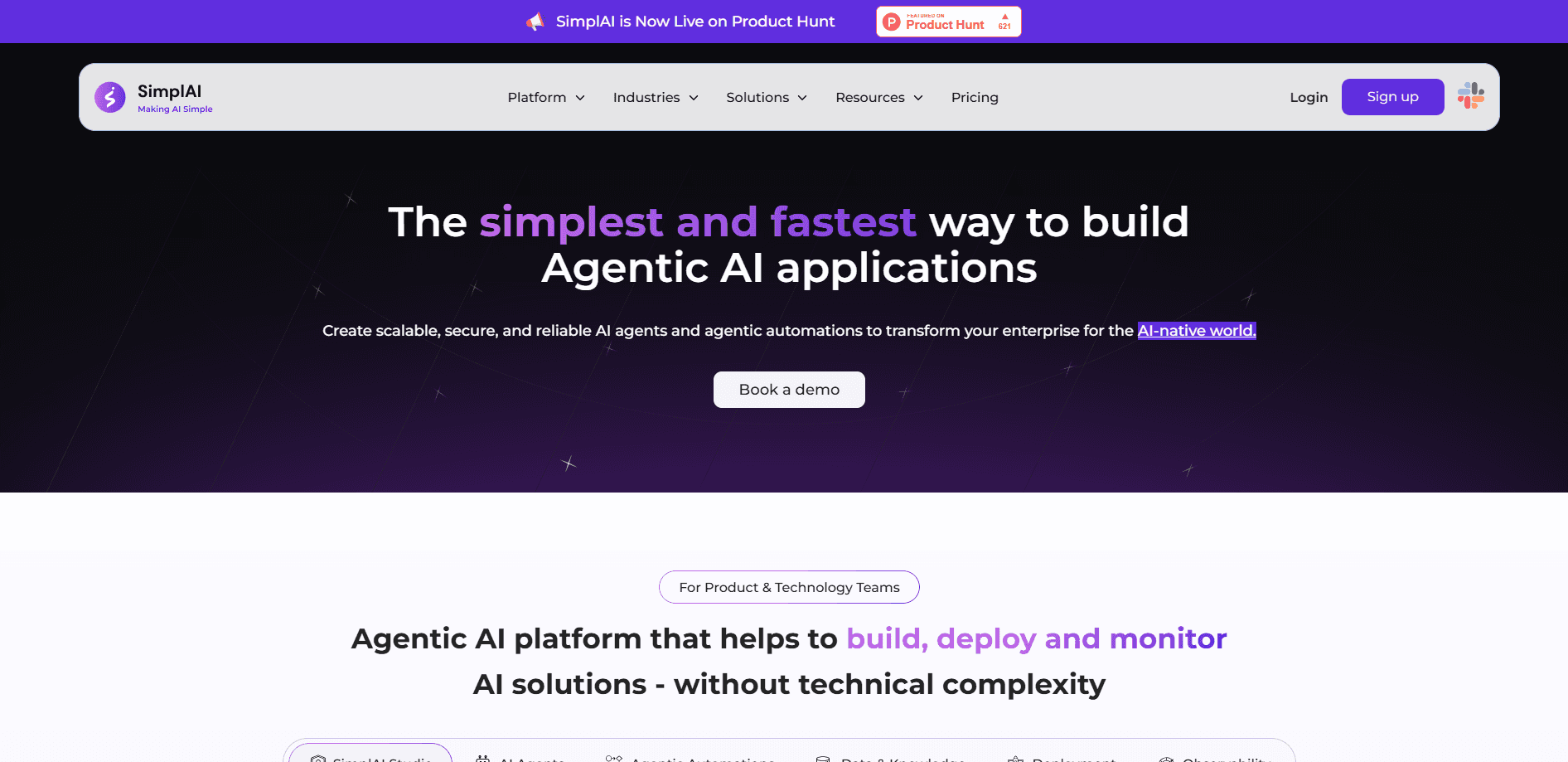
SimplAI is an enterprise agentic AI platform for building, orchestrating, and governing AI agents. It runs on-prem, private cloud, or hybrid, with security and compliance built in.
About SimplAI
What Is SimplAI
SimplAI is an enterprise platform that treats AI agents like production infrastructure instead of experiments. It calls itself an agentic AI operating system, and the name fits: it handles the build, run, and govern layers that teams usually stitch together by hand. The point is to turn scattered pilot projects into something you can actually operate at scale.
The platform centers on an AI agent builder where you define modular, reusable agents with roles, memory, and testable behavior. Around that core sit a workflow builder, a knowledge base, evaluation, and tracing, plus an extensibility layer that connects the agents to your existing tools and models. You can run it across several large language models, route work between them, and point agents at internal APIs through a gateway.
The main draw is deployment freedom. SimplAI runs on-prem, in a private cloud, in your own VPC, or in air-gapped setups, and your infrastructure stays yours. That matters for companies in regulated fields who can't ship data to a public AI service.
The trade-off is orientation. This is a platform for companies, not individuals, so there's no free hobby tier and no self-serve signup you can poke at over a weekend. If you want a playful tool to try, look elsewhere.
Getting Started
- Talk to the SimplAI team to scope the deployment model, whether that's SaaS, private cloud, VPC, or fully on-prem.
- Connect your data sources and models, then pick which LLMs the agents can call.
- Build agents in the agent builder, giving each one a role, memory, and the tools it needs.
- Wire agents into workflows, expose internal services through the MCP gateway, and set governance rules.
- Test with evaluations and tracing, harden in a staging environment, then promote to production.
Product Information
A quick look at SimplAI's pricing, supported platforms, and performance.
Best for
The users, tasks, and scenarios where this tool fits best.
Users
- Enterprise engineering teams
- Regulated industries like finance and insurance
- Platform and AI teams at larger companies
- Teams without an in-house AI engineering bench
Tasks
- Building reusable agents
- Orchestrating multi-agent work
- Exposing internal APIs to agents
- Adding voice to agents
- Evaluating and tracing runs
Scenarios
- Processing insurance documents
- Running customer operations
- Governed enterprise rollouts
- Shipping to production fast
Key features
AI Agent Builder
The agent builder is the heart of the platform. You create modular agents and give each one a defined role, memory, and evaluation parameters, so its behavior stays predictable as you reuse it. Because agents are reusable pieces rather than one-off scripts, the same building block can serve several workflows.
Multi-Agent Orchestration
SimplAI coordinates multi-agent, multi-step execution with lifecycle control, supervision, and recovery. It plans tasks and routes each step across agents, tools, and systems based on the context at runtime. Short-term working memory and long-term persistent memory keep a long task coherent across sessions.
MCP Gateway
The MCP gateway exposes your internal APIs and services as secure, schema-driven agent tools. You enforce permissions, policies, and contracts at the gateway, so agents can reach company systems without anyone rewriting the backend. It's the difference between a demo agent and one that can touch real data safely.
Model and Intelligence Layer
Agents run across several large language models under one roof, with reasoning, routing, and evaluation handled centrally. You can send a task to the model that fits it instead of locking into one provider. Bring-your-own-model support means you keep using the models you already trust.
Enterprise Governance and Security
The platform ships runtime isolation, a secrets vault, RBAC and ABAC access control, and per-environment separation across dev, stage, and prod. Audit trails record decisions and executions for regulatory reviews, and budget limits cap agent spending at runtime. For enterprises, AI governance isn't an extra, it's the reason the platform exists.
Deployment Flexibility
You can run SimplAI as SaaS, in a private cloud, in your own VPC, on-prem, or in an air-gapped environment. Infrastructure ownership stays with the enterprise, and the same architecture works across multiple cloud providers. That range is what lets a bank and a startup use the same platform.
Observability and Evaluation
Versioning, step-level tracing, and integrated evaluations give you a clear view of every run. You can see how an agent reasoned, where it called a tool, and whether the output met the bar. That visibility is what turns an agent from a black box into something you can improve.
Voice Intelligence
Voice-first capabilities let agents process natural speech into actions, with support for multiple languages. It extends the same governed workflows to phone and spoken interactions, so voice isn't a separate system to maintain.
Pros and cons
Pros
- Deployment options run from SaaS to fully air-gapped, so regulated companies keep their data in-house
- One platform covers building, orchestrating, evaluating, and governing agents instead of a patchwork of tools
- The MCP gateway lets agents use internal APIs without backend rewrites
- Enterprise controls like RBAC, audit trails, and budget limits are built in rather than added later
- Guided go-live support targets production in days rather than months
Cons
- There's no free tier or public self-serve signup, so you can't test it without talking to sales first
- Pricing isn't published, which makes it hard to budget before a conversation with the vendor
- It's aimed at companies, so individuals and small teams won't find much to use
- The heavy enterprise feature set means a real learning curve for teams new to agent governance
Frequently asked questions
SimplAI is an enterprise agentic AI platform, which the company describes as an agentic AI operating system. It lets teams build AI agents, orchestrate multi-agent workflows, and govern them with security, compliance, and observability built in.
Related content
Explore related tools, skills, and articles for SimplAI.
SimplAI Alternatives

Base Code
Base44 (Wix) · Coding · ProductivityBase Code is a shared cloud development environment from Base44. Teammates describe changes to an existing GitHub codebase in chat, preview them live and send them back as pull requests.

Google EmbeddingGemma 2
Google DeepMind · Writing · Image · CodingGoogle EmbeddingGemma 2 is a 740M-parameter open model that turns text, code, images, audio, and video frames into vectors in one 768-dimension space, running on phones and laptops.

GitGlow
GitGlow · Coding · ProductivityGitGlow is a local-first desktop Git client that lets independent developers review their own code and their AI agents' changes in one place before shipping.