

SiNGL
Alpharithm Technologies · Coding
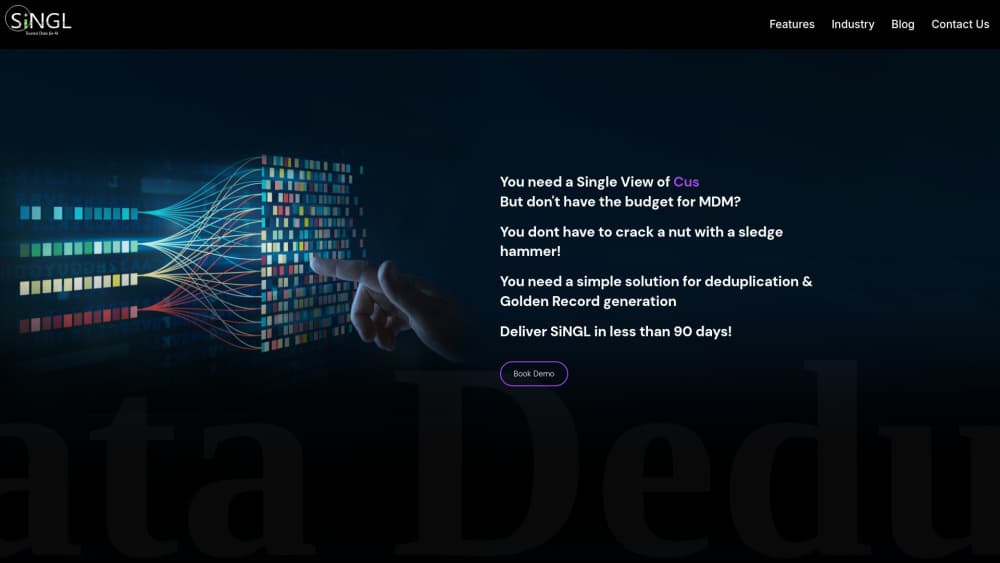
SiNGL is an AI master data management platform from Alpharithm that merges duplicate records into one trusted golden record and serves it to CRM, analytics and AI systems, on-premise or in the cloud.
About SiNGL
What Is SiNGL
SiNGL is an AI MDM platform for enterprises, built by Alpharithm Technologies, a data consultancy with offices in the USA, UK, India and Singapore. It solves a problem most large companies already know by name: the same customer exists in five systems under four spellings, and nobody can say which copy is right.
The platform reads records from CRM, ERP, billing and legacy databases, scores how likely two records describe one real person or company, and merges the matches above a threshold you set. The result is a golden record that other systems can query, which is what most teams actually want before they start any Customer 360 or AI project.
SiNGL is aimed at regulated industries rather than hobby projects. Banking, insurance, healthcare, pharmaceuticals, telecom, retail and government teams use it for identity resolution, compliance reporting and consolidation after acquisitions. Pricing isn't published, there's no free tier, and every engagement starts with a call.
Getting Started
- Book a demo through the SiNGL site and describe your records, sources and compliance constraints.
- Connect source systems through the platform's connectors or API, starting with one domain such as customer or patient.
- Train the matching model on a sample of your own data and set the score threshold that separates a match from a near match.
- Review the flagged pairs in the stewardship console, approve or reject them, then publish the golden record and expose it through the API.
Product Information
A quick look at SiNGL's pricing, supported platforms, and performance.
Best for
The users, tasks, and scenarios where this tool fits best.
Users
- Data stewards and MDM leads
- Heads of analytics and BI
- CIOs in regulated industries
Tasks
- Cleaning duplicate customer records after a merger
- Building a Customer 360 view
- Preparing data for AI projects
- Producing compliance reports
Scenarios
- A hospital group unifying patient identities across facilities
- A bank onboarding customers from an acquired portfolio
- A retailer merging loyalty and e-commerce records
Key features
AI Deduplication Trained on Your Own Data
SiNGL doesn't ship one fixed matching model. You train it on a sample of your own records, and it returns a score for each candidate pair, then decides whether two records describe the same physical entity using the threshold you configure. That matters in practice, because a name and address rule set that works for a US bank fails badly on Indian or Singaporean name formats.
Bulk Matching at Enterprise Scale
The company says its customers process more than 500 million records on the platform. Bulk match runs the same scoring logic across an entire base rather than one record at a time, which is the difference between cleaning a new acquisition in days and cleaning it over a quarter.
Customer 360 and Household Views
Beyond linking duplicates, SiNGL groups related records into households so a bank can see that three accounts belong to one family. That view feeds up-sell, cross-sell and retention campaigns, and it's the part sales teams ask for first.
GenAI Assisted Data Stewardship
Stewards get a queue of likely matches with the evidence behind each score, and GenAI support helps summarise why a pair was flagged. The human still decides. For teams drowning in manual review, cutting the queue down to genuinely ambiguous cases is the main time saver.
API Access and Enterprise Integrations
Records are consumed through APIs, and the platform connects to SAP, Oracle, Salesforce, Microsoft Dynamics, Snowflake, Databricks, AWS, Azure and Google Cloud. Existing applications keep working; they just read from a governed source instead of their own copy.
On-Premise or Cloud Deployment
SiNGL runs in your data centre or in the cloud, and the vendor says deployments complete in under 90 days. On-premise matters for organisations that can't send patient or account data to a third party, and the shorter timeline is a direct swipe at traditional MDM programmes that run for a year or more.
Pros and cons
Pros
- Matching models train on your data, so name, address and ID formats from your own market aren't squeezed into a foreign template.
- On-premise option keeps personal data inside your network, which clears security review in banking and healthcare faster.
- API-first design means the golden record lands in Salesforce, Snowflake or a custom app without a second integration project.
- Vendor claims 500M+ records processed and sub-90-day delivery, both useful benchmarks when you scope a pilot.
- Healthcare-specific EMPI support covers patient identity, a use case generic MDM tools handle poorly.
Cons
- No published pricing and no free trial, so you can't estimate cost or test the matching quality before a sales conversation.
- Enterprise-only positioning means small teams with a few thousand records will find it overbuilt and overpriced.
- Matching quality depends on your source data and on someone doing stewardship work; buy the platform and walk away and duplicates come back.
- Public technical documentation is thin, so API limits and connector behaviour surface during implementation rather than during evaluation.
Frequently asked questions
SiNGL finds duplicate records across enterprise systems, merges them into one golden record, and serves that record to CRM, analytics and AI applications through APIs. Typical uses are Customer 360, patient identity matching and post-merger data cleanup.
Related content
Explore related tools, skills, and articles for SiNGL.
SiNGL Alternatives

Base Code
Base44 (Wix) · Coding · ProductivityBase Code is a shared cloud development environment from Base44. Teammates describe changes to an existing GitHub codebase in chat, preview them live and send them back as pull requests.

Google EmbeddingGemma 2
Google DeepMind · Writing · Image · CodingGoogle EmbeddingGemma 2 is a 740M-parameter open model that turns text, code, images, audio, and video frames into vectors in one 768-dimension space, running on phones and laptops.

GitGlow
GitGlow · Coding · ProductivityGitGlow is a local-first desktop Git client that lets independent developers review their own code and their AI agents' changes in one place before shipping.