

sitefire.ai
Sitefire · Marketing · AI Detection
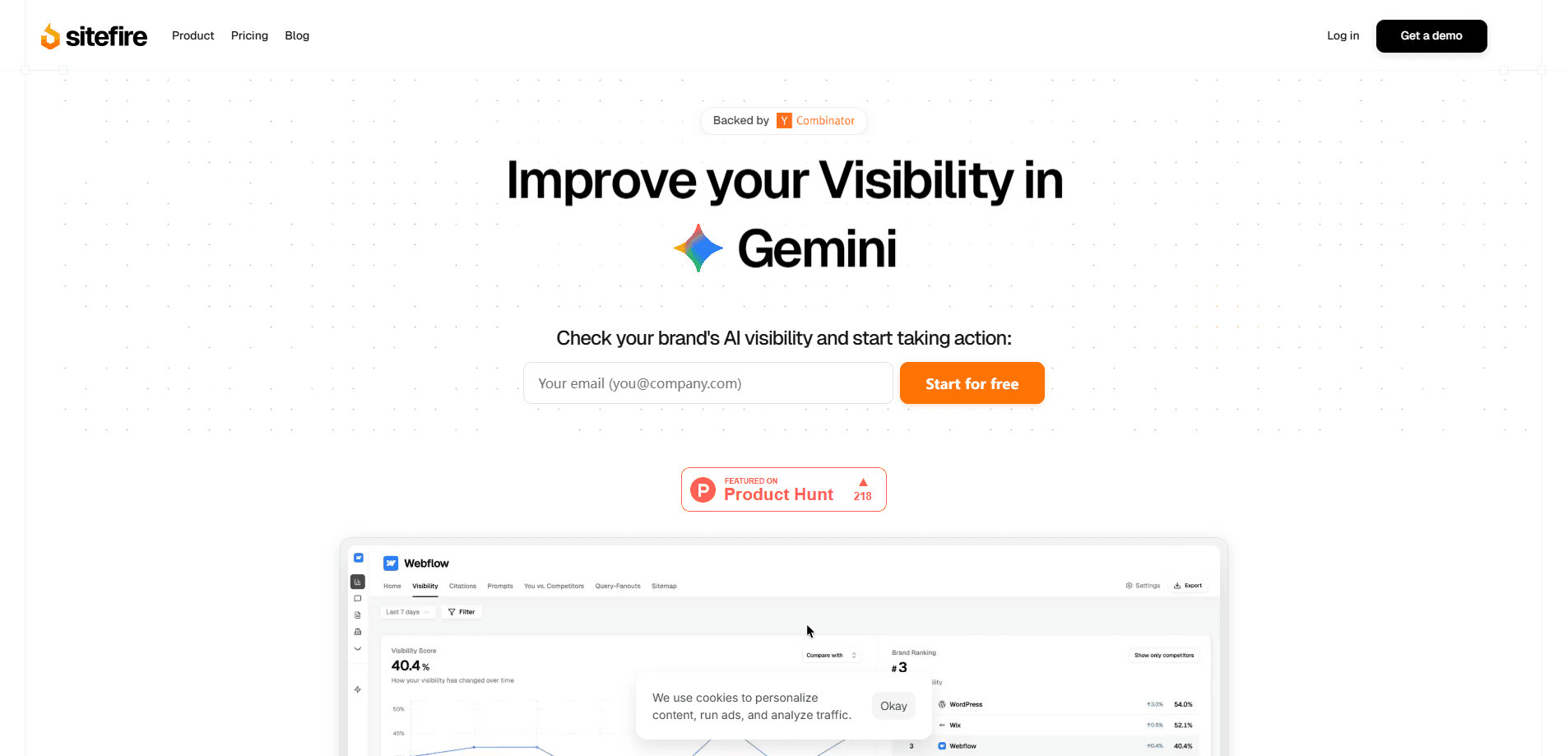
sitefire.ai is a marketing suite built for the agentic web. It tracks how AI models like ChatGPT, Gemini, Perplexity, and Claude talk about your brand, shows which sources they cite, and then hands you concrete actions to improve your position. Marketing teams use it to monitor AI search visibility, benchmark against competitors, and ship brand-aware content that gets picked up in generative answers.
About sitefire.ai
What Is sitefire.ai
sitefire.ai is an AI visibility platform for brands that want to show up when people ask an AI assistant about their category. Instead of watching search rankings alone, it watches the answers themselves: which prompts mention you, which sources get cited, and how much of the conversation in your space you actually own.
The product combines three things that usually live in separate tools. AI Monitoring tracks prompts across major models. Source Analytics shows the domains and URLs that drive those AI answers. Agent Analytics measures the human referrals and bot traffic coming back to your site, so you can connect AI visibility to real traffic.
The biggest catch is price. Plans start at $249 a month with no permanent free tier, only a 7-day trial. That puts it out of reach for solo bloggers and small side projects. It's aimed at teams with an existing content operation and a budget to match. Does that sound like your team? Then it's worth a look.
Getting Started
- Start a free trial through the Sitefire onboarding flow and connect the domain you want to track.
- Add the prompts and topics you care about, then let the platform benchmark your brand against competitors.
- Review the AI Monitoring and Source Analytics dashboards to see where you're mentioned, missed, or losing citations.
- Use the Agentic Actions and content generation features to draft fixes, or push new articles straight to your CMS.
- Connect Google Analytics, Cloudflare, or another tracking source to measure AI referral traffic end to end.
Product Information
A quick look at sitefire.ai's pricing, supported platforms, and performance.
Best for
The users, tasks, and scenarios where this tool fits best.
Users
- Marketing and SEO teams
- Brand and growth managers
- Agencies running AI search optimization for clients
Tasks
- AI visibility tracking
- Competitor benchmarking
- Generative engine optimization
- Reporting AI search ROI
Scenarios
- A product launch where you want to know within days whether AI assistants start recommending your brand.
- A content team that keeps losing citations on older pages and needs a clear list of what to fix first.
- Quarterly planning sessions where marketing has to justify spend on AI search against classic SEO.
Key features
AI Monitoring Across Major Models
sitefire.ai tracks the prompts that matter to your category across ChatGPT, Gemini, Perplexity, and Claude. You see which of them mention your brand, which skip it, and how your share of voice moves in real time. The point is to catch gaps early, not months later in a quarterly report. That's the whole game.
Source Analytics
The platform shows the domains and URLs that drive AI visibility in your space. That tells you which content actually earns citations, so you can lean on what works instead of guessing. It's the piece most teams miss when they focus only on their own pages. Not ideal, because your own site is half the story.
Agent Analytics
Agent Analytics measures the human referrals and bot traffic that AI answers send your way. This is how you connect a mention in Perplexity or ChatGPT to sessions and conversions in your own analytics. Without it, AI search stays a vanity metric. That's the trap.
Spark, the Built-In GEO Agent
Spark is Sitefire's assistant, available in the dashboard and over MCP. Think of it as a GEO tool you talk to. You can ask for something like a weekly report on your SEO and GEO metrics with content recommendations. It's a shortcut for teams that would rather ask a question than build a dashboard.
Automated Content Creation and Publishing
The platform researches what earns citations, writes a full article aligned with your existing content, and pushes it to your CMS as a draft. Webflow and Framer are supported directly, with more integrations on the Pro and Enterprise tiers. You still review and approve before anything goes live. No surprises.
Page Refresh for Lost Citations
When pages drop out of AI answers, Sitefire flags the drop across models and generates targeted edits that match the shape of what gets cited. You can open a pull request to your CMS or copy the changes over yourself. It's aimed at recovering visibility without a full rewrite. Fast, targeted, and low effort.
Off-Site Placement and Community Engagement
Beyond your own site, the tool identifies the publications, Reddit threads, LinkedIn posts, and YouTube content that AI models tend to pull from. It helps you pitch the right journalists and draft brand-aligned replies in the threads that actually get cited.
Pros and cons
Pros
- Tracks AI visibility across ChatGPT, Gemini, Perplexity, and Claude in one place, rather than checking each model by hand.
- Connects AI mentions to real referral traffic through Agent Analytics and integrations with Google Analytics, Cloudflare, and AWS CloudFront.
- Backs the content workflow end to end, from research and drafting to pushing drafts into Webflow, Framer, or dotCMS.
- Case studies report large AI referral gains, including +300% site visits for one customer and +78% AI referral traffic for another, based on the customers' own server logs.
- MCP access and an in-app agent (Spark) make it easy to pull AI visibility data into the tools your team already uses.
Cons
- No free plan, and the entry tier is $249 a month, which rules out individual creators and early-stage sites.
- Prompt tracking limits are tight on lower tiers (150 prompts on Lite, 300 on Pro), so broad brands may cap out quickly.
- Sentiment tracking only covers 30 prompts on the Pro plan, which limits how much tone analysis you get without going Enterprise.
- The feature set assumes you already have a content team and a CMS; smaller users won't get much from the publishing and PR tools.
Frequently asked questions
sitefire.ai measures how AI models describe and cite your brand, then helps you improve that. It tracks prompts across ChatGPT, Gemini, Perplexity, and Claude, shows which sources get cited, and offers actions to win more visibility.
Related content
Explore related tools, skills, and articles for sitefire.ai.
sitefire.ai Alternatives

ngram 2.0
ngram · Video · Marketingngram 2.0 is an AI video generator for teams. It turns a prompt, a screen recording, or a product URL into a narrated explainer, product demo, or AI avatar video, and every scene stays editable.

shippedit.me
Krawlup · Marketing · Businessshippedit.me now redirects to Krawlup, a web platform that audits SEO, AEO and page speed every week, then hands the fixes to AI coding agents over MCP.

MePersona
MePersona, Inc. · Writing · Productivity · MarketingMePersona is an AI unified inbox for creators. It learns your voice, drafts replies to fan messages from 12 platforms, and sends only what you approve.