

Slicker
Slicker · Other
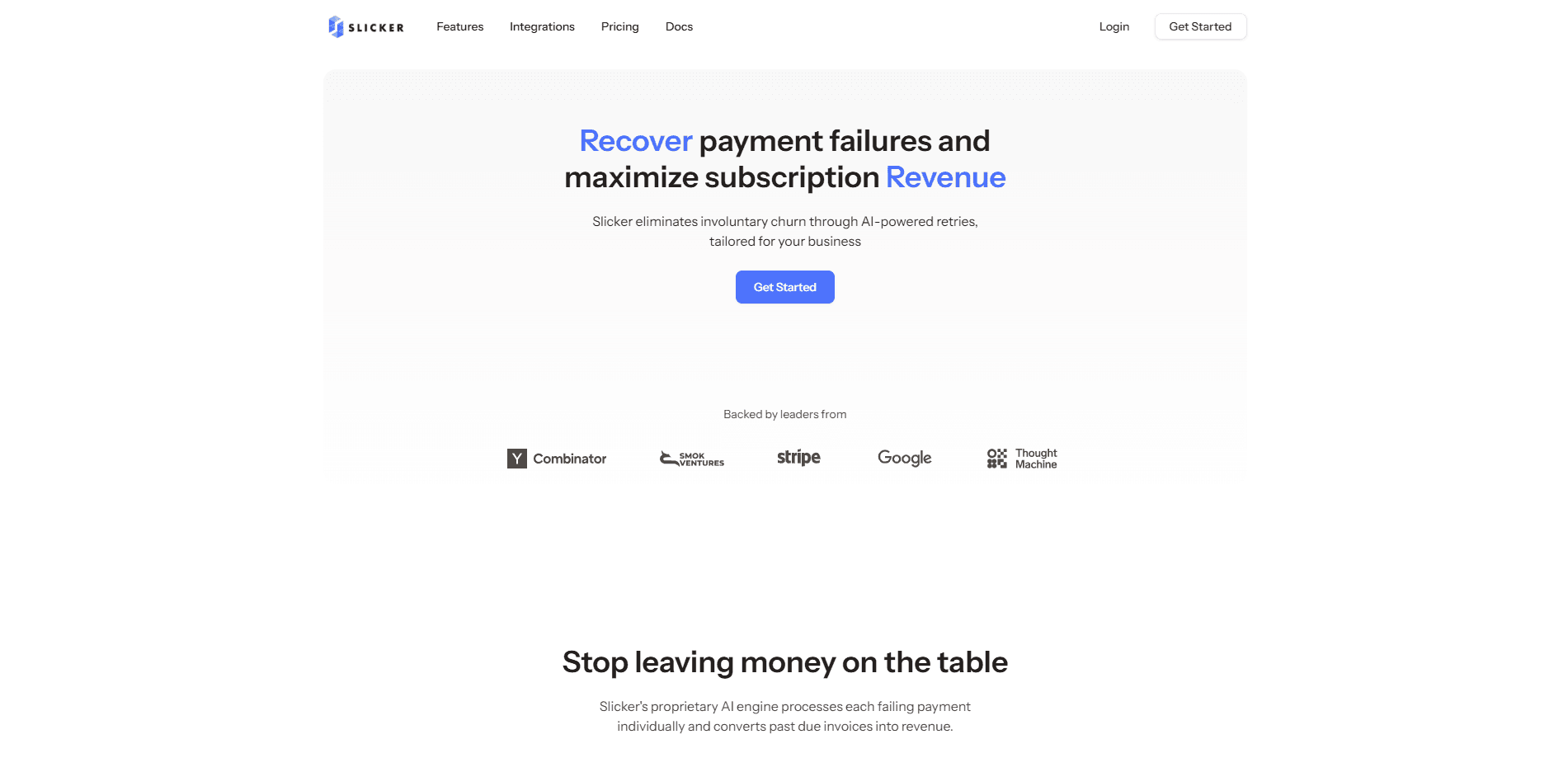
Slicker is an AI payment recovery platform that wins back failed subscription payments with smart retries and automated dunning emails, then proves the extra revenue it recovered against a control group.
About Slicker
What Is Slicker
Slicker is a payment recovery platform built for subscription businesses. It watches every recurring charge that fails, decides how to handle it, and then measures whether the recovery actually worked. The premise is simple: most failed payments aren't customers trying to leave. Cards expire, balances dip, and banks decline charges they'd approve a day later. Slicker treats those failures as recoverable revenue rather than lost customers.
The product runs on top of your existing billing and payment stack, so it works with the gateways and processors you already use. There's no new account for your customers to open and no replacement checkout. Slicker slots in, retries the charges that can be saved, and stays out of the way when a failure looks permanent.
The main limitation is fit. Slicker is aimed at teams with recurring revenue and enough failed transactions to make recovery worth measuring. If you sell one-off products or run a very small subscriber base, the lift the platform recovers may not justify the setup. Pricing is also performance-based, which suits businesses that want to pay from recovered revenue but complicates budgeting for teams that prefer flat, predictable fees.
Getting Started
- Create a Slicker account and connect your billing platform or payment processor.
- Let Slicker read your transaction history so it can learn your decline patterns.
- Turn on smart retries and dunning emails, or start with one and add the other later.
- Set up a control group so Slicker can measure recovered revenue against invoices it doesn't touch.
- Watch the dashboard to track recovery rates across plans and countries.
Product Information
A quick look at Slicker's pricing, supported platforms, and performance.
Best for
The users, tasks, and scenarios where this tool fits best.
Users
- Subscription billing teams
- Finance and revenue operations staff
- Growth-stage SaaS and DTC teams
Tasks
- Recovering failed renewals
- Sending dunning emails
- Measuring recovery performance
- Diagnosing decline patterns
Scenarios
- Involuntary churn from expired or replaced cards
- Cross-border subscriptions
- High-volume renewal days
Key features
AI Smart Retries
For every failed payment, Slicker answers three questions: whether to retry, when to retry, and how much to retry. An ensemble of machine learning models reads network-level messages, gateway error codes, and customer behavior signals, while built-in rules handle issuer quirks, regional rules, and public holidays. The result is a retry schedule tuned to each failure instead of a one-size-fits-all timer.
Automated Dunning Emails
When a retry isn't enough, Slicker sends targeted messages with a one-click payment link so customers can pay through their existing card or switch to a new method. The tone and timing adjust to the type of failure, which keeps a polite nudge from reading like a collections notice.
Lift Evaluation With a Control Group
Slicker's distinguishing feature is how it proves its value. The platform holds back a control group of invoices it doesn't touch, then compares recovered revenue against that baseline. Recovery claims come with confidence intervals, so you can see whether the lift is real rather than seasonal.
Payment Analytics Dashboard
A single dashboard shows payment attempts, failures, and recovery rates across plans and countries. Teams can track how recovery improves over time and drill into the decline reasons behind the numbers, which turns a vague retention metric into something specific to act on.
Wide Billing and Gateway Integrations
Slicker connects to billing platforms including Stripe Billing, Chargebee, Recurly, Zuora, and Recharge, and to payment processors such as Stripe, Braintree, Adyen, Checkout.com, Authorize.net, and Worldpay. It also supports in-house billing setups, so companies aren't locked into one vendor.
Free Diagnostic Tools
Slicker publishes free tools for anyone dealing with declines, including a BIN lookup, a decline code reference, and a card validator. These help support and finance teams work out why a payment failed before they decide how to recover it.
Pros and cons
Pros
- Recovery is measured against a control group, so the reported lift is backed by evidence rather than a vendor's own estimate.
- Works with the billing platforms and processors most subscription businesses already run.
- Handles both smart retries and dunning emails, covering the two main ways failed payments get recovered.
- Performance-based pricing ties the fee to recovered revenue instead of a flat subscription.
- Regional rules and holiday awareness reduce the manual tuning that basic retry tools need.
Cons
- No free plan, and performance-based pricing makes monthly costs harder to predict than a flat fee.
- The control group means Slicker intentionally leaves some invoices untouched, which feels counterintuitive for teams chasing every last recovery.
- The platform is built for recurring revenue, so one-off sellers and very small subscriber bases get little value from it.
- Public documentation on API access and self-serve onboarding is thin, so setup may lean on a sales conversation.
Frequently asked questions
Slicker recovers failed subscription payments. It retries charges that can be saved, sends dunning emails when a retry won't work, and reports how much revenue it recovered. It sits on top of your existing billing and payment setup rather than replacing it.
Related content
Explore related tools, skills, and articles for Slicker.
Slicker Alternatives

JarvisCore
Prescott Data · Coding · Productivity · OtherJarvisCore is an open source Python runtime where AI agents work as equal peers on an agent mesh, claim tasks from a shared ledger, and reach external services through a zero-trust broker.
Clef
Cloudflare · Business · OtherClef is Cloudflare's open-source decision model for Workers AI. It returns calibrated probabilities for typed questions, not generated text, so agents can classify, route, and act fast.

iFixAi
iFixAi · Business · OtheriFixAi is an open-source auditor for AI agents. It runs your agent through a simulation of your business, grades every reply, and returns an A to F scorecard backed by evidence.