

Snowglobe
Guardrails AI · Coding · Chatbot
Snowglobe is a simulation engine by Guardrails AI that creates realistic synthetic users to stress-test AI chatbots and agents, so teams can catch failures before launch.
About Snowglobe
What Is Snowglobe
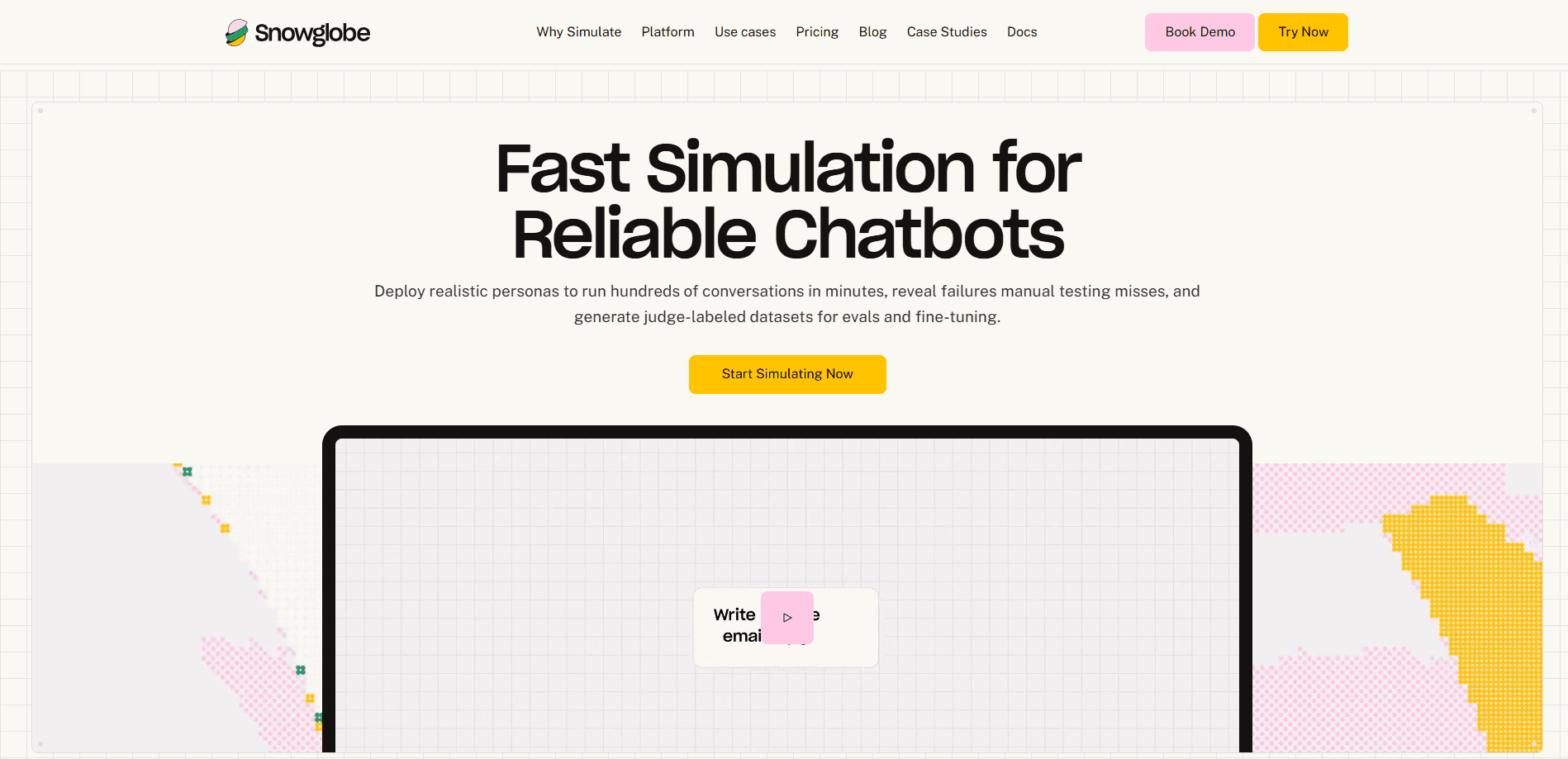
Snowglobe is a testing platform for AI agent testing and conversational AI. It spins up synthetic users with their own goals, tones, and personalities, then lets them talk to your chatbot at scale. One run can produce hundreds of conversations across edge cases that hand-written test scripts never reach.
The pitch is simple. Manual testing only covers what a person thinks to try. Snowglobe borrows the idea from self-driving car simulation: pressure-test the system in a controlled space so it behaves under real load. Companies like Masterclass and Singapore's AI Verify public sector unit use it to surface issues and build labeled datasets.
The catch is scope. Snowglobe handles chatbots that expose an API or SDK endpoint. If your assistant only lives inside a closed app with no programmatic access, there's no clean way to wire it up. It's built for teams shipping agents, not for casual users poking at a consumer app.
Getting Started
- Sign up at the Snowglobe web app and open a workspace.
- Connect your chatbot by pointing Snowglobe at its API endpoint or wiring in the SDK.
- Write a short description of what the chatbot does and pick the risks you want to track, like hallucination or tone drift.
- Run a simulation so Snowglobe generates personas and conversation scenarios automatically.
- Review the scoring, export the data as CSV or JSON, or push it to your eval and training tools.
Product Information
A quick look at Snowglobe's pricing, supported platforms, and performance.
Best for
The users, tasks, and scenarios where this tool fits best.
Users
- AI product teams
- QA and safety engineers
- Machine learning engineers
Tasks
- Building eval sets and LLM evals for chatbots
- Creating fine-tuning datasets
- Running regression tests before release
Scenarios
- Pre-launch testing of a customer support bot
- Compliance review in regulated industries
- Iterating on a RAG assistant
Key features
Synthetic User Personas
Snowglobe builds multidimensional personas with distinct goals, skills, and behavioral patterns. Instead of one generic tester, you get a cast of characters that press your chatbot in different directions. The result is coverage that a small QA team cannot match by hand.
Judge-Labeled Eval Sets
Each simulated conversation can carry judgments tied to the metrics you pick. You get test datasets that map real behavior across intents and tones, ready to drop into your evaluation tools. That turns ad hoc spot checks into repeatable scoring.
Fine-Tuning Data Generation
The same runs feed training pipelines. Snowglobe exports preference pairs for DPO or reward models and critique-and-revise triples for supervised fine-tuning as clean JSONL. You avoid building a separate data collection process.
Risk-Prioritized Simulation
The engine scores results and steers the next round toward the highest-risk personas. Rather than spreading effort evenly, it concentrates on where your assistant is most likely to break. Teams get signal on their worst cases fast.
Regression Suites and Error Tracking
You can save a suite of realistic conversations and rerun it on every build. Error rates are tracked over time so a fix on Monday does not quietly undo last week's work. Problems get caught before they ship.
CI/CD and Tool Integration
Snowglobe fits into build pipelines and exports to CSV, JSON, or your preferred evaluation tool. It reads like part of the dev workflow rather than a separate dashboard. That keeps simulation close to where changes actually land.
Pros and cons
Pros
- Generates conversation data at a scale manual testing cannot reach, covering rare and adversarial cases.
- Persona modeling produces varied, realistic dialogues rather than repetitive filler.
- Output doubles as both evaluation data and fine-tuning material, cutting duplicate work.
- Exports to CSV, JSON, and common eval tools, so it slots into existing pipelines.
Cons
- Requires a programmatic endpoint, so closed consumer apps without an API cannot be tested.
- Pricing is not public, which means you have to talk to sales before you can budget for it.
- No free tier is advertised, so trying it out means committing to a conversation first.
Frequently asked questions
It means generating realistic user conversations with your chatbot automatically, at scale, instead of writing test scripts by hand. Snowglobe creates those conversations and labels the outcomes so you can evaluate and train on them.
Related content
Explore related tools, skills, and articles for Snowglobe.
Snowglobe Alternatives

Base Code
Base44 (Wix) · Coding · ProductivityBase Code is a shared cloud development environment from Base44. Teammates describe changes to an existing GitHub codebase in chat, preview them live and send them back as pull requests.

Google EmbeddingGemma 2
Google DeepMind · Writing · Image · CodingGoogle EmbeddingGemma 2 is a 740M-parameter open model that turns text, code, images, audio, and video frames into vectors in one 768-dimension space, running on phones and laptops.

GitGlow
GitGlow · Coding · ProductivityGitGlow is a local-first desktop Git client that lets independent developers review their own code and their AI agents' changes in one place before shipping.