

Softgen
Softgen Labs · Coding
Softgen is an AI web app builder and no-code full stack app platform that turns plain English prompts into Next.js and Supabase projects you can edit, export and deploy on your own.
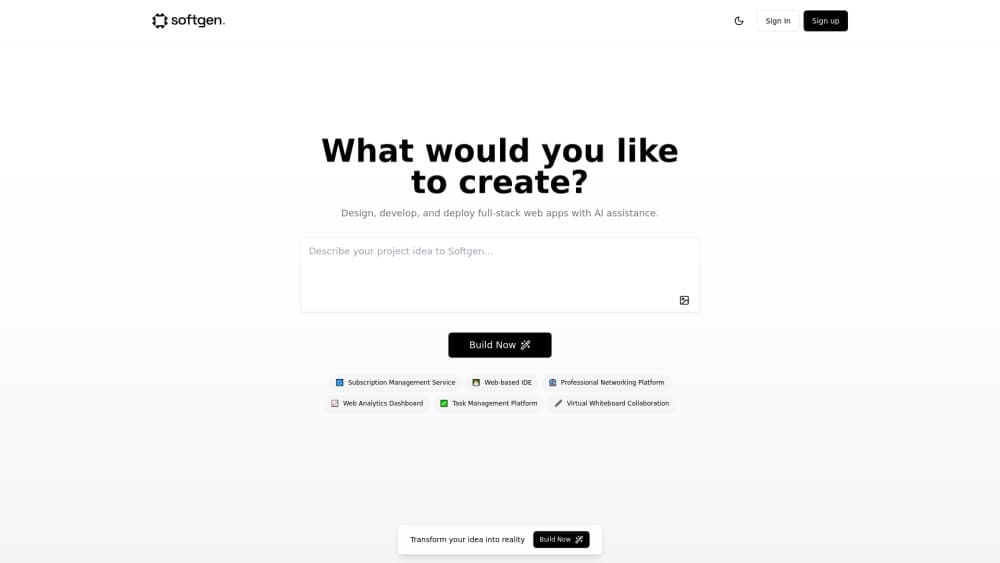
About Softgen
What Is Softgen
Softgen is an AI web app builder from Softgen Labs. You describe what you want in plain English, and it generates a working full-stack application rather than a mockup or a snippet. The output starts from a Next.js boilerplate and gets customized across three layers: the frontend interface, the backend logic and the third-party integrations that connect them. The company positions the tool for founders, solo builders and small teams who need a functional MVP without hiring a development team.
The pitch rests on ownership. Every project can be exported to GitHub, so the code you generate is code you keep, edit and eventually hand to engineers. Softgen runs on a credit system instead of a flat unlimited subscription, so the cost of building tracks how much you actually generate. It supports over a dozen models, which means you can point the same project at Claude, GPT or Gemini depending on the task in front of you.
Two boundaries matter before anyone signs up. Hosting is not included, so deployment to Vercel and Supabase is something you configure with guided steps. And project capacity is capped by plan, so a Lite account can hold three projects while higher tiers go much further.
Getting Started
- Sign up and collect your free trial credits, which land without a credit card
- Describe the app you want in plain English, then answer follow-up prompts as Softgen scaffolds the project
- Connect your own Supabase and Vercel accounts, or accept the platform-managed setup for a faster start
- Review the running preview, refine the prompt until the behavior matches, then export the repo when you are ready to own the code
Product Information
A quick look at Softgen's pricing, supported platforms, and performance.
Best for
The users, tasks, and scenarios where this tool fits best.
Users
- Solo founders and indie builders
- Non-technical product managers
- Small product teams
- Agency and freelance developers
Tasks
- Prompt-to-app generation
- Full-stack scaffolding
- Integration wiring
- Iterative refinement
- Code export and handoff
Scenarios
- A founder has a validated idea and a pitch date
- A PM needs to show stakeholders a clickable prototype
- An agency wins a small build
- A side project needs a database and auth
- A team wants to test AI-driven building
Key features
Prompt-to-App Generation
The core of Softgen is the prompt loop. You write what you want in ordinary language, and the platform scaffolds a project against a Next.js boilerplate, then rewrites the frontend and backend to match. You can describe an internal tool, a marketing site with a form, or a chatbot app, and each one becomes a real codebase rather than a slide. After each prompt, the running preview updates so you can judge the change without a deploy. The trial credits mean the first project can be built before any money changes hands.
Model Choice Across Twelve-Plus Models
Softgen does not lock you to a single model. Plans list model choice as a headline feature, with the Pro tier carrying access to a dozen options that include Claude, GPT and Gemini families alongside GLM and DeepSeek. The practical effect is that you can pick a reasoning-heavy model for backend logic and a faster one for straightforward layout work. The Starter tier keeps the selection narrower, and Lite is pinned to a single model, so model choice becomes one of the clearer reasons to move up a tier.
Managed Supabase Backend
A generated app needs a database, auth and storage, and Softgen answers that with Supabase. On the platform-managed path, Supabase is provisioned for you so the backend works without manual configuration. On the bring-your-own path, you connect a personal Supabase project and your data stays in your own account. The Pro tier adds backups, and the company states that on the bring-your-own route your data never passes through Softgen's own infrastructure. That distinction matters to anyone shipping something with real user records.
GitHub Export and Full Code Ownership
Export is central to how Softgen frames ownership. You get access to the repository, so the project is yours to edit, scale or hand off. On the Starter tier and above, pushing to GitHub is part of the plan rather than an add-on, which keeps the work under version control from early on. For an agency or a founder planning to hire later, this is the feature that separates a builder from a no-code cage, because the exit door is always open.
Deployment Guidance for Vercel and Supabase
Softgen does not host the finished app, and it does not pretend to. Instead it walks you through deploying the frontend on Vercel and the backend on Supabase, both of which have free production-ready tiers. Following the guided steps gives you a live app under your own accounts, so hosting costs and domain control sit with you rather than a platform markup. Teams that already run Vercel and Supabase will recognize the stack, which shortens the last mile.
Integrations and Publishing
Beyond the core stack, Softgen lists support for services such as Resend for transactional email and LemonSqueezy for payments, added by describing the requirement in a prompt. Publishing is bundled into the paid tiers, so you can push a project live without leaving the platform. The combination means a generated app can take real form submissions, send real emails and accept real payments, which is the point where a prototype starts behaving like a product.
Pros and cons
Pros
- Prompt-to-app output is a real Next.js and Supabase codebase, so the result is something a team can maintain later
- GitHub export and full code ownership are built in, which removes the usual no-code lock-in concern
- Model choice across a dozen options lets you match the model to the task instead of accepting one default
- Managed Supabase gets a working backend running fast, while the bring-your-own path keeps data in your account
- Free trial credits with no card lower the cost of finding out whether the workflow suits you
Cons
- Hosting is not included, so you must deploy to Vercel and Supabase on your own to get a live site
- The credit system can take time to read clearly, and heavy iteration burns through a monthly allowance
- Project capacity is capped, and the Lite tier holds only three projects and a single model
- Support depth steps up with price, so the cheaper tiers lean on community and standard channels rather than priority help
Frequently asked questions
Softgen is an AI web app builder that turns plain English prompts into full-stack web applications. It starts from a Next.js boilerplate and customizes the frontend, backend and integrations to match your description, then lets you export the code to GitHub and deploy it on your own accounts.
Related content
Explore related tools, skills, and articles for Softgen.
Softgen Alternatives

Base Code
Base44 (Wix) · Coding · ProductivityBase Code is a shared cloud development environment from Base44. Teammates describe changes to an existing GitHub codebase in chat, preview them live and send them back as pull requests.

Google EmbeddingGemma 2
Google DeepMind · Writing · Image · CodingGoogle EmbeddingGemma 2 is a 740M-parameter open model that turns text, code, images, audio, and video frames into vectors in one 768-dimension space, running on phones and laptops.

GitGlow
GitGlow · Coding · ProductivityGitGlow is a local-first desktop Git client that lets independent developers review their own code and their AI agents' changes in one place before shipping.