

Sonauto
Treblo, formerly Sonauto · Voice & Language
Sonauto, now renamed Treblo, is a free AI music generator that turns a text prompt or your own lyrics into a finished song with vocals, plus a paid music generation API.
About Sonauto
What Is Sonauto
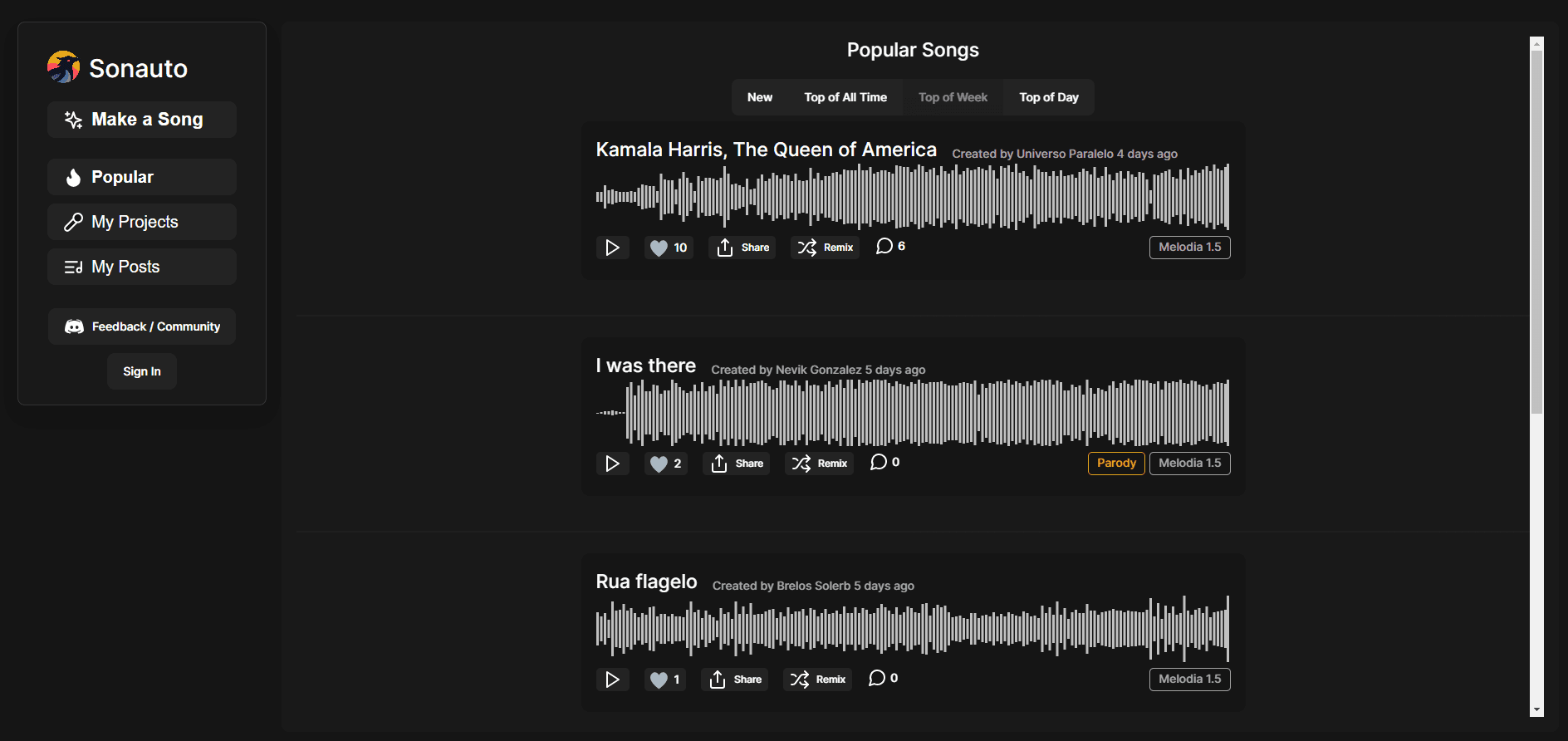
Sonauto is a browser-based AI song maker built by a four-person audio lab. You describe a song, add lyrics if you have them, and the app returns a mixed track with a singing voice. In June 2026 the team renamed the product Treblo and moved it to treblo.com. Accounts, songs and shared links carried over, and old sonauto.ai links still redirect.
The pitch is simple: most people who love music never get to make any. No instrument, no singer, no studio. Sonauto removes the first three steps and leaves you with the idea. A prompt like a country song about my WiFi going out mid-meeting is enough to start.
The engine is Melodia, now on version 3. The company says it reaches first audio in about 15 seconds and streams the rest while you listen, which is faster than the 30 to 45 second waits it lists for unnamed competitors. A language model architecture keeps compute costs down, and that is why the web app can stay free.
The limits matter too. This is a browser tool, not a digital audio workstation. Editing works on sections and stems rather than a full mixer, so serious production still ends in another program. Vocal quality shifts by genre, and the free tier gives you no priority queue.
Getting Started
- Sign up at treblo.com with an email address. No card is needed for the free web app.
- Start a project, then write a prompt that names a genre, a mood and a subject. Style tags narrow the result further.
- Paste your own lyrics, or let the model write them. Pick instrumental if you want no vocal.
- Generate, then listen. First audio arrives in seconds and the rest streams in.
- Extend a section, regenerate a weak part, split stems, then download in OGG, MP3, WAV, FLAC or M4A.
Product Information
A quick look at Sonauto's pricing, supported platforms, and performance.
Best for
The users, tasks, and scenarios where this tool fits best.
Users
- Bedroom songwriters
- Video and podcast creators
- Developers
Tasks
- Turning a written idea into a text to song demo
- Writing melody against existing lyrics
- Isolating parts after generation
Scenarios
- A weekend project with friends
- A video deadline tomorrow
- Testing an arrangement before paying for studio time
Key features
Melodia v3 generation with streaming playback
The current model starts audio in roughly 15 seconds and streams the remainder as it renders. You hear the hook before the full song exists, which changes how you iterate: reject a weak direction early instead of waiting out a two minute render.
Prompt control through thousands of style tags
The tag library holds 4,160 entries covering genre, era, mood, instrumentation and vocal type, from 1970s soul to hyperpop to orchestral soundtrack. Stacking a handful of tags is how you steer a result without writing a long description.
Your lyrics or generated ones, in any language
Paste a finished lyric sheet and the model sings it, or ask for lyrics and edit what comes back. It handles languages other than English, so a Spanish or Japanese chorus is possible without a session singer.
Section level editing, covers and remixes
You can extend a track past its first ending, regenerate a weak section, or cover an existing song in a new style. Edits stay inside the project, so a bad pass does not cost you the whole generation.
Stem separation and five download formats
Tracks export as OGG, MP3, WAV, FLAC or M4A, and stems come out separated by part. Producers who want to finish in a DAW get usable material rather than a single mixed file.
A music generation API with predictable credits
The AI music API lives at api.treblo.com. One song costs 100 credits, two variations cost 150, and plans run from $11 for 200 songs per month to $1,150 for 28,750. Pay-as-you-go credits never expire, and a card verified trial includes 3,000 credits.
Pros and cons
Pros
- The free web app is unlimited, with no daily cap and no paid wall on downloads or stem separation.
- First audio lands in about 15 seconds, so you can judge a direction fast.
- Editing goes past generate and pray: extend, regenerate sections, cover, remix.
- API entry is cheap at $11 per month for 200 songs, well below most rivals.
- Style tags are deep enough to hit narrow references, like late 1970s French chanson.
Cons
- The rename to Treblo broke bookmarks and forces API users to migrate to a new host, and the old api.sonauto.ai address is only temporary.
- There is no native mobile app, so sketching an idea on a phone means using a browser on a small screen.
- Mixing stops at stems. You cannot balance a full multitrack inside the app, so finished work needs another editor.
- Vocal tone still drifts by genre, and ballads expose artifacts that a dense rock mix hides.
Frequently asked questions
Yes. The product was renamed Treblo on June 3, 2026 and now runs at treblo.com. Existing accounts, songs and shared links still work, and sonauto.ai redirects.
Related content
Explore related tools, skills, and articles for Sonauto.
Sonauto Alternatives

Foley
Hanamori Labs, LLC · Voice & Language · Productivity · AI AssistantFoley is a voice to-do list that turns a spoken sentence into a filed task, complete with project, date and time, then helps you plan the day around what is already there.

HireKey
HireKey · Voice & Language · Productivity · LeaningHireKey is an AI job search copilot built by a former tech recruiter. It checks role fit, tailors resumes, runs interview practice and tracks every application.

Fluence
Yay Software (Yannick Huchard) · Writing · Voice & Language · ProductivityFluence is an Android app that reads PDFs, EPUBs, Word files and web articles aloud, follows each sentence as it speaks, and answers questions about the text on the phone itself.