

SONOTELLER.AI
SONOTELLER · Writing · Voice & Language
SONOTELLER.AI is an AI song analyzer that listens to a track and returns lyrics, genre, mood, instruments, BPM, key and a golden-minute highlight.
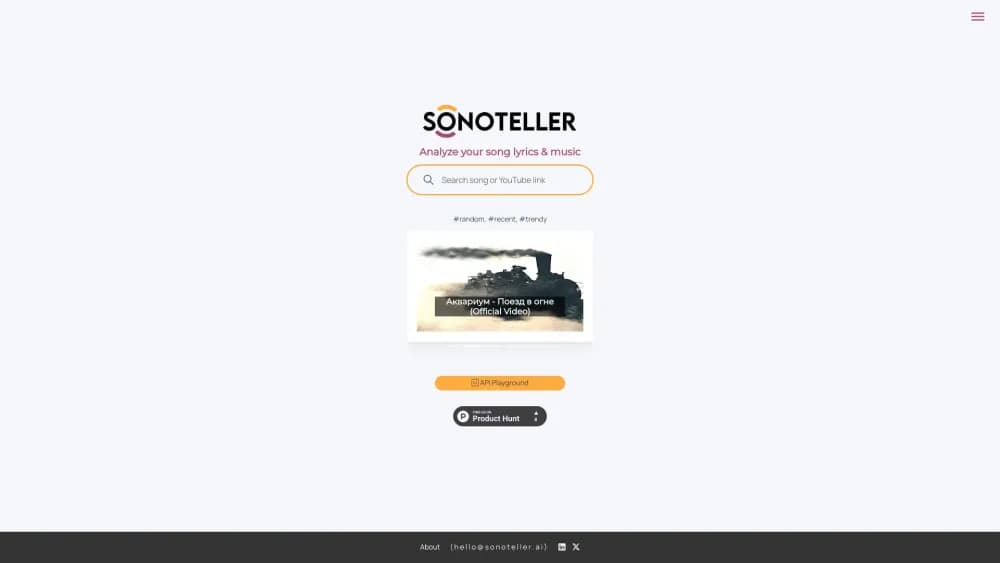
About SONOTELLER.AI
What Is SONOTELLER.AI
SONOTELLER.AI is a web tool that listens to a song and writes a report about it. Drop in a track or a YouTube link and the engine returns a structured summary covering the lyrics, the musical attributes, and the emotional tone. It runs song analysis and lyric analysis in one pass and reads genres, subgenres, moods, instruments, tempo in BPM, and musical key, then packages everything into a text description you can reuse as metadata.
The problem it solves is metadata, not discovery. Artists, sync agencies, and catalog managers need consistent descriptors to tag a track for streaming platforms and music libraries, and writing those by hand across a whole catalog is slow and inconsistent. SONOTELLER.AI generates them automatically, which is where its API plans come in. The web interface is a demo of the same engine.
Two limits shape how you use it. The service is still in beta, so the team warns about occasional errors and delays, and analysis takes around a minute per song because both the lyrics and the audio get processed. The free web tool also leans on YouTube links for demo purposes, while the song analyzer API expects music files you own.
Getting Started
- Go to sonoteller.ai and paste a YouTube link or upload your own audio file into the analysis box.
- Wait roughly a minute while the engine processes the lyrics and the music separately, then reads the results together.
- Open the report and review the sections, starting with the overall summary and the detected lyrics.
- Check the musical attributes: genre, subgenre, mood, instruments, BPM, and key.
- Jump to the golden minute to hear the section the tool flagged as the track's highlight, then copy the descriptors you want to keep.
Product Information
A quick look at SONOTELLER.AI's pricing, supported platforms, and performance.
Best for
The users, tasks, and scenarios where this tool fits best.
Users
- Independent artists and producers
- Sync and licensing agencies
- Music catalog managers and distributors
Tasks
- Tagging a track for distribution
- Getting lyrics without typing them out
- Finding the highlight section
- Building searchable metadata
Scenarios
- Preparing a single for release
- Auditing a back catalog
- Briefing a sync pitch
Key features
Lyrics and Language Analysis
The engine transcribes the lyrics and summarizes what the song is about, then identifies the language it is written in. That matters when a catalog spans several languages and you need a quick read on content without opening every file. It also flags explicit content, which helps when you're prepping tracks for platforms that filter on that label.
Musical Attribute Extraction
SONOTELLER.AI returns a set of musical attributes: genre, subgenre, mood, instruments, BPM, and musical key. These are the fields distributors and libraries actually ask for, so the output drops straight into a metadata sheet. The point is consistency, and automated extraction keeps the same vocabulary across a whole catalog.
Golden Minute Detection
The tool pinpoints what it calls the golden minute, the section that carries the chorus or the strongest hook. For anyone cutting a preview, a teaser, or a playlist clip, that single flag saves a manual hunt through the waveform. It's a small feature, but it's one of the more practical ones for day-to-day work.
Free Web Analyzer
The web interface costs nothing and takes a YouTube link or an uploaded file. It's the fastest way to see what the engine produces before you commit to an API plan. The trade-off is that demos run on YouTube links, while production use through the API expects files you own.
Developer API Plans
Beyond the free tool, SONOTELLER.AI sells song analyzer API access through RapidAPI in four tiers: Basic, Pro, Ultra, and Mega. The plans differ in rate limits, support channels, and platform bandwidth fees, so you pick one based on how many tracks you process each month. The API is what turns the analyzer into something you can wire into a distribution or catalog workflow.
Content Tagging and Summaries
Alongside the musical data, the engine produces a short summary and content tags for each track. This is the layer that makes a catalog browsable, since tags let a listener or a search filter jump to a mood or a theme. The summaries read as plain text, not marketing copy, which keeps them usable as working notes and keeps the lyric analysis separate from the marketing spin.
Pros and cons
Pros
- Combines lyrics and music analysis in one pass, so you get themes, genre, and mood without running two separate tools.
- The web analyzer is free and needs no account, which makes it easy to test before paying for API access.
- Output is structured metadata that fits distributor and library fields, not just an editorial write-up.
- Golden minute detection flags the hook automatically, which saves time on clip and preview work.
- Graded API plans let small catalogs start cheap and scale up rate limits as volume grows.
Cons
- The service is in beta, so the team itself warns about random errors and delays, which means you should not treat a single run as final.
- Analysis takes around a minute per track, so large catalogs move slowly unless you queue jobs through the API.
- The free web tool leans on YouTube links for demos, while real analysis through the API needs music files you own, so the free path does not cover owned-file workflows.
- Pricing lives on the RapidAPI listing rather than the main site, so you check a third-party page to compare the four plan tiers.
Frequently asked questions
It listens to a song and writes a report about it. The report covers the lyrics, the language, the musical attributes such as genre, mood, instruments, BPM, and key, plus a content summary. Think of it as a song analysis tool built for metadata rather than a critic's review.
Related content
Explore related tools, skills, and articles for SONOTELLER.AI.
SONOTELLER.AI Alternatives

Google EmbeddingGemma 2
Google DeepMind · Writing · Image · CodingGoogle EmbeddingGemma 2 is a 740M-parameter open model that turns text, code, images, audio, and video frames into vectors in one 768-dimension space, running on phones and laptops.

MePersona
MePersona, Inc. · Writing · Productivity · MarketingMePersona is an AI unified inbox for creators. It learns your voice, drafts replies to fan messages from 12 platforms, and sends only what you approve.

Fluence
Yay Software (Yannick Huchard) · Writing · Voice & Language · ProductivityFluence is an Android app that reads PDFs, EPUBs, Word files and web articles aloud, follows each sentence as it speaks, and answers questions about the text on the phone itself.