
Spark
Spark Systems Inc. · Coding · Productivity
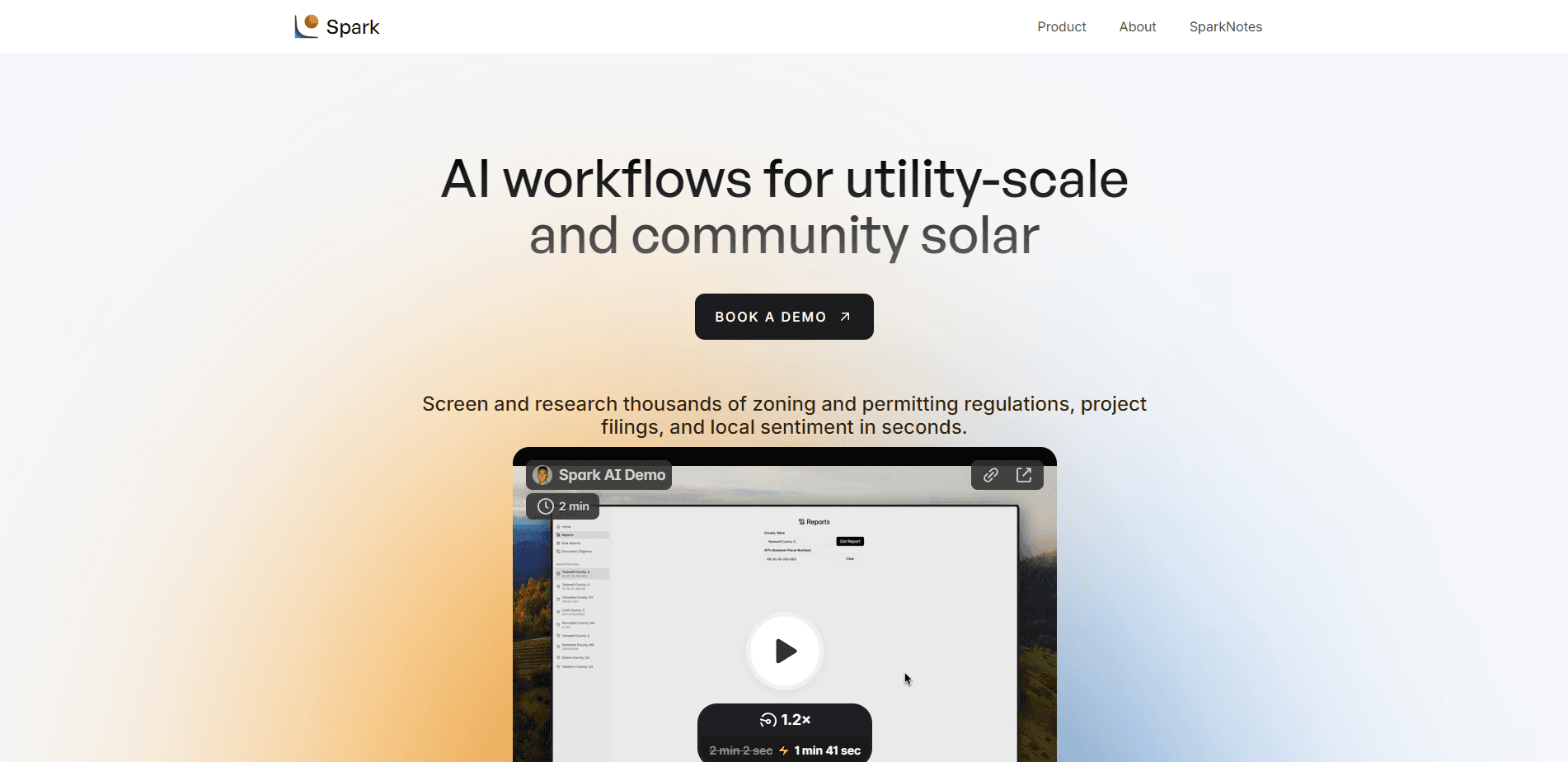
Spark is an AI permitting and site selection platform for solar, storage, and data center developers. It builds cited permit matrices, screens sites in minutes, and tracks local opposition before hearings.
About Spark
What Is Spark
Spark Systems Inc. runs a research platform that answers one question quickly: can this site get permitted? Hand it a county, a township, or a parcel number and it returns the zoning rules, replacing the manual zoning research most teams do by hand, active moratoria, community sentiment, and the officials who vote on projects in that jurisdiction.
The company started with utility-scale and community solar developers and now sells the same engine to battery storage and data center teams. Wind and natural gas projects run through the permitting workflow too, and solar and storage remain the core market.
Most solar permitting software hands you a list of rules. What separates Spark from a general chatbot is traceability. Every claim in a report links to the ordinance, meeting minute, or news article it came from, which is what makes the output usable in front of a lender or an investment committee.
Getting Started
- Request the free diligence report with a location, a project type, and an optional capacity in MW.
- Wait for the report, which covers zoning, permitted uses, moratoria, sentiment, and political stakeholders for that area.
- Book a demo if you want the full platform, which adds portfolio monitoring, document review, and multi-site screening.
- Upload your own leases or data room files and generate permit matrices and executive summaries from them.
Product Information
A quick look at Spark's pricing, supported platforms, and performance.
Best for
The users, tasks, and scenarios where this tool fits best.
Users
- Solar developers
- Battery storage and data center developers
- Project finance and M&A teams
- Land and permitting managers
Tasks
- Fatal-flaw screening
- Building a permit matrix
- Community sentiment analysis
- Lease and easement review
Scenarios
- Entering a new state
- Late-stage permitting
- Pre-hearing preparation
Key features
Permit Matrices With Sources Attached
Spark generates a permit matrix that lays out allowed uses, approval steps, setbacks, and known opposition for a given site. Each row cites the document behind it, so your team can check the reasoning instead of trusting a summary. The company says matrices for solar, storage, and data center projects arrive within about seven days.
Fast Site Screening
Early-stage work is mostly elimination. Spark screens hundreds of parcels against zoning, solar ordinances, setbacks, and moratorium status, and the company reports per-site evaluation dropping from four to ten hours down to roughly twenty minutes. That speed matters most when you're ranking a pipeline rather than studying one site.
Community Sentiment Tracking
Local opposition usually shows up online months before a hearing. Spark tracks county-level news, public meetings, and social groups tied to solar, storage, and data center projects, then summarizes what residents and organized groups are saying. It's a signal, not a verdict, but it tells you where to expect a fight.
Portfolio Change Monitoring
Ordinances change after you file. Spark sends regular diffs on active counties, covering new moratoria, amended zoning text, and meeting agendas. For a developer with projects already in permitting, this is the feature that prevents a nasty surprise at the last public hearing.
Document Diligence
Upload land leases, easements, or a full data room and Spark extracts terms and produces portfolio-level summaries. The company quotes typical document review at about two minutes instead of fifteen. Handoffs get easier too, since a new project manager can read a structured summary rather than a folder of PDFs.
Stakeholder Mapping
Before a conditional-use hearing, you need to know who decides. Spark lists county commissioners, planning board members, and zoning officials, along with their past votes on comparable projects and public statements. That turns a guessing game about local politics into a list you can actually prepare against.
Pros and cons
Pros
- Every finding carries a citation, which is the difference between research you can defend and research you can't.
- One workflow covers solar, storage, data centers, and broader infrastructure, so teams don't juggle separate tools per asset class.
- A free county or parcel diligence report lets you test output quality before any sales call.
- SOC 2 compliance and zero data retention on uploaded documents address the objection most legal teams raise first.
- It replaces recurring consultant research pulls on early-stage sites, which is where diligence budgets quietly drain.
Cons
- No public price list, so cost only shows up after a demo and a scoped quote.
- Coverage is built around U.S. jurisdictions, and the site offers no clear answer on projects in Canada, Europe, or Latin America.
- It's a browser tool with no mobile app, which is awkward for site visits and field work.
- Spark researches permitting but doesn't file applications, so you still need local counsel and a filing process.
Frequently asked questions
Spark researches the permitting picture of a specific site. You give it a county, township, or parcel, and it returns zoning rules, moratoria, community sentiment, and the officials involved, with sources cited for each finding.
Related content
Explore related tools, skills, and articles for Spark.
Spark Alternatives

Base Code
Base44 (Wix) · Coding · ProductivityBase Code is a shared cloud development environment from Base44. Teammates describe changes to an existing GitHub codebase in chat, preview them live and send them back as pull requests.

Google EmbeddingGemma 2
Google DeepMind · Writing · Image · CodingGoogle EmbeddingGemma 2 is a 740M-parameter open model that turns text, code, images, audio, and video frames into vectors in one 768-dimension space, running on phones and laptops.

GitGlow
GitGlow · Coding · ProductivityGitGlow is a local-first desktop Git client that lets independent developers review their own code and their AI agents' changes in one place before shipping.