

Spatial.ai
Spatial.ai · Marketing
Spatial.ai is a consumer segmentation platform for retailers. Its PersonaLive tool sorts every US household into 80 behavioral segments so brands can choose store sites and target ads.
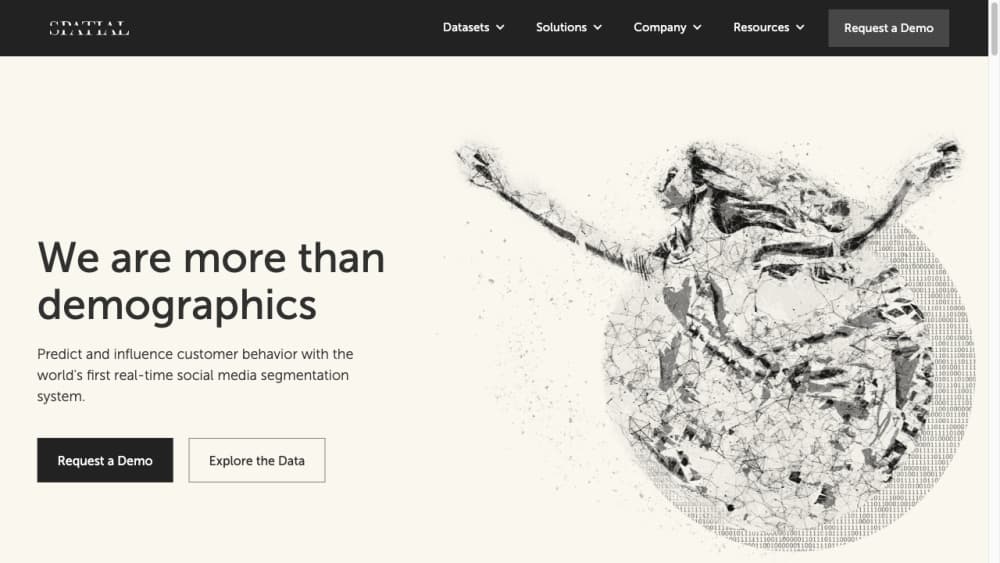
About Spatial.ai
What Is Spatial.ai
Spatial.ai is a retail marketing analytics company that sells one product: PersonaLive, a consumer segmentation platform. It divides every household in the United States into 17 broad groups and 80 behavioral segments, then lets a brand see which of those segments shop with it, which shop with rivals, and where more of them live.
The idea behind it is simple. Two people can share an age bracket, a zip code, and an income and still behave nothing alike. Spatial.ai started in 2016 by organizing public social posts into psychographic segmentation, then added mobile and card data. PersonaLive builds its customer segmentation software on four inputs instead of one: demographics, public social media activity, mobile movement data, and credit card transactions. Spatial.ai says this mix gives a 17% average lift in predicting retail behavior compared with demographics alone, and that campaigns built on it perform up to 50% better. Those numbers come from the vendor, not from an independent study.
The service is built for teams that already have customer data and want to act on it. You upload a CRM file or a store visitation report, read the segment ranking, then push audiences into ad platforms. Two limits matter up front. The data covers US households only, and the cheapest plan starts at $500 a month, so it rarely makes sense for a single-location shop testing an idea.
Getting Started
- Book the free 30-minute demo. There's no self-serve signup, and a product specialist walks through your category before you pay.
- Pick a plan, then upload a customer file or a store visitation report. Drawing a polygon around a trade area works too when you don't have a list.
- Read the segment ranking and the segment portraits to see who your best customers are, what they spend on, and which brands they visit.
- Export the chosen segments to Meta, TikTok, Snapchat, X, programmatic display, or direct mail, then reuse the same segments for site selection.
Product Information
A quick look at Spatial.ai's pricing, supported platforms, and performance.
Best for
The users, tasks, and scenarios where this tool fits best.
Users
- Retail marketers
- Location planners and real estate teams
- Agency strategists
- Consumer brands with a loyalty file
Tasks
- Auditing a customer list
- Choosing a new store location
- Building a paid social audience
- Benchmarking market share
Scenarios
- A retailer planning three openings in one year
- A brand whose social audience and store customers don't match
- An agency pitching a category newcomer
Key features
A Fixed Set of Behavioral Segments
PersonaLive assigns every US household to one of 17 high-level groups and 80 segments, and the names describe behavior rather than income. That fixed taxonomy is the core of the product: two brands comparing notes use the same labels, and an agency can move a strategy from one client to another without rebuilding a model. The trade-off is that you can't define your own segment from scratch.
Customer File and Store Visit Append
Upload a CRM export or a visitation report and the platform returns the segments inside it, ranked by value. You can also draw a polygon around a location when you have no list at all. The append step writes segment codes and demographic fields back to your records, which is what makes the next step possible, since audience targeting needs segment IDs attached to real contacts.
Segment Portraits
Each segment comes with a portrait: age and income ranges, the brands its members visit, the accounts they follow on social media, and the channels that tend to reach them. Marketing teams use these portraits to brief creative work, and the page can be shared as a link with people outside the platform. It's the fastest way to explain a segment to someone who has never opened the tool.
Market Share and Spend Analysis
The Strategist plan adds a panel built from more than 100 million credit card transactions. You can see how much a segment spends with your brand, how much goes to competitors, and how that split shifts over time. For a category where the leader is obvious, this turns a vague "we're losing ground" feeling into a segment-by-segment number, which is far easier to act on.
Multi-Channel Audience Activation
Selected segments export to Meta, TikTok, Snapchat, X, programmatic display, and direct mail. The Media Buyer plan removes the cap on social audiences, so you can build as many as the channels allow. This is the part that separates the product from a dashboard: the same segment definition carries from analysis into media buying, and results can be read back against the original cohort.
Trade Area Mapping
The location intelligence view shows where a segment concentrates around a store, a competitor, or a candidate site. Planners use the view to compare a downtown location with a suburban one on the same segment basis, and to spot places where a brand has demand but no store. The output is a map and a segment list, not a full site-scoring model, so financial modeling still happens elsewhere.
Pros and cons
Pros
- Segment definitions rest on behavior, not just age and income, which fits retail categories where two similar households buy very differently.
- The workflow runs end to end: upload, rank, portrait, export. You don't need a separate CDP or a data team to get from a customer list to a live audience.
- Market share data at the segment level is hard to find elsewhere at this price, and it answers a question most analytics tools skip.
- Audience exports cover the main social channels plus programmatic and direct mail, so one segment can feed several campaigns.
- A 90-day opt-out gives a team room to test the platform on a real category before committing for a year.
Cons
- Coverage stops at US households. A brand selling in Canada, the UK, or Mexico can't use the same segments, which rules the tool out for international teams.
- There's no free tier and no self-serve trial. You have to sit through a sales demo before you can see whether your category is well represented.
- Every plan caps seats at 5 users, so a mid-size marketing department ends up sharing logins or negotiating a custom contract.
- No public API is documented, which means segment data has to move through file uploads and exports rather than into your own warehouse.
Frequently asked questions
Spatial.ai is used to find and reach a retailer's best customers by behavior. You upload a customer list or a store visit report, learn which of the 80 PersonaLive segments are most valuable, and export those segments as ad audiences or use them to compare store locations.
Related content
Explore related tools, skills, and articles for Spatial.ai.
Spatial.ai Alternatives

ngram 2.0
ngram · Video · Marketingngram 2.0 is an AI video generator for teams. It turns a prompt, a screen recording, or a product URL into a narrated explainer, product demo, or AI avatar video, and every scene stays editable.

shippedit.me
Krawlup · Marketing · Businessshippedit.me now redirects to Krawlup, a web platform that audits SEO, AEO and page speed every week, then hands the fixes to AI coding agents over MCP.

MePersona
MePersona, Inc. · Writing · Productivity · MarketingMePersona is an AI unified inbox for creators. It learns your voice, drafts replies to fan messages from 12 platforms, and sends only what you approve.