

Sports AI
Sports AI · Other
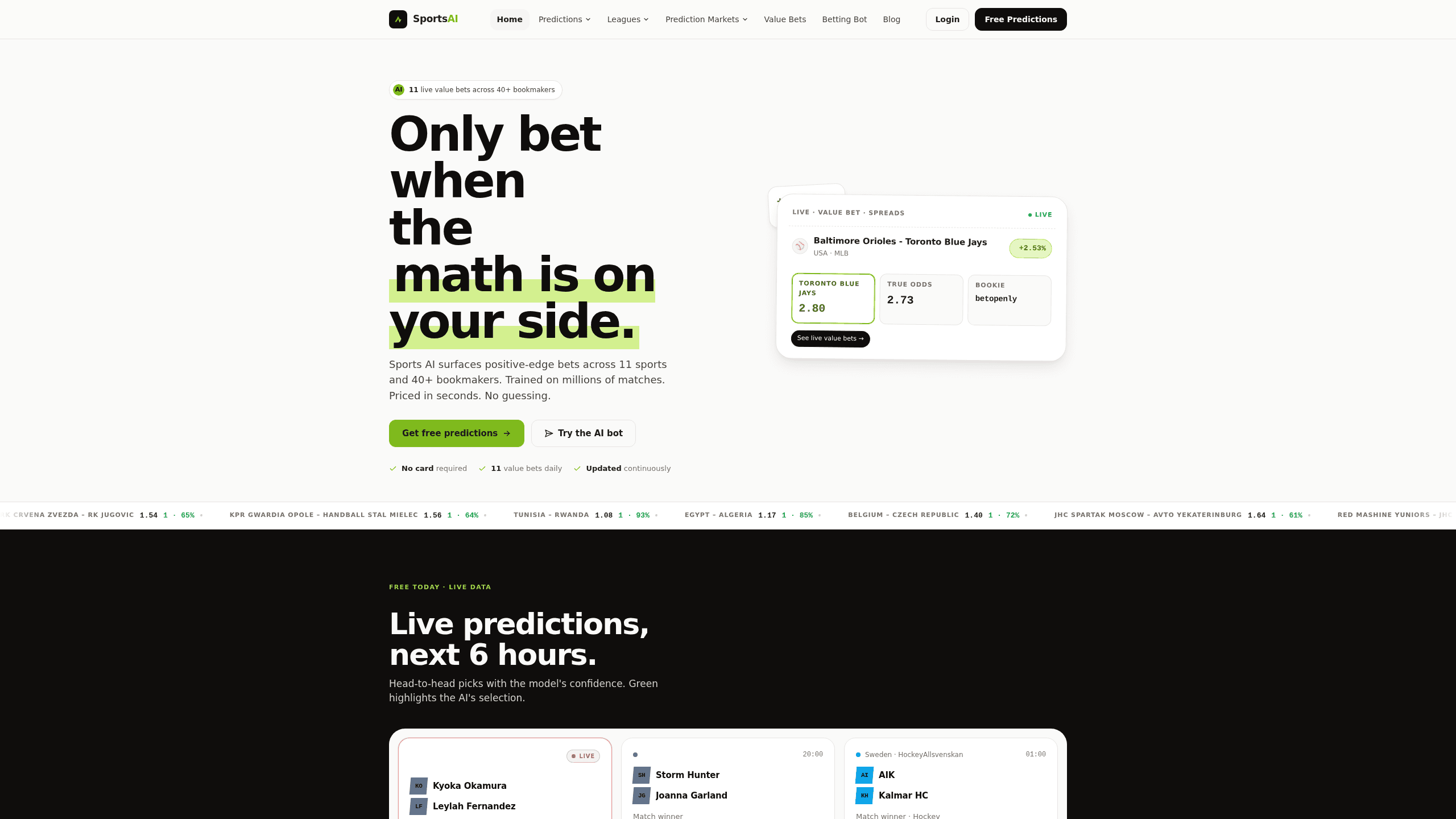
Sports AI is an AI sports betting predictions tool that turns historical match data into "true" odds, then compares those numbers against live prices at 40+ bookmakers to surface positive expected value bets. It covers 11 sports, from football and basketball to tennis, handball and hockey, and refreshes its value-bet stream as bookmakers move their lines. The free feed shows predictions for upcoming matches, while a paid tier unlocks the full value-bet stream.
About Sports AI
What Is Sports AI
Sports AI is a value-bet engine for bettors who care about expected value (EV) rather than gut feeling. The idea is simple: instead of chasing tips, you look at where a bookmaker's price is too generous relative to what the AI thinks the real probability is. When the bookmaker's implied probability is lower than the model's, the bet carries a positive edge.
The model ingests team form, lineups, injuries, rest days, venue and historical head-to-head records, then outputs a probability distribution across every outcome. That distribution becomes the "true odds." Sports AI pulls live odds from the bookmakers it follows and flags only the bets where its number beats the market.
The main limitation is scope. Sports AI surfaces bets and leaves the wagering itself to you and your bookmaker account, so you still need accounts at the books it tracks. It also leans on math, not certainty. A positive edge is a favorable number over time, not a guaranteed winner on any single match.
Getting Started
- Go to the Sports AI website and browse the free predictions feed, which lists upcoming matches and the model's confidence for each pick.
- Create an account when you want more than the free feed, since the full value-bet stream sits behind a subscription.
- Pick the Professional plan and start the 7-day free trial, billed through Stripe and cancellable at any time.
- Compare the flagged value bets against your own bookmaker accounts and place the wagers you're comfortable with.
- Check back often, as value windows close fast when bookmakers adjust their lines.
Product Information
A quick look at Sports AI's pricing, supported platforms, and performance.
Best for
The users, tasks, and scenarios where this tool fits best.
Users
- Value bettors
- Data-minded sports fans
- Tipster skeptics
Tasks
- Finding positive-edge bets
- Comparing bookmaker odds
- Screening a match card
Scenarios
- A quiet evening with a full slate of matches
- Following a league you know well
- Weekends with several sports running at once
Key features
AI-powered true odds
Sports AI trains its model on millions of historical matches across every major league and retrains it continuously. The output is a probability distribution for each match, which becomes the true odds the whole system runs on. It's the part that decides whether a bookmaker's price is worth taking.
Positive-edge bet filtering
Not every match makes the cut. Sports AI only surfaces bets where the bookmaker's implied probability is lower than the model's, which is where positive expected value lives. So what clears the bar? Only the numbers that clear it. No guessing, just those prices.
Coverage across 11 sports
The value-bet stream spans 11 sports, including football, tennis, volleyball, basketball, handball and hockey. Match-winner markets form the backbone, with the model's confidence shown next to each pick. If you bet across a few leagues rather than one, the breadth saves you from running separate tools.
40+ bookmaker comparison
Sports AI pulls live odds from more than 40 bookmakers so each match carries several market prices to weigh against its true odds. That comparison is what turns a raw prediction into a real bet. The edge depends entirely on where you can get the best line.
Continuous refresh
Value windows close fast because bookmakers adjust their lines constantly. Sports AI refreshes its own numbers on the same rhythm, so the edges you see reflect the current market rather than last night's prices. It's the difference between a stale tip and a live one. Lines move fast. So do we.
Full audit trail
Every bet is logged before kick-off and settled against the real result, so you can see the model's record without cherry-picking. That matters if you've grown tired of channels that only post their wins. It's a transparency feature as much as a performance one.
Free predictions feed
The predictions feed stays free and shows upcoming matches with confidence levels, so you can judge the model's quality before paying. Premium unlocks the full value-bet stream, which is the part built for actual betting. The split lets casual followers stay free.
Pros and cons
Pros
- Focuses on expected value rather than tips, so every pick comes with a reason you can check
- Covers 11 sports and 40+ bookmakers in one place, cutting down on tab-switching
- Refreshes continuously to track fast-moving bookmaker lines
- Logs every bet before kick-off for an honest, verifiable record
- Has a free predictions feed and a 7-day trial on the paid tier
Cons
- Doesn't place bets for you, so you still need accounts at the bookmakers it tracks
- The full value-bet stream sits behind the Professional subscription
- A positive edge is a long-run number, not a guaranteed win on any single match, which can frustrate newcomers expecting locks
Frequently asked questions
No. It surfaces bets with a positive expected value, which is a favorable number over many wagers. Any single match can still go against the model.
Related content
Explore related tools, skills, and articles for Sports AI.
Sports AI Alternatives

Odyssey 3
Odyssey · OtherOdyssey-3 is Odyssey's foundation world model. It simulates physics in real time, turns a prompt into an interactive environment, and adapts to robots, cars and games.

JarvisCore
Prescott Data · Coding · Productivity · OtherJarvisCore is an open source Python runtime where AI agents work as equal peers on an agent mesh, claim tasks from a shared ledger, and reach external services through a zero-trust broker.
Clef
Cloudflare · Business · OtherClef is Cloudflare's open-source decision model for Workers AI. It returns calibrated probabilities for typed questions, not generated text, so agents can classify, route, and act fast.