

SQLBuilder.ai
NeverBlink · Coding
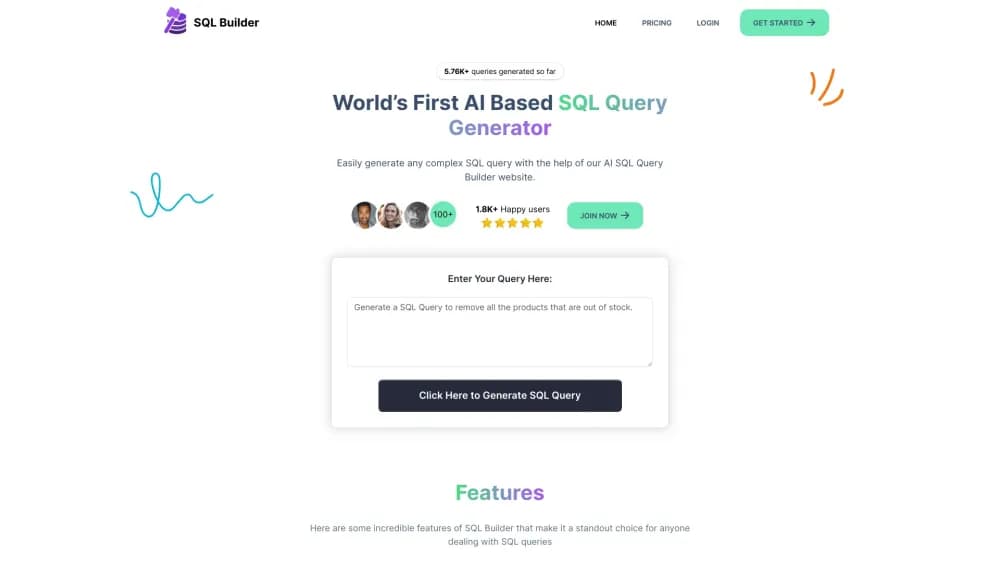
SQLBuilder.ai started as an AI SQL query builder that turned plain English into working queries. The domain now leads to NeverBlink, an AI database monitoring service.
About SQLBuilder.ai
What Is SQLBuilder.ai
SQLBuilder.ai is best understood in two parts. The name belongs to an AI SQL query builder that let people describe a query in plain English and get SQL back. That shortcut saved typing for analysts who already knew what they wanted. Search for a text to SQL tool today and the name still carries that association.
The site no longer sells that product. Typing sqlbuilder.ai into a browser lands on NeverBlink, a database reliability and AI database optimization platform built by the same team. It watches production clusters around the clock, finds the query, schema or configuration change behind a slowdown, and tells engineers what to fix first.
The scope is narrower than a general observability suite. NeverBlink works one engine at a time, with checks written for how Elasticsearch, OpenSearch, ClickHouse and PostgreSQL actually behave. Teams on MySQL or SQL Server are out of scope for now.
Getting Started
- Create an account on the NeverBlink site. The first cluster costs nothing and no credit card is required.
- Create a read-only monitoring user on the database you want to watch.
- Run the lightweight collector inside your own environment, on Kubernetes, Docker, ECS, Nomad or a plain VM.
- Paste the ingest key and wait for the first health assessment, which usually lands the same day.
- Point alerts at Slack, email, PagerDuty or your own tooling through the REST API and MCP server.
Product Information
A quick look at SQLBuilder.ai's pricing, supported platforms, and performance.
Best for
The users, tasks, and scenarios where this tool fits best.
Users
- Backend and platform engineers who own a database on top of a full-time job
- Startups without a DBA
- Teams shipping code through AI agents
Tasks
- Tracking down a slow dashboard query
- Spotting AI-generated SQL that will hurt in production
- Cutting cloud database spend
Scenarios
- A cluster that pages someone every few weeks and nobody can explain it
- Elasticsearch or OpenSearch estates spread across teams
- A migration or version upgrade
Key features
Continuous Health Checks
The collector reads operational metrics, system tables and metadata on a schedule you set. Findings arrive as a prioritized list instead of a wall of charts, so a small team can act on the top item and leave the rest. Each report covers queries, merges, replication, schema and configuration for the engine in question.
Root-Cause Analysis With the Fix Attached
When an alert fires, the platform traces it back to the change or query shape responsible and prints the command that resolves it. Your engineers still apply the change, which keeps a human in the loop on production. The reasoning ships with the recommendation, so you can audit a suggestion before you trust it.
Query and Index Review
Slow queries get a profile view that shows which stage eats the time, and index mapping reviews catch the field types that quietly kill search performance. This is the part that replaces the old SQL query generator habit. Instead of writing the query for you, the tool shows why the query you have is expensive and what to change.
Detection of Sloppy Agent-Written SQL
More teams now let coding agents write to the database, and those agents produce queries that look fine and scan far too much. NeverBlink flags the query shapes, missing filters and index misuse that show up in agent traffic, then suggests a safer form.
MCP Server and REST API
The MCP server plugs into Claude Code, Cursor, Codex and any other MCP client, so an agent can ask what changed on a cluster and get evidence back. A REST API does the same for CI pipelines and internal tools. Call limits apply, with 10 calls a month on the Agentic plan and no cap on Premium.
Managed Service and Engine Coverage
Checks exist for Elasticsearch, OpenSearch, ClickHouse and PostgreSQL, including managed offerings such as Elastic Cloud, Amazon OpenSearch Service, ClickHouse Cloud and Amazon RDS. The team behind it has spent over 15 years running these systems in production, which is where the engine-specific rules come from.
Pros and cons
Pros
- Every recommendation arrives with its evidence and the exact command to run.
- The collector runs inside your network with a read-only user, and it never reads table rows.
- The first cluster is free, and pricing is per cluster, so a small estate can test it without a sales call.
- Higher plans add human engineers on top of the AI, which matters when an incident needs judgment.
Cons
- Engine coverage stops at Elasticsearch, OpenSearch, ClickHouse and PostgreSQL. A MySQL or SQL Server shop gets nothing.
- Nothing is applied automatically. If your team can't act on a recommendation, the finding sits there.
- Unlimited recommendations, full query analytics and the cost optimizer start at Premium, so the $29 plan shows only a slice.
- The MCP server allows 10 calls a month on Agentic, which is tight for a busy agent workflow.
Frequently asked questions
No. The domain now redirects to NeverBlink, a database monitoring and optimization platform. The old natural language to SQL tool is gone, and the current product watches production databases instead of writing queries for you.
Related content
Explore related tools, skills, and articles for SQLBuilder.ai.
SQLBuilder.ai Alternatives

Base Code
Base44 (Wix) · Coding · ProductivityBase Code is a shared cloud development environment from Base44. Teammates describe changes to an existing GitHub codebase in chat, preview them live and send them back as pull requests.

Google EmbeddingGemma 2
Google DeepMind · Writing · Image · CodingGoogle EmbeddingGemma 2 is a 740M-parameter open model that turns text, code, images, audio, and video frames into vectors in one 768-dimension space, running on phones and laptops.

GitGlow
GitGlow · Coding · ProductivityGitGlow is a local-first desktop Git client that lets independent developers review their own code and their AI agents' changes in one place before shipping.