

SQOR
SQOR Technologies Inc · Coding · Marketing
SQOR is an AI decision intelligence platform that reads your warehouse and SaaS apps, builds its own KPI layer against your ledger, and answers business questions in plain English.
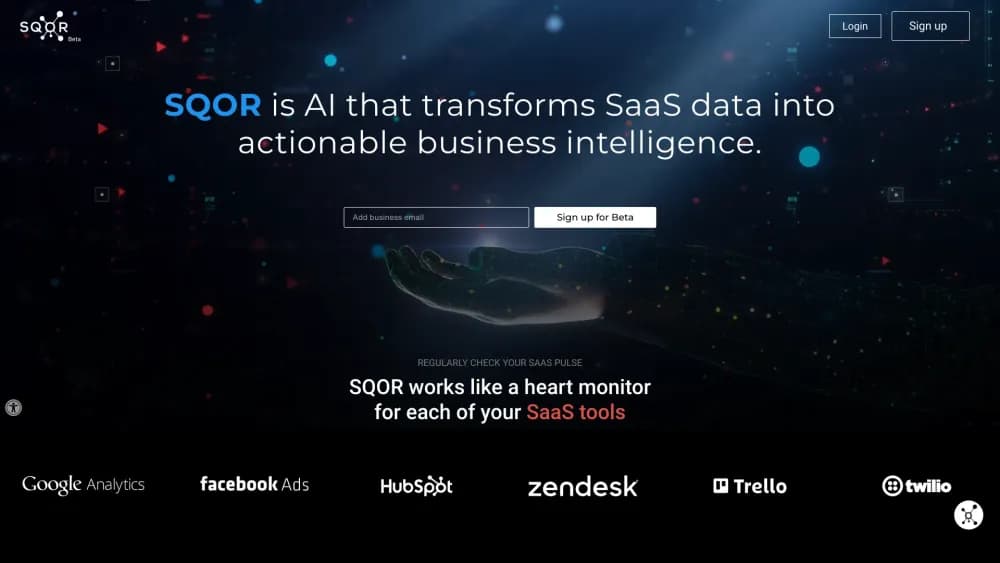
About SQOR
What Is SQOR
SQOR, usually written SQOR.ai, is a decision intelligence platform built around one claim: the time between a business question and a usable answer can drop from weeks to seconds. It connects to your data with read-only access, generates a measurement layer on top of what it finds, and returns figures that reconcile to your general ledger. The website says the product was named as a sample vendor in Gartner's 2026 Hype Cycle for Analytics and Business Intelligence under the Vibe Analytics category, a label SQOR also uses for the approach it sells.
The problem it targets is familiar to anyone who has waited on a reporting queue. A question goes to an analyst, the analyst models the data, builds a view, and comes back a week or two later with a chart that now needs explaining. SQOR removes the modeling and the dashboard build from that path. You type the question, and the platform computes the answer from data it has already read.
The limit worth knowing before you talk to sales: there is no self-serve signup and no public price list. Every plan says "talk to us," sales cycles run through a demo, and subscriptions are annual. The entry point is also a 25-user tier, which rules out a solo founder testing it on a side project.
Getting Started
- Book a demo through sqor.ai and go through the read, retention, and reconciliation questions with the team, especially if you have a security review to clear.
- Grant read-only access to the sources you want answered, usually your warehouse and a short list of SaaS applications. BigQuery, Snowflake, Databricks, Redshift, Azure Synapse, and a plain SQL estate are all supported.
- Confirm what your key figures should read. One person who knows the numbers well is enough for this stage, since the platform reconciles every metric against that reference.
- Ask questions in your own words and read the answers. Each one arrives with the figure, the drivers behind it, a forecast, and a ranked recommendation for what to do next.
- Expand coverage as gaps surface. Anything the platform can't bind comes back as a named list of what to connect next rather than as a wrong number.
Product Information
A quick look at SQOR's pricing, supported platforms, and performance.
Best for
The users, tasks, and scenarios where this tool fits best.
Users
- CFOs and finance leads
- CEOs and general managers
- Private equity and venture investors
- Senior operators
Tasks
- Explaining a variance
- Forecasting a quarter
- Chasing a rising cost line
- Cutting reporting overhead
Scenarios
- Quarterly board preparation
- Multi-location operations
- Post-acquisition integration
- Testing before committing
Key features
Query Volume Pricing with Unlimited Seats
Pricing is tied to the number of questions your organization asks, not to the number of people who need answers. Seats are unlimited on every plan, which changes who gets access. A regional manager can ask without adding a license, and a finance analyst can pull a figure without filing a ticket. The three tiers start at 135,000 queries per year for roughly 25 users and scale to 540,000 queries per year, extending to 2.7 million on enterprise agreements.
Automatic KPI Generation
SQOR's KPI spawner reads your data estate and builds the metrics your data actually supports, named from your own columns and anchored to your own ledger. There's no fixed catalog to fit into. A company with unusual revenue recognition or its own operating vocabulary is treated as normal, because nothing was precomputed against someone else's template. If your team already has calculation logic that works, the platform preserves and attributes it instead of replacing it.
Computed Numbers with LLM Explanation Only
The design splits two jobs that most AI analytics tools blur. Machine learning computes every figure and reconciles it to your source. A language model only puts that result into plain words, and it never holds the number, so it can't invent one. That's the structural answer to hallucination, and the same split rules out drift: the same question returns the same figure tomorrow, because the governed answer is computed, reconciled, and stored.
Causal Analysis, Forecasting, and Ranked Actions
Twelve kinds of analysis run against every metric the platform generates, including causal analysis that ranks the drivers behind a move, impact and sensitivity analysis, trend and period analysis, and predictive modeling across 7, 30, and 90-day horizons. Each answer closes with a recommendation scored against the causal analysis behind it. For a CFO looking at a margin drop, the useful part isn't the chart. It's knowing which driver moved and what to do about it.
Continued Monitoring with Agent Layer
Hundreds of agents work on data that has already been computed, explaining movement, forecasting, generating and scoring recommended actions, and watching for anything that needs attention. It's the difference between a tool you query and a system that tells you when something changed. Nothing an agent produces can alter a figure, which keeps the audit trail intact.
Read-Only Connections and Traceable Figures
Every connection is read-only by design, not by setting, so the platform can't modify your systems or write to your books. Each figure traces to its source record, its calculation, and its logic, with the date it was computed. When a number can't be reconciled, SQOR withholds it and says so rather than serving something plausible. For auditors and security teams, that combination is the part that matters.
Pros and cons
Pros
- Unlimited seats on query-based pricing means the whole organization can ask questions without a license negotiation per team.
- The compute and explain split gives you numbers you can defend in an audit, with a source record and calculation behind every figure.
- Read-only access on every source keeps the security review short and leaves nothing to unwind if a pilot doesn't work out.
- Autonomous BI without a modeling project is the practical gain: the measurement layer gets generated from your data instead of hand-built by a data team.
- Warehouse support covers BigQuery, Snowflake, Databricks, Redshift, Azure Synapse, and plain SQL, and a warehouse is included if you don't have one.
- Portfolio-level monitoring maps companies with different charts of accounts onto one model, which is unusual for a tool in this category.
Cons
- There's no public pricing and no self-serve signup. You can't evaluate the cost without a sales conversation, and commitments are annual.
- The smallest plan assumes around 25 users, so a small team or a single department pays for capacity it may never use.
- Coverage depends on data quality. Messy tables produce a gap list rather than answers, and closing those gaps takes internal work.
- Answers are only as good as the ledger you reconcile against. If your books are behind or your definitions are unsettled, so are the metrics.
Frequently asked questions
SQOR answers business questions from your own data. You ask in plain language and get a figure reconciled to your ledger, plus the drivers behind it, a forecast, and a ranked recommendation. It replaces the modeling, dashboard building, and analyst time that normally sit between a question and its answer.
Related content
Explore related tools, skills, and articles for SQOR.
SQOR Alternatives

Base Code
Base44 (Wix) · Coding · ProductivityBase Code is a shared cloud development environment from Base44. Teammates describe changes to an existing GitHub codebase in chat, preview them live and send them back as pull requests.

Google EmbeddingGemma 2
Google DeepMind · Writing · Image · CodingGoogle EmbeddingGemma 2 is a 740M-parameter open model that turns text, code, images, audio, and video frames into vectors in one 768-dimension space, running on phones and laptops.

GitGlow
GitGlow · Coding · ProductivityGitGlow is a local-first desktop Git client that lets independent developers review their own code and their AI agents' changes in one place before shipping.