

StartupBolt
StartupBolt · Coding
StartupBolt is a Next.js SaaS boilerplate that hands technical founders payments, authentication, and database setup so they can launch in hours, not weeks.
About StartupBolt
What Is StartupBolt
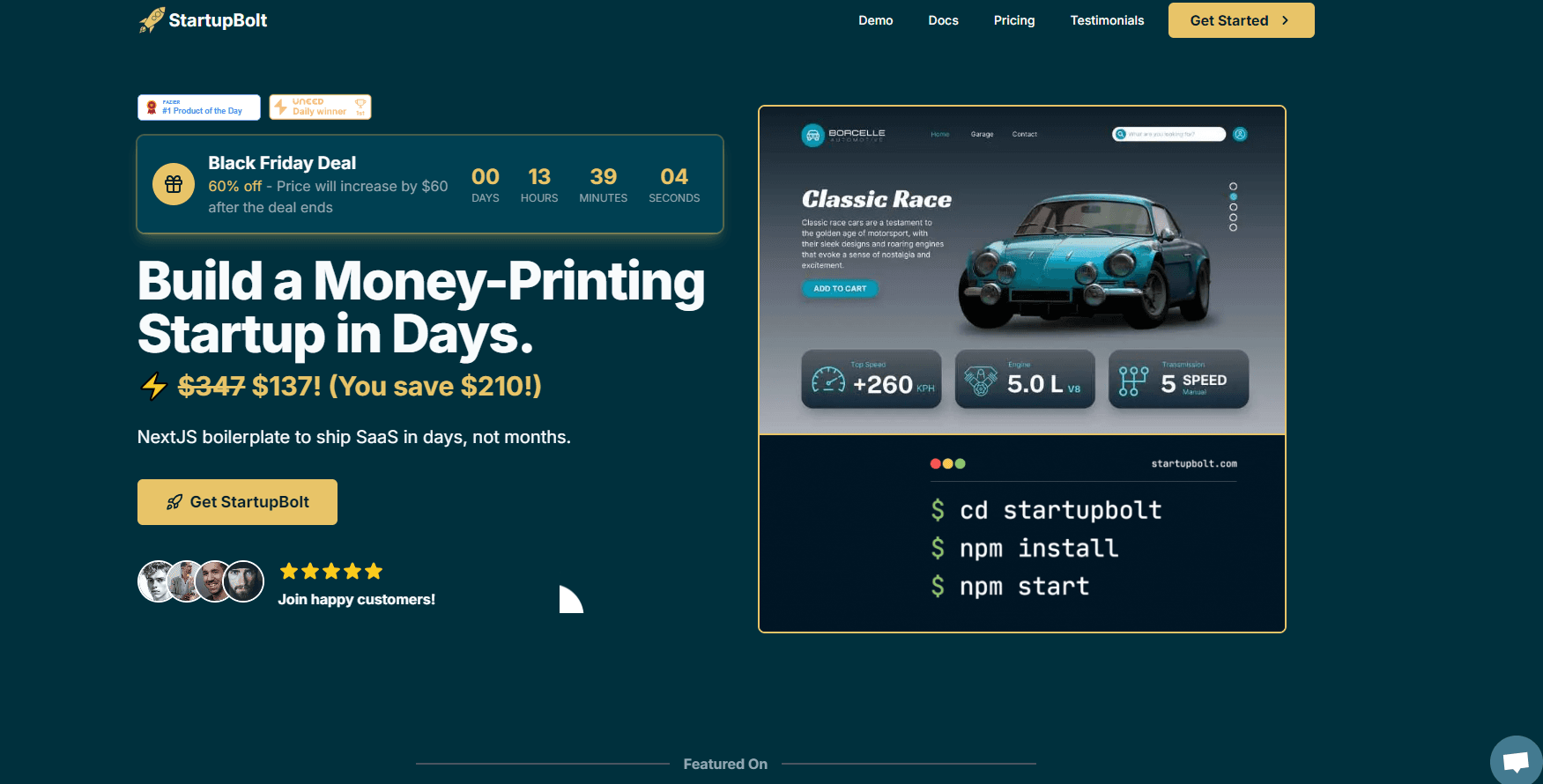
StartupBolt is a Next.js starter kit for building SaaS products and landing pages. Think of it as a Next.js boilerplate for founders who want to launch SaaS fast. It bundles the parts that usually eat weeks of a solo founder's time: payment integration, authentication, database setup, protected routes, theming, and SEO. The pitch is blunt and specific. Instead of wiring Stripe from scratch, you toggle a variable. Instead of building auth flows, you get magic links and social OAuth out of the box. That leaves the actual business logic as the only thing you have to write yourself.
The kit leans on server components, so the JavaScript bundle stays small and data fetching feels quick. It ships with shadcn for theming, which means reusable pieces like date pickers, sidebars, and pagination are already there. For anyone building AI apps, the credit-based access system stands out. You can tie usage to credits instead of a simple on/off paywall, which matters when a feature costs money every time someone uses it. So why does that matter for a SaaS starter kit? Because most kits gate features with a blunt yes or no, and usage-based products need something finer. Payments run through Stripe or LemonSqueezy, and you switch between them without rewriting code.
The limits are worth stating up front. StartupBolt is a starting point, not a finished product, and even though it removes the setup work that stalls most solo builds, the core features that actually make a product useful are still yours to design, write, test, and ship. The maker says so directly: once those are ready, launch can take around 30 minutes. It's built for people comfortable with Next.js. If you don't know the stack, the time savings shrink fast. And it won't guarantee sales. No boilerplate does.
Getting Started
- Buy the one-time license and download the Next.js code from the official site.
- Run
npm installand connect your own database. - Set your environment variables, then pick Stripe or LemonSqueezy by flipping a toggle.
- Configure auth, theming, and the pages you want to protect.
- Build your business logic, then deploy in about ten minutes.
Product Information
A quick look at StartupBolt's pricing, supported platforms, and performance.
Best for
The users, tasks, and scenarios where this tool fits best.
Users
- Technical founders
- Solo developers and indie hackers
- Freelancers building client sites
Tasks
- Launching a SaaS MVP
- Building landing pages
- Metering AI usage
Scenarios
- Validation on a tight budget
- A project you've rebuilt too many times
- Moving off another kit
Key features
Ready-to-Use Next.js Code
You download a complete Next.js codebase and start building the moment the install finishes. Modules for common UI patterns are included, so you're not assembling a project structure from zero. The setup is designed around npm install and a short configuration pass.
Payment Integration with Stripe and LemonSqueezy
Payments are wired for both Stripe and LemonSqueezy. You choose a provider by toggling a variable rather than rewriting the integration, which cuts down on setup errors and makes switching providers cheap. You can also run payments without forcing a sign-in first, which removes a common reason people abandon checkout.
Credit-Based Access System
Most starter kits gate features with a simple on/off check. StartupBolt lets you tie access to credits instead, which fits AI apps and any service where each use has a real cost. If you're building an image generator or an LLM tool, this gives you a way to charge by usage without building the metering yourself.
Authentication with Magic Links and Social OAuth
Login is handled through magic links and social sign-in, so you don't maintain your own password system. Protected pages and API routes come built in, which means you can keep private areas private without inventing your own guard logic.
Theming and Dark Mode with shadcn
The design system uses shadcn, giving you reusable components like date pickers, sidebars, and pagination. Tailwind CSS handles styling and color schemes, and dark mode works with a single toggle. For founders without a designer, this skips a lot of guesswork.
Built-in Documentation Generator
A documentation system is built into the kit rather than bolted on later. You can create and maintain project docs inside the same codebase, which helps when a project grows past a weekend prototype.
Marketing and Analytics Integrations
The kit includes setup guides for Meta Ads, X Ads, Google Analytics, and Microsoft Clarity. Clarity records user sessions, so you can watch what people actually do on your site instead of guessing from a dashboard alone.
Pros and cons
Pros
- Saves weeks of setup by handling payments, auth, database, and SEO out of the box.
- One-time payment with lifetime updates, so there's no monthly subscription to carry.
- Server components keep the bundle small, which helps page speed and data fetching.
- Switching between Stripe and LemonSqueezy takes a toggle, not a rewrite.
- Credit-based access system supports AI and usage-based pricing models directly.
Cons
- It's a starting point, not a finished product. You still build all your core features yourself.
- No free plan, so you pay before you can try it in your stack.
- It assumes you already know Next.js. Beginners gain far less from it.
- Buyer reviews on the site are self-published. There's no independent benchmark to verify launch-speed claims.
Frequently asked questions
It's a Next.js boilerplate for building SaaS products and landing pages, and it also works as a general SaaS starter kit for teams that keep rebuilding the same foundation. It packages the setup work (payments, authentication, database, protected routes, theming, SEO) so you can start with those already working and focus on your product's own features.
Related content
Explore related tools, skills, and articles for StartupBolt.
StartupBolt Alternatives

Base Code
Base44 (Wix) · Coding · ProductivityBase Code is a shared cloud development environment from Base44. Teammates describe changes to an existing GitHub codebase in chat, preview them live and send them back as pull requests.

Google EmbeddingGemma 2
Google DeepMind · Writing · Image · CodingGoogle EmbeddingGemma 2 is a 740M-parameter open model that turns text, code, images, audio, and video frames into vectors in one 768-dimension space, running on phones and laptops.

GitGlow
GitGlow · Coding · ProductivityGitGlow is a local-first desktop Git client that lets independent developers review their own code and their AI agents' changes in one place before shipping.