

StepFun
StepFun · Other · China AI
Step 3.5 Flash is an open-source foundation model from StepFun, built as a sparse Mixture of Experts (MoE) system that activates only 11B of its 196B parameters for each token. That design keeps reasoning strong while pushing generation speed to 100–300 tokens per second. Who wants to wait on a slow model? Nobody. As an AI agent model, it fits coding assistants and long-context work where speed decides whether you actually use the tool.
About StepFun
What Is StepFun Step 3.5 Flash
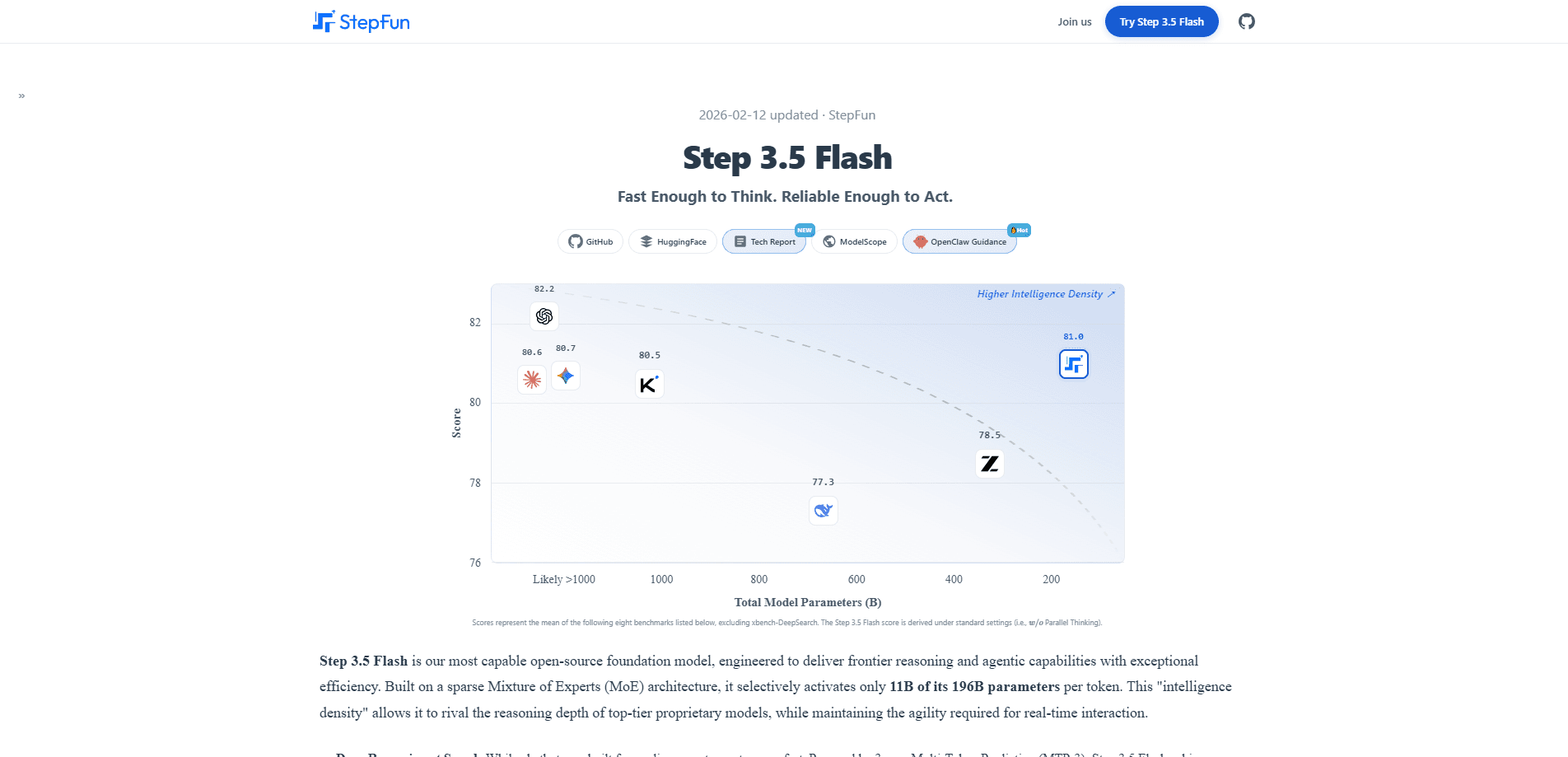
Step 3.5 Flash is a text-based AI model that StepFun released as open weights, so anyone can download the model files and run them locally or through a cloud API. As an open-source AI model, the draw is efficiency without a big drop in quality. Instead of firing all 196B parameters on every token, a routing layer picks the small slice of experts each token actually needs. StepFun calls this "intelligence density," and the numbers back the claim: an average score of 81.0 across eight benchmarks, ahead of several much larger models in the same comparison.
For people building agents, the practical parts matter more than the architecture slide. It handles a 256K context window, so it can hold a long codebase or a stack of documents in one pass. According to StepFun, it hits 74.4% on SWE-bench Verified and 51.0% on Terminal-Bench 2.0, which is the kind of result you want when a model has to plan across many steps and call tools without drifting.
The limits are worth stating plainly. The published benchmark numbers come from StepFun itself. Treat them as vendor claims until independent tests confirm them. It also has no built-in image understanding in this version, so anything visual has to be handled by a separate model. And while it runs on high-end consumer hardware, "high-end" is doing real work there: a Mac Studio M4 Max or an NVIDIA DGX Spark, not a typical laptop.
Getting Started
- Pick an access path. Use StepFun's hosted API for the quickest start, or pull the open weights from GitHub or ModelScope if you want to run it on your own machine.
- Get an API key from the StepFun platform console, then point your client at the OpenAI-compatible endpoint (base URL https://api.stepfun.com/v1) and set the model to step-3.5-flash.
- Send a first request through any OpenAI-style SDK, starting with a short prompt to confirm the connection works.
- For agent or coding work, wire the model into your tool loop and let it call functions or run code across multiple turns.
- Scale up. Raise the context window for long inputs, and move to local deployment if data privacy is a priority.
Product Information
A quick look at StepFun's pricing, supported platforms, and performance.
Best for
The users, tasks, and scenarios where this tool fits best.
Users
- Developers building agents
- Engineers with privacy needs
- Researchers and tinkerers
Tasks
- Agentic coding
- Long-context analysis
- High-throughput automation
Scenarios
- Running a coding agent overnight
- Analyzing a large document set
- Building a private assistant
Key features
Sparse MoE architecture with 11B active parameters
Step 3.5 Flash keeps a 196B parameter pool but only activates around 11B per token. Small slice, big model. The result is closer to the speed of a small model with much of the reasoning depth of a large one, which is exactly the trade-off agent workloads need.
High-speed generation with MTP-3
Using 3-way Multi-Token Prediction, the model generates 100–300 tokens per second in normal use, peaking near 350 tokens per second on single-stream coding tasks. For anyone waiting on long chains of reasoning, that speed is the difference between a tool you use and a tool you avoid.
256K context with hybrid attention
The model pairs sliding window attention with full attention at a 3:1 ratio, so most layers look at a local window while a few cover the whole sequence. This keeps performance steady across long inputs while cutting the compute that usually comes with a big context window.
Strong coding and agent benchmarks
According to StepFun, the model scores 74.4% on SWE-bench Verified and 51.0% on Terminal-Bench 2.0. Those are the tests that track whether a model can actually finish real engineering work, not just answer trivia.
Open weights and local deployment
The model files are open on GitHub and ModelScope, and it runs on hardware like the Mac Studio M4 Max, NVIDIA DGX Spark, and AMD AI Max+ 395. Running it yourself means your data stays local and you sidestep per-token fees entirely.
OpenAI-compatible API
StepFun's hosted endpoint speaks the OpenAI API format, so existing SDKs and clients work with a base URL swap. There's also a free tier on OpenRouter, which lets you test agent setups before committing to paid usage.
Pros and cons
Pros
- Fast generation (100–300 tok/s, up to 350 on coding) suits agents and interactive tools.
- The 256K context window handles large codebases and document sets in one request.
- Open weights let you run it locally and keep data private.
- Strong published results on coding and terminal benchmarks.
- OpenAI-compatible API keeps migration from other providers simple.
Cons
- Benchmark figures come from StepFun, so independent verification is still thin.
- Local deployment needs high-end hardware, not a standard laptop.
- No built-in image or multimodal understanding in this version.
Frequently asked questions
It's built for tasks that need fast reasoning and tool use, like coding agents, automated workflows, and long-context analysis. Its speed and context window make it a fit for pipelines where many requests run in sequence.
Related content
Explore related tools, skills, and articles for StepFun.
StepFun Alternatives
BinkBink
BinkBink · OtherBinkBink is a free online game platform and AI game maker that lets anyone turn a short text description into a playable browser game. You can jump into hundreds of community-made games. Or describe your own idea and play it in seconds, then share it with friends. Want to create your own game? You don't need to code. No engine setup, no download, no hassle.

Audiogen
Audiogen Inc. · OtherAudiogen is an AI music generator built by Audiogen Inc., a small research team that spent about 2.5 years training its own generative music model and designing a web interface around it. Instead of a plain text box, this AI music tool turns the timeline into a beginner-friendly Generative Audio Workstation, or GAW, where inpainting, extending, remixing and stem editing work more like painting on a canvas. The product is still in beta, so access runs through a waitlist or an invite. Paid plans aren't published yet.

Aiml API
AIMLAPI OÜ · OtherAiml API is a unified AI model API that puts more than 1000 models from OpenAI, Google, Anthropic, and others behind one endpoint and one bill. You write code against a single OpenAI-compatible schema, then switch between chat, image, video, and audio models by changing a model string. It suits developers and small teams who want multi-model access without juggling a dozen separate provider accounts, and it removes the usual billing headache that comes with testing several vendors. One key covers it all.