

Stish From Start to Finish
Stish · Other
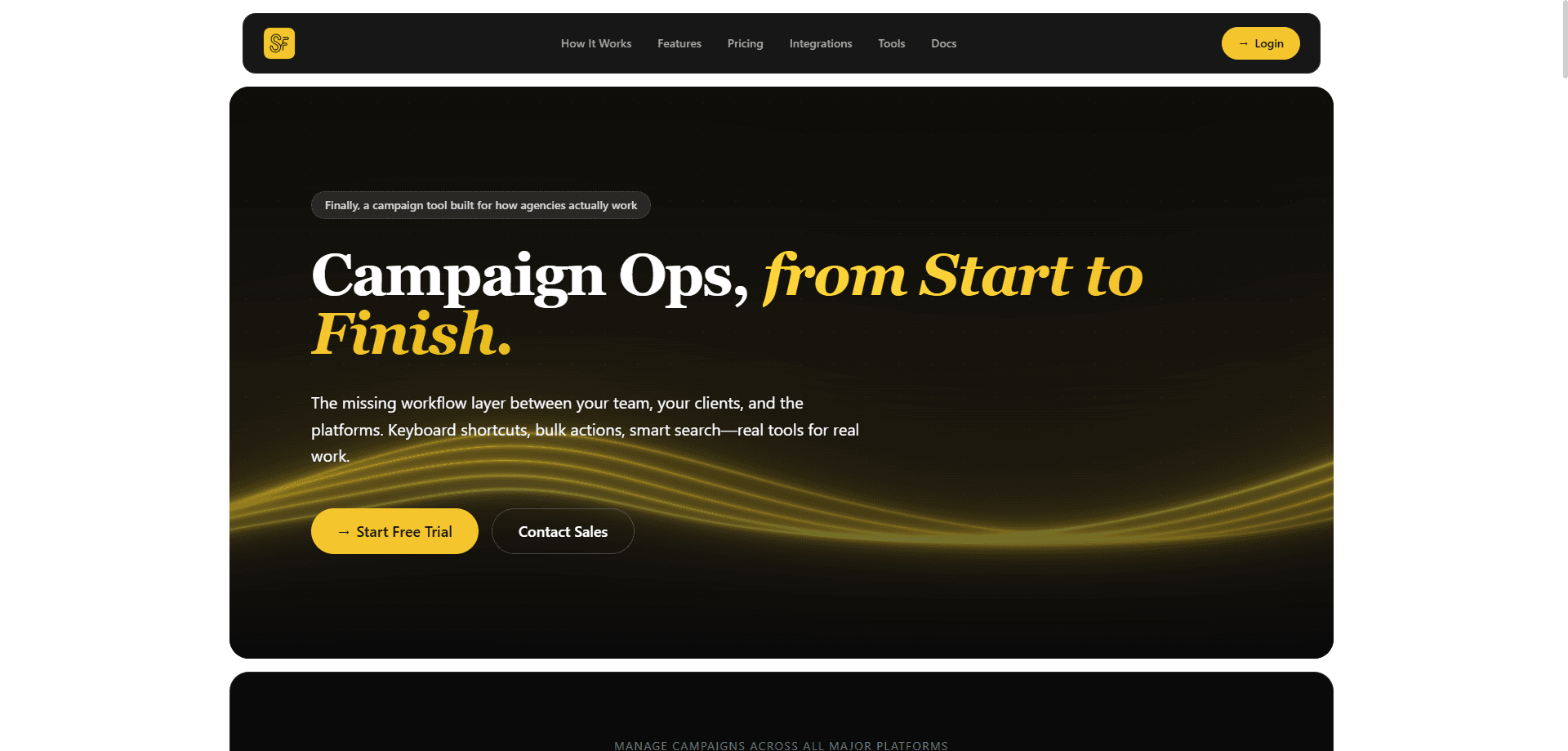
Stish From Start to Finish is a campaign operations platform for agencies that buy paid media. Its core piece is an AI advisor that reads 30 days of ad spend overnight and returns a morning audit of leaks, saturation signals, and budget that can be reclaimed. Around that sits an agency workspace with one project space per client, plus a conversational assistant you open with a keyboard shortcut. The company behind it runs an Athens performance agency, so the tool was built on daily use rather than a demo account.
About Stish From Start to Finish
What Is Stish From Start to Finish
Stish From Start to Finish is a paid media platform split into two halves. The first is the advisor, an automated review that connects to ad accounts through read-only OAuth and studies the last 30 days of spending. It surfaces specific findings: branded clicks leaking to competitors, search terms eating budget with no conversions, asset groups capped below their demand, retargeting frequency that has burned through a cold audience. Every line links back to the auction behind it. That trace matters a lot when you have to justify a change to a client.
The second half is the agency operations layer. Each client gets its own workspace with projects, tasks, notes, clients, specs, and integrations. The tool is keyboard-first, built for the three roles that touch every account. Performance managers, creative directors, account managers. A spec checker keeps creative work inside platform requirements before it ships, and asset status moves from Draft to In use without anyone losing track.
The biggest limit is scope. Google Ads was still pending platform verification at the time of writing, so depending on your setup you may be auditing Meta, LinkedIn, and TikTok accounts first. And the advisor hands findings to your team, not to the ad platform. It won't pause a campaign or rewrite a bid on its own. A human still decides what gets acted on. Treat it as a daily second opinion, not an autopilot.
Getting Started
- Create your account at stish.app and set up a workspace, which in practice means one per client so nothing gets mixed together across accounts.
- Connect ad accounts through read-only OAuth. Meta, LinkedIn, and TikTok connect in about five minutes each.
- Let the advisor run overnight on the last 30 days of spend, or open it manually once data is in.
- Read the morning audit: check each finding, its impact estimate, and whether it's a reclaim or a flag.
- Ship the change inside the ad platform yourself, then mark the finding resolved so the team can track it.
Product Information
A quick look at Stish From Start to Finish's pricing, supported platforms, and performance.
Best for
The users, tasks, and scenarios where this tool fits best.
Users
- Performance managers
- Media buyers
- Creative directors
- Account managers
Tasks
- Ad spend audits
- Campaign management
- Team handoffs
- Creative compliance
Scenarios
- Monday morning reviews
- Taking on a new client
- Scaling a small agency
Key features
AI Advisor Audits
The advisor reads the last 30 days of ad spend and returns a structured audit of six or so findings. Each one names the surface, describes the problem, and puts a monthly figure on it. A live example on the site shows a reclaim ceiling of €5,719 a month on a single retail account, and every finding is tied back to the auction that produced it so you can defend the number to a client without digging for evidence yourself. Findings are classified as reclaim or flagged, so you know which are money back and which are risk.
One Workspace Per Client
Every client gets a separate workspace with projects, tasks, notes, clients, and specs inside it. That structure keeps agency work from bleeding between accounts. It's a simple idea, and it fixes a real problem, because knowing which client a stray task or note belongs to shouldn't be guesswork.
Keyboard-First Interface
Stish is built to be driven from the keyboard. A single shortcut opens both the search and assistant surfaces from anywhere in the app. No menu diving. You aren't clicking through three screens just to find an account or ask a question.
Search and Assistant Surfaces
Two conversational tools share that shortcut. Search reads what's already in your workspace, answering questions about existing campaigns and notes. Assistant creates what isn't there yet, drafting or generating new material. Each assistant message costs one AI credit. Keep an eye on that.
Spec Compliance Checking
Creative work gets checked against platform requirements before it ships. That matters in an agency, because a rejected asset can burn a launch window you spent weeks planning around. The validator catches format and spec issues early, and asset status moves from Draft to In use with a visible trail.
Integrations and White-Label
The Growth plan adds Slack, Google Drive, Sheets, and Calendar. The Agency plan adds white-label branding, Asana sync, and API access. Those integrations matter most for shops that want client-facing output to look like their own product rather than a third-party tool wrapped around someone else's brand.
Pros and cons
Pros
- The advisor returns specific findings with a reclaim estimate, not a vague dashboard of metrics.
- Findings link back to the auction they came from, which makes client conversations easier.
- One workspace per client keeps projects, tasks, and specs together.
- Free Starter plan covers one ad account, so you can test before committing budget.
- White-label and API access on the Agency plan fit client-facing agency workflows.
Cons
- Google Ads was still pending platform verification at the time of writing, so you can't assume full Google coverage yet.
- The advisor doesn't act on its own. Someone still has to ship changes inside the ad platform, so it won't replace a media buyer.
- Assistant messages burn AI credits, and heavy conversational use on higher plans needs watching.
- Pricing sits in euros and scales by seats and ad accounts, so small shops pay for headroom they may not use.
Frequently asked questions
It's a marketing AI tool with two parts: an AI advisor that audits ad spend and flags waste, and an agency workspace that holds client projects, tasks, and specs. The audit runs overnight, and findings wait for your team in the morning.
Related content
Explore related tools, skills, and articles for Stish From Start to Finish.
Stish From Start to Finish Alternatives
BinkBink
BinkBink · OtherBinkBink is a free online game platform and AI game maker that lets anyone turn a short text description into a playable browser game. You can jump into hundreds of community-made games. Or describe your own idea and play it in seconds, then share it with friends. Want to create your own game? You don't need to code. No engine setup, no download, no hassle.

Audiogen
Audiogen Inc. · OtherAudiogen is an AI music generator built by Audiogen Inc., a small research team that spent about 2.5 years training its own generative music model and designing a web interface around it. Instead of a plain text box, this AI music tool turns the timeline into a beginner-friendly Generative Audio Workstation, or GAW, where inpainting, extending, remixing and stem editing work more like painting on a canvas. The product is still in beta, so access runs through a waitlist or an invite. Paid plans aren't published yet.

Aiml API
AIMLAPI OÜ · OtherAiml API is a unified AI model API that puts more than 1000 models from OpenAI, Google, Anthropic, and others behind one endpoint and one bill. You write code against a single OpenAI-compatible schema, then switch between chat, image, video, and audio models by changing a model string. It suits developers and small teams who want multi-model access without juggling a dozen separate provider accounts, and it removes the usual billing headache that comes with testing several vendors. One key covers it all.