

Strongest Layer
StrongestLayer · Writing · Marketing
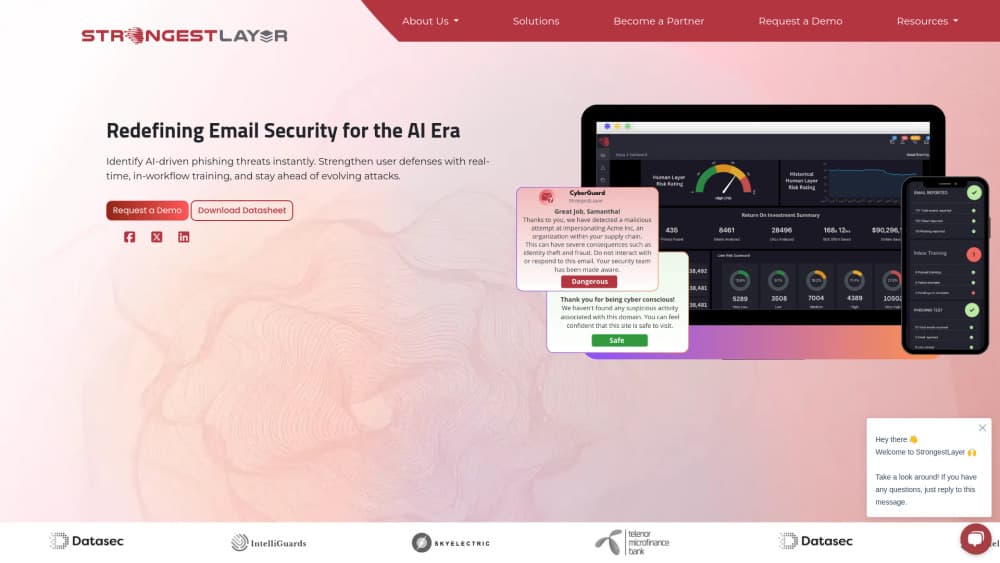
StrongestLayer is an AI-native email security platform that reads what each message is trying to do, then blocks phishing, business email compromise, and adversary-in-the-middle attacks that slip past gateways and spam filters.
About Strongest Layer
What Is StrongestLayer
StrongestLayer is an email security platform built around large language models instead of the signature and pattern matching that older filters rely on. The company launched in 2024, founded by Alan LeFort, Muhammad Rizwan, and Joshua Bass, three engineers and operators who previously worked at Proofpoint, FireEye, Mandiant, Google, McAfee, and Intel Security. It raised $9.3 million in total seed funding and came out of stealth mode in 2025.
The problem it targets is straightforward. Generative AI lets attackers write fresh, believable emails at scale, and each one looks clean to tools that only compare messages against threats they've seen before. StrongestLayer takes a different route: it reads every email with three reasoning models, works out the sender's intent, and checks that intent against how your company actually does business. A payment redirect dressed up as a routine invoice gets flagged because the vendor never used that bank and the domain is one letter off, not because it matched a known attack string.
The main limits are scope and access. The platform is made for organizations running Microsoft 365 or Google Workspace, so it won't help a team on a different mail stack. Pricing is quote-based and sold by mailbox count, which makes it a poor fit for anyone who wants a self-serve plan. It also runs alongside your existing gateway rather than replacing it on day one, so you keep paying for the gateway until you decide to retire it.
Getting Started
- An admin authorizes the platform through the Microsoft 365 admin center or Google Workspace, which connects it to mailboxes via the Graph API or Gmail API.
- The team picks a verdict mode for users, either an in-app panel in Outlook and Gmail or an email reply that leaves a persistent record per message.
- The reasoning engine goes live on the deployed mailboxes, and verdicts start appearing in the inbox, typically within minutes of setup.
- Analysts connect the SIEM, such as Microsoft Sentinel or Splunk, so detections and reasoning traces forward into the tools they already use.
- Most teams run a 14-day proof of concept on a slice of the environment before rolling out to every mailbox.
Note: This page reflects details published on the official StrongestLayer website as of late 2025.
Product Information
A quick look at Strongest Layer's pricing, supported platforms, and performance.
Best for
The users, tasks, and scenarios where this tool fits best.
Users
- Security teams on Microsoft 365
- Security teams on Google Workspace
- SOC analysts
- Everyday employees
Tasks
- Stopping AI-written phishing
- Catching business email compromise
- Clearing out alert backlogs
- Hunting a threat across the org
Scenarios
- A finance team gets a routine-looking invoice with updated banking details
- An employee wants to know if a DocuSign notice is real
- A vendor's reply thread is hijacked and a real contact suddenly asks to move a payment
- Leadership needs to know what a security control actually did
Key features
TRACE Reasoning Engine
TRACE runs three separate language models over each email. One builds the case that the message is legitimate, a second builds the case against it, and a third weighs sender history and infrastructure. The outcome is a verdict with the full reasoning trace attached, which is what lets an analyst defend the call later. Most competing tools run a single model, which is why they can't explain a decision as cleanly.
AI Email Security
The core detection layer reads every message across the gateway, inbox, and SOC. It targets AI-generated phishing that passes SPF, DKIM, and DMARC checks, which is where signature-based tools tend to fall down. The vendor reports a false positive rate under 1%, and the platform is designed to run alongside an existing secure email gateway rather than force a cutover.
Inbox Advisor
Inbox Advisor is an add-on inside Outlook and Gmail that gives users a verdict on any sender in seconds. It answers three plain questions: who the sender claims to be, whether the organization has dealt with them before, and whether their company is legitimate. Verdicts come with cited sources, so a user sees why a message is safe instead of being told to trust it. It's available on Microsoft AppSource.
Threat Triage
Every alert reaches the SOC with a MITRE ATT&CK mapping, a reasoning trace, and a recommended disposition already attached. Analysts make the call instead of investigating from scratch, and disputed verdicts arrive enriched with the detail a human would otherwise gather by hand. It forwards into Microsoft Sentinel, Splunk, and Radiant Security.
Threat Hunt
When one malicious email turns up, Threat Hunt sweeps the same indicators across every protected mailbox. Users can search by sender, subject, URL, transport header, or recipient, and scope the sweep by time window, group, or org unit. Any email file in .eml or .msg format can also be uploaded for an instant read.
Trust Management
Trust Management lets a team override the AI for specific use cases by building policy exceptions. Common ones ship as templates: exceptions for trusted vendors and partners, VIP and sender protections that flag executive impersonation, and content rules for legal, finance, and HR workflows. Protections stay on by default, and exceptions are added only when the business genuinely needs them.
SIEM and SOAR Integration
StrongestLayer forwards detections, verdicts, and reasoning traces to existing security tools instead of forcing analysts into a new console. It supports native integrations with Microsoft Sentinel, Splunk, and Radiant Security, and passes the reasoning trace as a structured log object rather than a text blob. Standard formats include CEF, LEEF, and JSON, with a webhook and REST API for custom work.
Pros and cons
Pros
- Reads the intent behind a message rather than matching it against known attacks, so it can catch threats with no prior signature.
- Deploys through the Graph API or Gmail API in about 15 minutes with no MX changes and no mail-flow disruption.
- Ships the full platform at every tier, so there's no module gating or hidden upgrade path.
- Reasoning traces and cited sources make verdicts defensible to leadership and auditors.
- Runs alongside an existing secure email gateway, so a team can test it before committing.
Cons
- Pricing is quote-based and sold by mailbox count, with no public self-serve plan, so small teams can't start without a sales call.
- Built only for Microsoft 365 and Google Workspace, which rules out organizations on other mail platforms.
- It works best as a layer on top of an existing gateway, so the full security stack costs more than either tool alone until you retire the older one.
- Some Inbox Advisor features, such as immediate quarantine on report, are listed as coming soon rather than available now.
Frequently asked questions
It reads every email an organization receives, works out what the message is trying to accomplish, and blocks the ones that are trying to deceive someone. It focuses on phishing, business email compromise, and adversary-in-the-middle attacks that pass through traditional gateways.
Related content
Explore related tools, skills, and articles for Strongest Layer.
Strongest Layer Alternatives

Google EmbeddingGemma 2
Google DeepMind · Writing · Image · CodingGoogle EmbeddingGemma 2 is a 740M-parameter open model that turns text, code, images, audio, and video frames into vectors in one 768-dimension space, running on phones and laptops.

MePersona
MePersona, Inc. · Writing · Productivity · MarketingMePersona is an AI unified inbox for creators. It learns your voice, drafts replies to fan messages from 12 platforms, and sends only what you approve.

Fluence
Yay Software (Yannick Huchard) · Writing · Voice & Language · ProductivityFluence is an Android app that reads PDFs, EPUBs, Word files and web articles aloud, follows each sentence as it speaks, and answers questions about the text on the phone itself.