

Substrate AI Inference Platform
Substrate Labs Inc. · Coding
Substrate AI Inference Platform ran multi-step AI programs as a single graph, with text, image, and speech nodes plus Python and TypeScript SDKs. The service is retired.
About Substrate AI Inference Platform
What Is Substrate AI Inference Platform
Substrate AI Inference Platform is an AI workflow API from Substrate Labs Inc., a New York company founded in 2023 by Rob Cheung and Ben Guo. Instead of wrapping one model behind one endpoint, it let developers describe an AI feature as a graph of small nodes: generate text, extract structured JSON, make an image, transcribe audio, embed a document, or run your own Python and JavaScript.
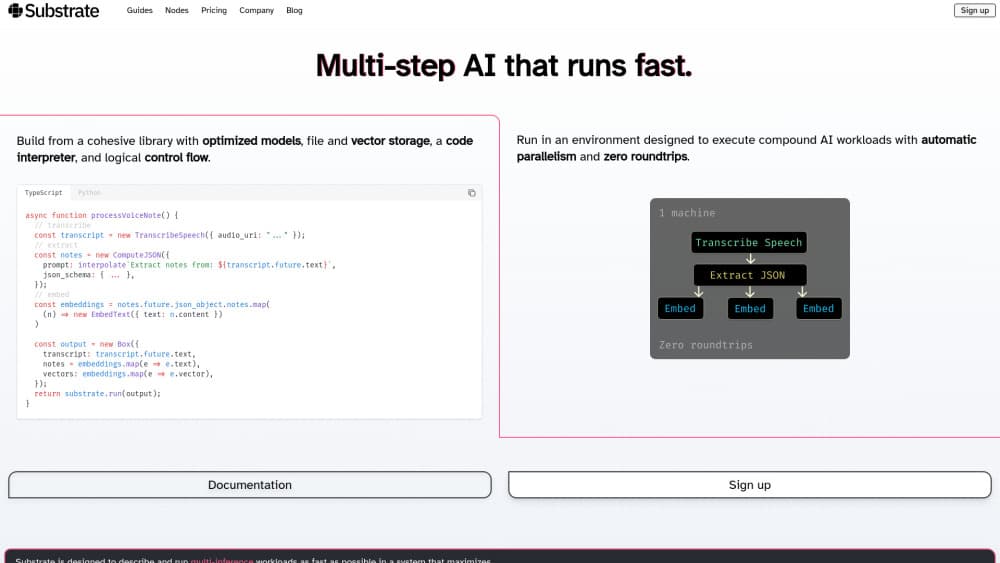
The problem it attacked was plumbing. Chaining model calls by hand means glue code between vendors, files uploaded twice, retries scattered across services, and a bill split across three dashboards. Substrate took a program written in its SDK, analyzed the graph, and scheduled the nodes for maximum parallelism and throughput. Every node in that graph was guaranteed to run in the same cluster, so intermediate data stayed close to the compute that needed it. That is the data locality claim in its own documentation.
The limitation is the status. By mid 2025 the company had moved its attention to Zo Computer, a personal cloud computer built by the same team, and substrate.run plus docs.substrate.run now redirect there. New API keys aren't issued, and an existing graph can't be exported to another platform as is. The ideas are still useful, which is why the page stays up.
Getting Started
This is the flow the platform used before it closed to new signups.
- Create an account at substrate.run and copy the API key from the dashboard.
- Install a client library:
pip install substratefor Python ornpm install substratefor TypeScript. - Describe the job as nodes, then pass one node's output into the next, for example text into a JSON extractor and then into an image prompt.
- Run the program and read the streamed events, or replay a saved run while you tune prompts.
Product Information
A quick look at Substrate AI Inference Platform's pricing, supported platforms, and performance.
Best for
The users, tasks, and scenarios where this tool fits best.
Users
- Developers who still maintain a Substrate integration
- Teams that chain several model calls in production
- Engineers learning model orchestration
Tasks
- Multi-step content pipelines
- Batch enrichment jobs
- Mixed-modality requests
Scenarios
- Auditing an old integration
- Choosing an orchestration design
- Researching the company's pivot
Key features
Graph-Based Program Execution
You defined a program as nodes with dependencies, not as a sequence of HTTP calls. Substrate read the whole graph first, then scheduled independent branches to run at the same time. On a job with three parallel text generations and one join step, that meant the join waited for the slowest branch instead of running everything one after another. This is what the product meant by multi-inference: one request, many model calls, one result.
Built-In Nodes for Text, JSON, Images, and Audio
The platform shipped ready-made nodes so you didn't have to host a model to get started. Text generation, JSON extraction that returns typed fields, image generation, speech transcription, and embeddings were all callable with the same client. A common pattern was to draft with a text node, force the output into a JSON schema, and store the result, all in a single run without moving data between providers.
Custom Compute Inside the Graph
Two nodes, one for Python and one for JavaScript, let a program run ordinary code next to the model calls. That covered the parts models are bad at: parsing a CSV, calling an internal endpoint, reshaping a payload. Because the code node ran in the same cluster as the model nodes, you could pass large intermediate objects between them without serializing them through your own server.
Same-Cluster Data Locality
Substrate promised that every node of a program executed in the same cluster. For users, the practical effect was fewer round trips and no egress bill for passing a transcript from the speech node into a text node. It also made latency more predictable on long chains, since each hop was a local call rather than a public internet request.
Python and TypeScript SDKs
The Python SDK and the TypeScript SDK were the main interface. Both let you build nodes as objects, chain them by passing one as the input to another, and inspect the run afterward. Ben Guo spent eight years on API and SDK design at Stripe, and it shows in the ergonomics: typed inputs, short method names, and a run object that holds every intermediate value for replay.
One Account, One Meter
Model calls, custom code, and storage of run results drew from a single usage bill. For a small team that was the difference between one invoice to reconcile and four, and it removed the need to pre-buy credits from each model vendor separately. Usage was metered per node, so you could see which step in a graph was eating the budget.
Pros and cons
Pros
- Graph-level parallelism meant a program with independent branches finished faster than the same logic written as sequential API calls.
- One SDK and one bill covered text, image, audio, and embeddings, which cut down integration work for small teams.
- Data locality kept intermediate payloads inside the cluster, so a long chain didn't pay egress or risk a public hop.
- The SDK design was unusually clean for an infrastructure product, with typed nodes and a replayable run object.
Cons
- The platform is closed to new users, so you can't test it or run a pilot today.
- Programs were written against a proprietary graph format with no export path, which means a migration is a rewrite, not a config change.
- The model catalog was narrower than what the big clouds offer, and there's no public roadmap to check what would have come next.
Frequently asked questions
It's an API from Substrate Labs for running AI programs made of connected nodes. You described the steps in Python or TypeScript, and the platform executed the graph with parallel branches and same-cluster data handling.
Related content
Explore related tools, skills, and articles for Substrate AI Inference Platform.
Substrate AI Inference Platform Alternatives

Base Code
Base44 (Wix) · Coding · ProductivityBase Code is a shared cloud development environment from Base44. Teammates describe changes to an existing GitHub codebase in chat, preview them live and send them back as pull requests.

Google EmbeddingGemma 2
Google DeepMind · Writing · Image · CodingGoogle EmbeddingGemma 2 is a 740M-parameter open model that turns text, code, images, audio, and video frames into vectors in one 768-dimension space, running on phones and laptops.

GitGlow
GitGlow · Coding · ProductivityGitGlow is a local-first desktop Git client that lets independent developers review their own code and their AI agents' changes in one place before shipping.