

Sudowrite
Sudowrite · Writing
Sudowrite is an AI writing app built for novelists and fiction authors. It drafts prose, expands scenes, and revises your work using Muse, a model tuned only for fiction.
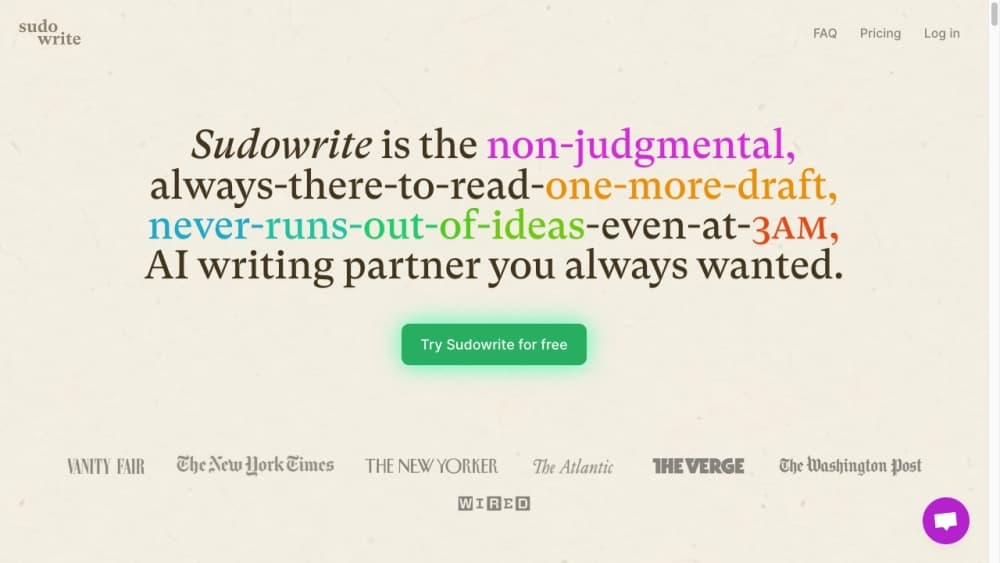
About Sudowrite
What Is Sudowrite
Sudowrite is a novel writing software built specifically for people who write fiction. Instead of a general chatbot that answers questions, it lives inside your manuscript and works on the page with you. You feed it your characters, setting, and plot, and it suggests the next paragraph in your voice, rewrites a clumsy line, or builds out a scene you sketched too thin.
The idea is that fiction has different needs than an email or a report. Most AI tools write clean, generic prose that reads like a press release. Sudowrite leans on Muse, its own model trained on licensed fiction rather than everything on the web, to produce text that sounds like storytelling.
Two things set the boundaries. The tool helps you write, but it doesn't write the book for you. You still decide what happens and what stays. And your draft is only as good as the details you give it, so a thin story bible leads to vague suggestions. Authors who treat it as a fast first-draft partner tend to get the most out of it.
Getting Started
- Sign up at sudowrite.com and start a project. There's a free trial with no credit card needed.
- Build a story bible. List your main characters, their traits, the tone, and the genre so the AI has context to work from.
- Write a short beat or outline the next scene, then use Write to generate the following prose. You can accept a suggestion, ask for options, or guide it with a note.
- Revise with Rewrite, Describe, and Expand. Improve a weak sentence, add sensory detail, or stretch a rushed scene to a fuller length.
- Run Feedback for notes, then keep editing. Sudowrite flags pacing, character, and prose issues so you know where to focus.
Product Information
A quick look at Sudowrite's pricing, supported platforms, and performance.
Best for
The users, tasks, and scenarios where this tool fits best.
Users
- Fiction authors
- NaNoWriMo and hobby writers
- Indie and self-publishing authors
- Screenwriters and series writers
Tasks
- Drafting the next scene
- Expanding a thin chapter
- Rewriting a clumsy line
- Adding sensory detail
- Getting early feedback
Scenarios
- Pushing through a stalled chapter
- Planning a book before drafting
- Keeping a series consistent
- Polishing a finished draft
Key features
Muse, an AI Model Built for Fiction
Muse is Sudowrite's own model, trained on a licensed fiction dataset with the authors' consent rather than on the open web. The company says it was built to avoid the clichés and flat prose that general models produce, and to handle chapter-length output instead of short snippets. It's the differentiator that separates Sudowrite from a generic text generator, and it's only available inside Sudowrite.
Write, Expand, and Rewrite
The three core drafting tools cover the main writing problems. Write reads your story context and suggests the next stretch of prose in your voice, with multiple options to pick from. Expand stretches a scene you summarized too quickly so the pacing doesn't feel rushed. Rewrite revises an existing line or paragraph and follows your instructions, so you can ask for a different mood or a cleaner sentence.
Story Bible
The Story Bible holds your characters, settings, tone, and plot in one place, and the AI draws on it with every suggestion. You fill it out step by step from idea to outline to chapter beats, and it keeps the details straight as the book grows. For anyone writing a series, it's the feature that stops a character's eye color from changing between books.
Describe and Brainstorm
Describe generates sensory prose so a scene reads like a place rather than a list of events. Brainstorm works as an idea partner for plot points, names, and twists, and it learns from the options you mark as favorites. Together they cover the two ends of a scene, the detail work and the what-happens-next work.
Feedback and Chat
Feedback reads your draft and returns five areas to improve, covering things like pacing, character depth, and prose clarity. Chat is a conversational assistant built with novelists in mind, so you can ask it about your story, talk through a plot problem, or get it to edit a passage. Both are aimed at authors who want notes on a draft without waiting on a human reader.
Plugins
Sudowrite ships a library of more than 1,000 plugins that add one-click tools for editing, feedback, and generation. You can simulate readers, talk to your characters, convert a novel to a screenplay, or build your own plugin by describing what it should do. It's a way to shape the app around a specific genre or workflow instead of living with the default set.
Pros and cons
Pros
- Muse produces fiction-flavored prose that needs less cleanup than general-purpose models, which saves editing time on a long draft.
- The toolkit covers the whole path from brainstorming to revision, so you don't juggle a separate outlining app and a separate editor.
- Pricing scales with how much you write, and the entry plan is cheap enough to test without a big commitment.
- Sudowrite states it doesn't train on your writing and doesn't claim rights over what you create, which matters for authors who worry about ownership.
- The plugin library and story bible make it practical for long projects and series, not just short experiments.
Cons
- It's built for fiction. If you write business copy, articles, or technical docs, a general assistant fits better.
- The AI drafts, it doesn't finish. Every suggestion needs review and rewriting before it reads like your own work.
- Output quality depends on your story bible. A vague setup returns generic prose, so the upfront work is real.
- Some features may fall back to English when the model isn't sure, which can be awkward for authors writing in other languages.
Frequently asked questions
Sudowrite is used to write and revise fiction. Authors use this AI writing tool for fiction to draft scenes, expand thin chapters, rewrite lines, add sensory detail, and get feedback on a manuscript, all within an app built around novels and short stories.
Related content
Explore related tools, skills, and articles for Sudowrite.
Sudowrite Alternatives

Google EmbeddingGemma 2
Google DeepMind · Writing · Image · CodingGoogle EmbeddingGemma 2 is a 740M-parameter open model that turns text, code, images, audio, and video frames into vectors in one 768-dimension space, running on phones and laptops.

MePersona
MePersona, Inc. · Writing · Productivity · MarketingMePersona is an AI unified inbox for creators. It learns your voice, drafts replies to fan messages from 12 platforms, and sends only what you approve.

Fluence
Yay Software (Yannick Huchard) · Writing · Voice & Language · ProductivityFluence is an Android app that reads PDFs, EPUBs, Word files and web articles aloud, follows each sentence as it speaks, and answers questions about the text on the phone itself.