

Supabase
Supabase Inc. · Coding
Supabase is an open-source Postgres backend platform for developers who need a database, auth, storage, and instant APIs without running servers.
About Supabase
What Is Supabase
Supabase is an open source backend platform built on PostgreSQL. It gives you a real Postgres database plus authentication, file storage, serverless functions, realtime sync, and auto-generated APIs, all connected in one project. If you've ever wired up a backend from scratch, you know the pain: separate services for logins, uploads, and database calls, each with its own bill and config. Supabase bundles those pieces so you start with a working backend instead of assembling one.
The pitch is closest to Firebase, except the data layer is plain Postgres. That matters for a few reasons. Postgres is a standard. You can move your data somewhere else whenever you want, so there's no lock-in. You can also connect with any Postgres client or ORM, including psql, Prisma, and Drizzle, using a normal connection string. And because it's open source, you can self-host the whole stack on your own machines if you'd rather not pay a cloud provider.
The tradeoff is that Supabase expects you to be comfortable with developer concepts. This isn't a no-code builder. You'll be writing SQL, managing schemas, and setting row-level security policies to keep data safe. Beginners can get a project running quickly, but the platform rewards people who already understand how databases and APIs work. It's a developer tool through and through. Think twice if that sounds like too much.
Getting Started
- Create a free account at supabase.com and start a new project. Pick a region close to your users and set a database password.
- Open the Table Editor to create tables visually, or write SQL in the SQL Editor to define your schema.
- Turn on Auth and choose your login methods, such as email and password, magic links, or social providers.
- Call the auto-generated REST or GraphQL APIs from your app using the project URL and anon key, and add row-level security policies before going live.
- Add Storage buckets, Edge Functions, or Realtime as your app grows. Unused products cost nothing.
Product Information
A quick look at Supabase's pricing, supported platforms, and performance.
Best for
The users, tasks, and scenarios where this tool fits best.
Users
- Indie developers and small teams
- Frontend and mobile developers
- Teams that want to avoid vendor lock-in
Tasks
- Building a web or mobile app backend
- Adding AI search to an app
- Real-time features like chat and live dashboards
Scenarios
- Weekend prototypes and MVPs
- Migrating off Firebase
- Regulated or privacy-sensitive projects
Key features
Postgres Database with Auto-Generated APIs
Every project is a dedicated Postgres database, and Supabase builds REST and GraphQL APIs from your schema automatically. You don't write CRUD endpoints by hand. You define tables, and the API appears, which is the main reason teams pick it over stitching together a database and a custom server.
Built-In Authentication
Supabase handles user signups, logins, and session management with email and password, phone OTP, magic links, and over 20 social providers. Access rules run through Postgres row-level security, so you control who can read or write each row at the database level. That keeps authorization logic in one place instead of scattered across your app code.
File Storage with a Global CDN
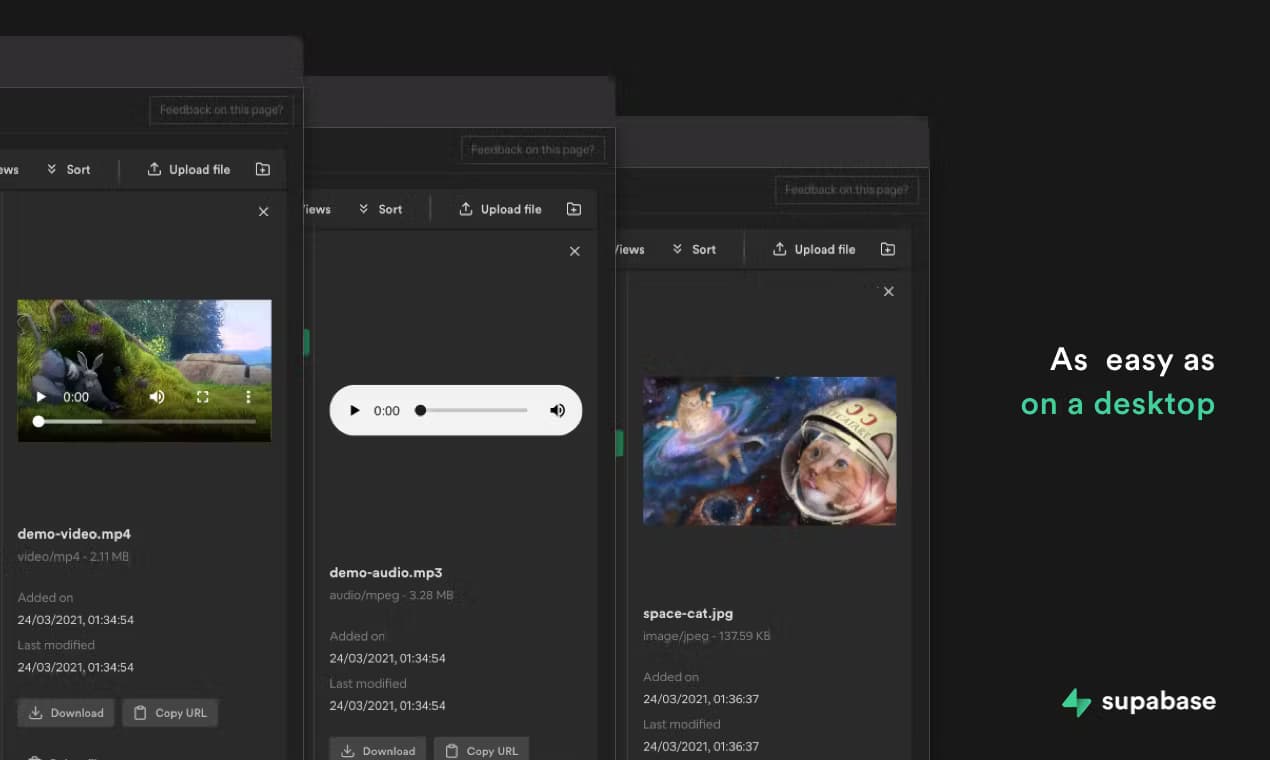
Storage is S3-compatible object storage served through a CDN that spans 285+ cities. Image transformations are built in. You get three bucket types, including a vector bucket for AI workloads. Uploads feel fast worldwide, and you don't have to bolt on a separate storage vendor.
Edge Functions
Edge Functions are globally distributed serverless functions written in TypeScript or Deno, with Node.js compatibility and access to 2M+ NPM modules. They run close to your users, so latency stays low. Use them for webhooks, payment integrations, or any custom logic your APIs don't cover.
Realtime Sync
Realtime taps into your database over WebSockets and powers three things: listening for row changes, showing who's online, and broadcasting arbitrary messages. Chat apps, live dashboards, and collaborative tools get their update layer for free. No separate pub/sub service to run. That's a real time saver.
Vector Database for AI Apps
Supabase ships pgvector, so you can store, index, and query vector embeddings right next to your transactional data. That means a semantic search or recommendation feature stays in the same database your app already uses, which is simpler than syncing a separate vector store.
Pros and cons
Pros
- Real Postgres underneath, so you can use standard clients, ORMs, and extensions and move your data later.
- Open source and self-hostable, which keeps you from being locked into one provider.
- Auth, storage, functions, and realtime work together in a single project. That cuts a lot of setup.
- Generous free tier with 500 MB database size and 50,000 monthly active users to prototype on.
- Auto-generated REST and GraphQL APIs save you from writing boilerplate endpoints.
Cons
- Free projects pause after a week of inactivity, so live demos or low-traffic apps can go offline.
- You need to write SQL and set row-level security policies, which can trip up beginners.
- Pricing adds up across compute and usage beyond plan quotas, so costs take some tracking.
Frequently asked questions
Supabase is a backend platform for web and mobile apps. It provides a Postgres database plus authentication, storage, serverless functions, realtime updates, and auto-generated APIs, so developers can launch an app without building those services themselves.
Related content
Explore related tools, skills, and articles for Supabase.
Supabase Alternatives

Base Code
Base44 (Wix) · Coding · ProductivityBase Code is a shared cloud development environment from Base44. Teammates describe changes to an existing GitHub codebase in chat, preview them live and send them back as pull requests.

Google EmbeddingGemma 2
Google DeepMind · Writing · Image · CodingGoogle EmbeddingGemma 2 is a 740M-parameter open model that turns text, code, images, audio, and video frames into vectors in one 768-dimension space, running on phones and laptops.

GitGlow
GitGlow · Coding · ProductivityGitGlow is a local-first desktop Git client that lets independent developers review their own code and their AI agents' changes in one place before shipping.