

Supavec
Supavec · Coding · Leaning
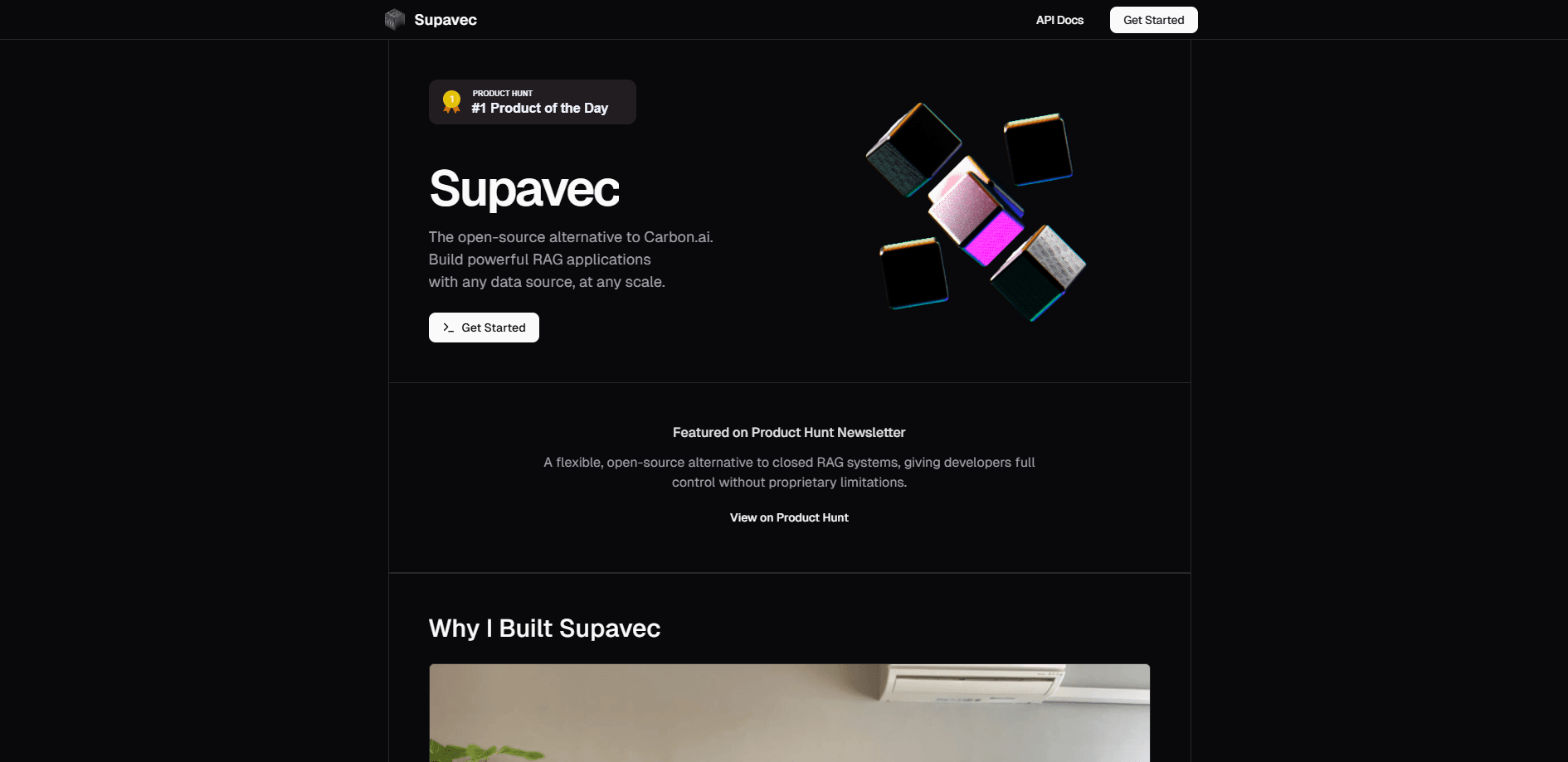
Supavec is an open source RAG-as-a-Service platform that turns your documents into an AI-ready knowledge base, so any app can answer questions with your own data.
About Supavec
What Is Supavec
Supavec is an open source platform for retrieval-augmented generation, or RAG. It handles the parts of a document AI app that are tedious to build yourself: uploading files, splitting them into chunks, creating embeddings, storing vectors, and searching them when a question arrives. You send your documents through an API, then query them from any app or chatbot.
The team built it after Carbon AI shut down and left its users without a home. Supavec positions itself as the open source alternative, keeping the code public so developers can run, inspect, or self-host the stack if they want. It's built on proven pieces, mainly Supabase with pgvector and OpenAI embeddings.
The main limit is that Supavec is aimed at developers rather than end users. There's a dashboard, but real work happens through HTTP endpoints and API keys. Anyone who wants a chat window with file uploads and no code will find the platform thinner than a finished consumer product, and the open source project is smaller than older RAG toolkits, so community templates are fewer.
Getting Started
- Sign up at supavec.com and create a workspace. The free plan needs no credit card.
- Generate an API key from the dashboard and store it somewhere safe.
- Upload your files or raw text through the upload endpoints. Supavec handles parsing, chunking, and embedding.
- Run a search request with a query and the file IDs you want it to read, then feed the matching passages into your model.
- Call the chat endpoint with a query and stream the answer back, or wire the search results into your own app.
Product Information
A quick look at Supavec's pricing, supported platforms, and performance.
Best for
The users, tasks, and scenarios where this tool fits best.
Users
- Developers building document AI
- Startups that need RAG fast
- Teams that want open code
Tasks
- Building a support bot
- Querying internal documents
- Adding document awareness to an existing app
Scenarios
- Standing up a knowledge base without running infrastructure
- Migrating off a shutting-down RAG vendor
- Prototyping before a full build
Key features
Open source RAG stack
Supavec publishes its code for anyone to read, run, or self-host. It leans on Supabase with pgvector for storage and search and OpenAI for embeddings, so the underlying pieces are familiar to most developers. The open license matters most when a vendor shuts down, since the code survives even if the hosted service doesn't.
Document upload and indexing
You send files or raw text to the API and Supavec handles the rest: parsing the content, splitting it into chunks, and generating embeddings. All supported file types work the same way, so you don't write separate handling for each format. A resync and overwrite option keeps a document current when the source changes rather than forcing a fresh upload.
Search and retrieval endpoints
A search request takes a query plus the file IDs you want it to use and returns the most relevant chunks. This is the core move in RAG: instead of relying on what a model memorized in training, you pull the exact passages that match a question. The results can be dropped into your own prompt or passed to the chat endpoint.
Chat with your documents
Supavec includes a chat endpoint that answers a question using your uploaded files. You choose streaming or a standard JSON response per request, which lets a chat interface show tokens as they arrive or wait for a single block. It's the fastest route to a working "ask my documents" feature without building the retrieval layer yourself.
Hosted infrastructure and simple API
The platform runs the storage and search for you, so there's no database to provision or vector index to tune. Everything goes through HTTP endpoints with an API key, and errors come back in a consistent shape. That keeps the integration small, even for teams that have never built a RAG pipeline before.
Usage-based tiers from free to enterprise
Pricing scales with API calls: 100 a month on the free plan, 750 on Basic, and 5,000 on Enterprise. Each step up adds a higher request rate and better support, and the enterprise tier adds team access with multiple API keys and dedicated infrastructure. A free plan with no card makes it easy to start before paying.
Pros and cons
Pros
- Open source code: the full stack is public and can be self-hosted, so the project survives even if the hosted service ever stops.
- Fast setup: a workspace, an API key, and a couple of endpoints get you from documents to answers in minutes.
- Managed infrastructure: chunking, embeddings, and vector search run as a service, so there's no database to maintain.
- Clear pricing: three tiers tied to monthly API calls make the cost predictable as usage grows.
- Free starting point: 100 monthly calls with no credit card let you test real documents before upgrading.
Cons
- Developer-focused: the product lives behind HTTP endpoints and API keys, so non-technical users won't get far without help.
- Rate limits on lower tiers: the free plan caps at 5 requests per minute and Basic at 15, which slows anything running at volume.
- Smaller community: as a newer project, it has fewer tutorials, examples, and integrations than long-running RAG frameworks.
- Chat quality depends on your model: Supavec retrieves the right passages, but the answer is only as good as the model you connect to it.
Frequently asked questions
Supavec is used to turn your own documents into a searchable knowledge base that an AI app can query. It handles uploading, chunking, embedding, and retrieval so you can answer questions with your data instead of general model knowledge.
Related content
Explore related tools, skills, and articles for Supavec.
Supavec Alternatives

Base Code
Base44 (Wix) · Coding · ProductivityBase Code is a shared cloud development environment from Base44. Teammates describe changes to an existing GitHub codebase in chat, preview them live and send them back as pull requests.

Google EmbeddingGemma 2
Google DeepMind · Writing · Image · CodingGoogle EmbeddingGemma 2 is a 740M-parameter open model that turns text, code, images, audio, and video frames into vectors in one 768-dimension space, running on phones and laptops.

GitGlow
GitGlow · Coding · ProductivityGitGlow is a local-first desktop Git client that lets independent developers review their own code and their AI agents' changes in one place before shipping.