

superlog
Superlog · Coding
Superlog is an OpenTelemetry-based observability platform built for engineering teams that want their monitoring to keep up with code changes on its own. It auto-instruments your code, keeps dashboards and alerts from drifting out of sync, and can investigate incidents and open fix pull requests through an agent. It's aimed at teams that already run OpenTelemetry and don't want to babysit dashboards every time a service ships.
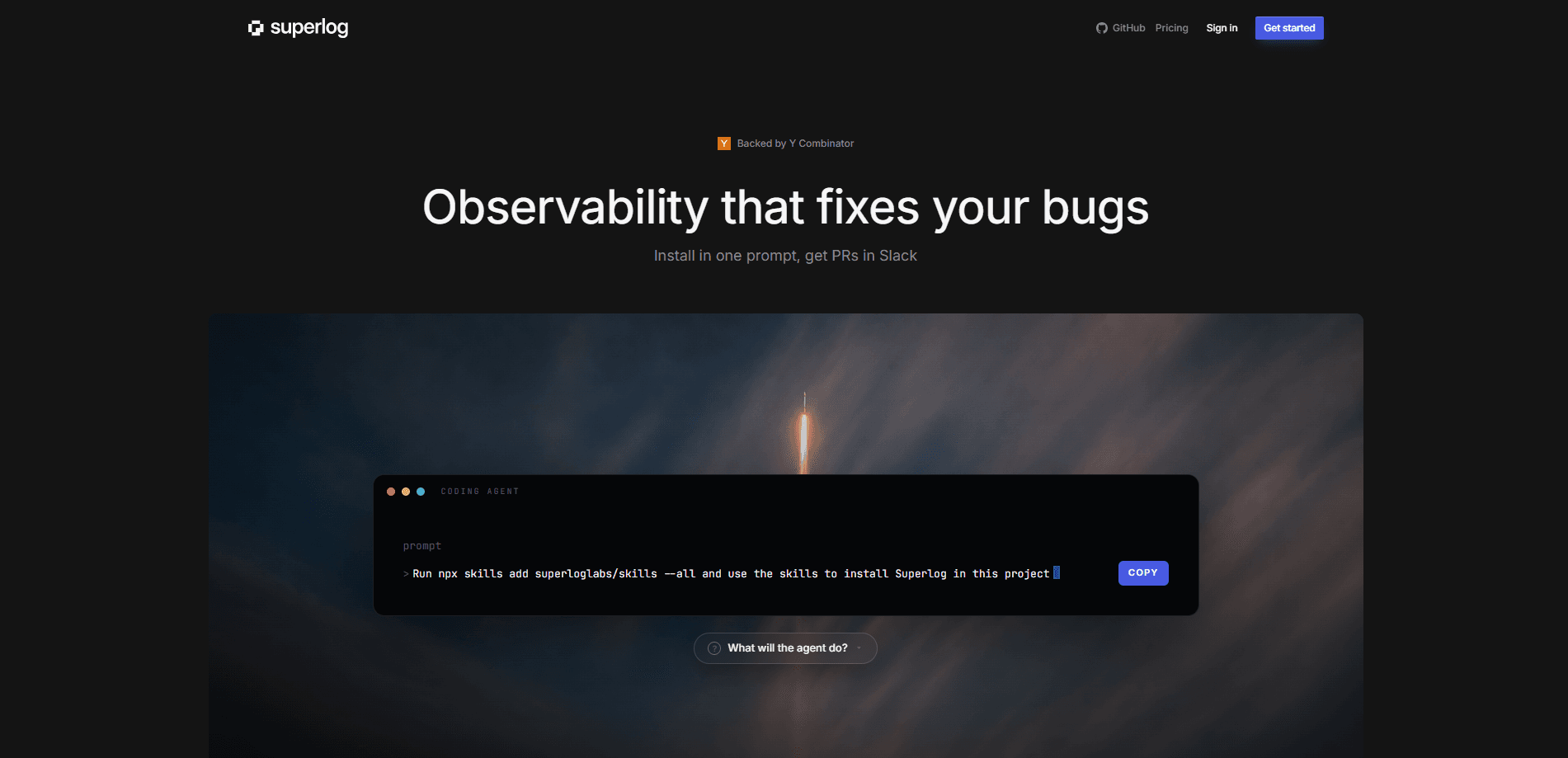
About superlog
What Is Superlog
Superlog is an observability product for teams running cloud software. Instead of asking you to hand-wire every metric, log, and trace across dozens of services, it instruments your code automatically and builds the observability dashboards and alerts from what it finds, so setup runs once and stays useful. That's the pitch.
The problem it targets is drift. Dashboards go stale. Alerts fire on services that no longer exist, and someone has to spend a Friday afternoon cleaning up after every deploy because nobody else wanted to own that chore. Superlog does root cause analysis with help from an agent, so the first pass of an investigation isn't left to a tired human. It leans on OpenTelemetry, the open standard for telemetry data, so the signals it collects aren't locked to one vendor. According to the company, that agent also handles part of the incident work itself: it investigates what broke, works out why, and can ship a fix as a pull request for your team to review.
The main limitation to know up front is scope. This is tooling for people who ship and run software, not a general analytics product. If your team doesn't already run cloud services or have anywhere to review pull requests, most of it won't apply to you. There's also less independent testing and review out there than you'd find for older monitoring incumbents. So it pays to kick the tires yourself before you commit a whole on-call rotation to it.
Getting Started
- Create an account on the Superlog site and connect the repository or environment you want to observe.
- Let the auto-instrumentation hook into your code so traces, metrics, and logs start flowing through OpenTelemetry.
- Review the dashboards and alerts Superlog generates, and trim anything your team doesn't care about.
- Point the incident agent at your services so it can investigate failures and draft fix pull requests.
- Wire notifications into your existing channels so alerts reach the people on call.
Product Information
A quick look at superlog's pricing, supported platforms, and performance.
Best for
The users, tasks, and scenarios where this tool fits best.
Users
- Backend and platform engineers
- SRE and on-call teams
- Small engineering teams
Tasks
- Auto-instrumenting services
- Keeping dashboards fresh
- Investigating incidents
Scenarios
- A service ships a change and a dashboard silently breaks
- An on-call engineer gets paged at 2 a.m.
- A team adopts OpenTelemetry
Key features
OpenTelemetry-based Instrumentation
Superlog builds on OpenTelemetry, the vendor-neutral standard for collecting traces, metrics, and logs. That means the data model stays portable. If you later move to another backend, you're not starting from zero. It also means the signals line up with what the rest of the open-source tooling expects.
Automatic Code Instrumentation
Rather than asking you to sprinkle instrumentation calls through every service, Superlog auto-instruments your code. New services get covered without a manual pass. That matters most for teams shipping often. You spend less time wiring telemetry and more time reading it.
Drift-resistant Dashboards and Alerts
The common failure mode for monitoring is that it ages badly. Dashboards point at retired services. Alerts fire for metrics that no longer exist, and nobody trusts the graphs anymore. Superlog keeps dashboards and alerts tied to your current code, so they stay accurate as things change. That's the whole point of an AI observability platform.
Agent-driven Incident Investigation
An agent investigates incidents for you instead of leaving the first 30 minutes to a tired human. It works through what failed and assembles the relevant signals. From there it can draft a fix and open a pull request. A human still reviews and merges it.
Pull Request Fixes
When the agent finds a likely fix, it ships it as a pull request rather than pushing straight to production. Your normal review process stays intact, so nothing bypasses the checks you already trust. The value is a head start, not an autopilot that merges on its own.
Unified Traces, Metrics, and Logs
Superlog keeps the three core telemetry signals in one place, so you're not stitching together separate tools to understand a single request. What does that buy you in practice? Correlation across traces, metrics, and logs, which is exactly what makes debugging a slow endpoint possible without guesswork and back-and-forth between dashboards that never quite agree with each other.
Pros and cons
Pros
- Built on OpenTelemetry, so telemetry data stays portable and isn't locked to one vendor.
- Auto-instrumentation cuts the manual work of wiring traces, metrics, and logs.
- Drift protection keeps dashboards and alerts matching what's actually deployed.
- The agent gives on-call engineers a starting point on incidents instead of a blank page.
- Fix pull requests slot into existing review workflows rather than bypassing them.
Cons
- Aimed at teams already running cloud services and OpenTelemetry, so it isn't useful outside that context.
- Less independent testing and user review is available than for established monitoring vendors.
- The agent's fix pull requests still need human review, so they don't remove the on-call burden entirely.
- Pricing details are thin on the public site, which makes budgeting harder before you talk to sales.
Frequently asked questions
It auto-instruments your code with OpenTelemetry, builds dashboards and alerts that stay current, and runs an agent that investigates incidents and can open fix pull requests. Short version: less babysitting.
Related content
Explore related tools, skills, and articles for superlog.
superlog Alternatives
Forefront
Forefront · CodingForefront is a web platform for building with open-source AI. It lets you fine-tune leading open-source language models on your own data, evaluate how they perform, and run them through an API or export them to host yourself. Developers who want the convenience of a closed-source platform but insist on owning their models and data are the target audience here.

Startkit
StartKit.AI · CodingStartkit is a boilerplate for building AI SaaS and AI wrapper products. Think of it as an AI startup boilerplate with the boring parts already wired up: authentication, Stripe and Lemon Squeezy payments, usage limits, transactional email, and an AI API starter that talks to OpenAI, Anthropic, Groq, or Llama. You clone the repo, set your price, and start on the part of your product that people actually pay for. It's Next.js under React and Tailwind, so most of the boilerplate code already feels familiar.
Testim
Tricentis · CodingTestim is an AI-powered test automation platform for building and running end-to-end tests across web, mobile, and Salesforce applications. It leans on machine learning to keep tests stable when an interface changes, so teams spend less time fixing broken selectors. Not bad for an automated testing tool you can start using today. You create tests by recording actions in a browser, then optionally add JavaScript when you need more control. It's a solid pick for busy QA teams.