

Suprbox
Suprbox · Other
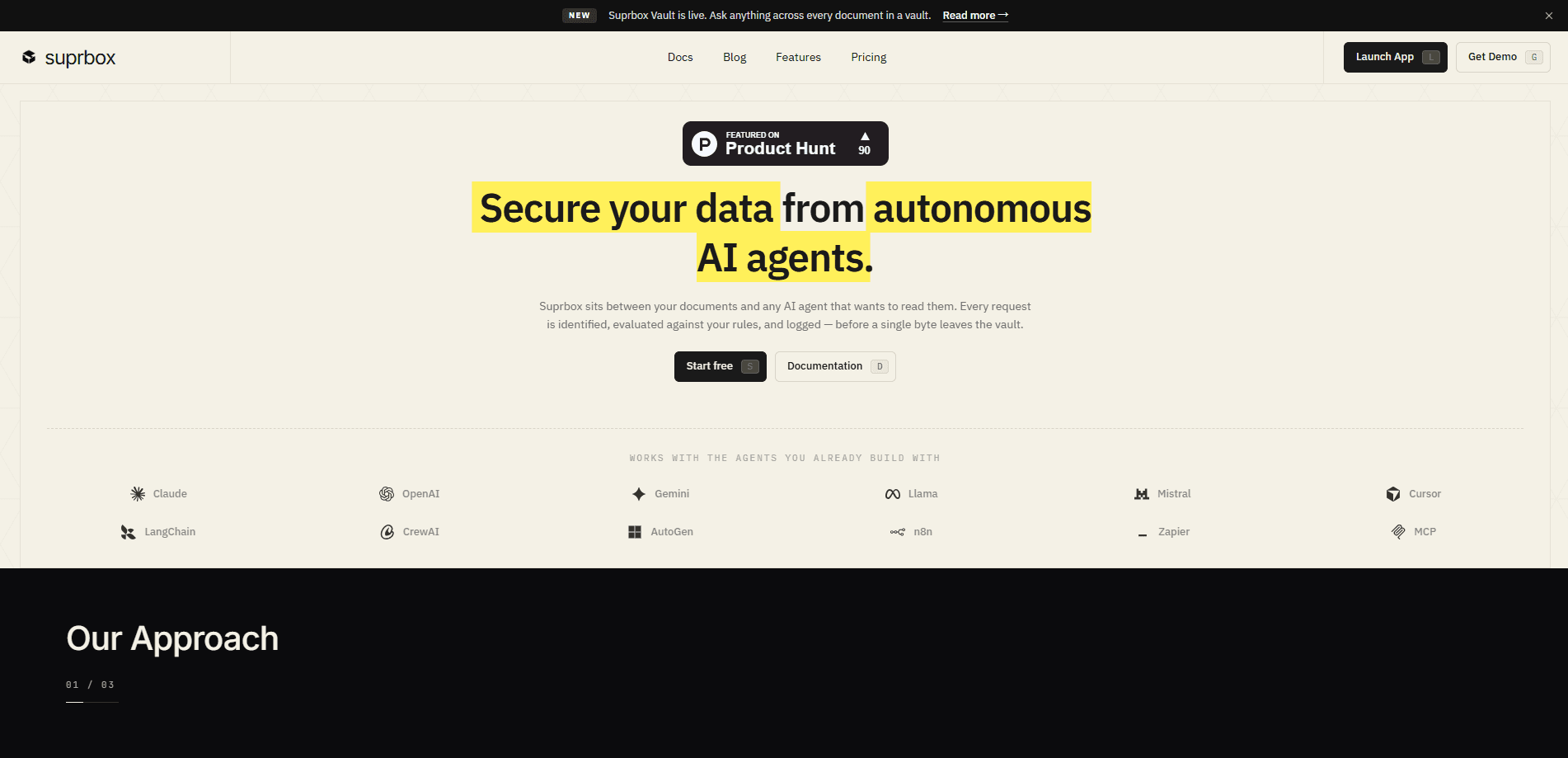
Suprbox is a secure document vault that sits between your files and any AI agent that wants to read them. You upload documents into vaults, attach rules to each vault, and hand every agent a scoped API key. Before a single byte leaves the vault, Suprbox authenticates the request, checks it against your policy, and records the outcome in an audit log. It's aimed at teams running autonomous agents over sensitive material like contracts, invoices, and patient records. If you've been searching for secure document storage for AI agents, this is a purpose-built answer.
About Suprbox
What Is Suprbox
Suprbox is a self-hostable gateway that describes itself as a policy-gated document vault for autonomous AI agents. It isn't a vector store, a memory layer, or a model runtime. It does one job: deciding what an agent can see when it asks for a file. Your existing storage stays in place, and Suprbox puts a single REST surface in front of it.
The problem it targets is specific. Agents are non-deterministic, so the same request can pass one run and fail the next. That gap is where leaks happen, and patching one edge case doesn't protect you from the next. Suprbox closes it by making every tool call flow through the same gate: authenticated by API key, evaluated against policy rules, and logged before delivery. That's the core of its AI agent access control model.
The main limit is scope. Suprbox governs access, not the agents themselves, and it assumes you're comfortable running or deploying a Next.js service with an SDK in your stack. If your team just needs cloud file storage with sharing links, this is more machinery than you need. What about teams without a Node engineer? They'll feel the setup cost most.
Getting Started
- Deploy Suprbox (self-hosted) or connect to a hosted instance, then sign in to the admin console.
- Create a vault and upload the documents the agent should be able to reach.
- Attach policy rules to the vault, such as classification tiers, PII detectors, or rate limits.
- Issue a scoped API key for each agent and paste it into your agent's SDK config.
- Install the suprbox-sdk client in your app and route document calls through it, then watch the audit log on the first live request.
Product Information
A quick look at Suprbox's pricing, supported platforms, and performance.
Best for
The users, tasks, and scenarios where this tool fits best.
Users
- Platform engineers wiring agents into production
- Security and compliance teams at small firms
- Builders handling sensitive documents
Tasks
- Gating agent reads on confidential files
- Redacting or masking data before it reaches a model
- Reviewing what agents did
- Wiring agents across frameworks
Scenarios
- A finance bot summarizing invoices
- A legal review agent reading contracts
- Regulated data workflows under GDPR
- Prototyping with unknown agents
Key features
Policy Rule Engine
Nine rule types cover the guardrails most teams need. When people talk about AI agent document security, this engine is usually the part they mean. You match a condition, such as sensitivity, content keywords, time window, rate, or scope, then enforce an action like allow, throttle, require approval, or deny. Rules stack per vault, so you shape exactly the policy you want without touching agent code.
Request-Time Authentication and Scope
Every call is tied to an API key and optionally a per-vault session lease. Suprbox resolves the vault scope through a step it calls vault scope resolution, checking identity before any tool dispatch happens. A request from an unknown agent doesn't get a chance to read anything.
Nine Policy Primitives
The rule set is built from primitives rather than fixed presets. Classification matches document sensitivity and labels, so confidential or regulated tiers stay sealed. Data detectors catch PII, secrets, and API keys inline. Content keywords fire on phrases like "merger talks" or "q3 forecast." Edit and delete rules control write, export, and destructive operations with optional approval.
Audit Log
Suprbox writes an audit row for every request whether it's allowed, throttled, or denied. For teams that need an audit log for AI agents, that record is what turns a vague "the agent read something" worry into a concrete trail you can actually hand to a reviewer.
Response Routing
Deliveries aren't all-or-nothing. Depending on policy, Suprbox returns metadata, an excerpt, full content, or original bytes, and it can redact, watermark, or hold a response. The agent gets an answer. Just not the whole thing. Only the version your rules permit.
Self-Hostable Deployment
Suprbox is a Next.js application you can run yourself, which matters if your documents can't leave your infrastructure. The SDK is a thin TypeScript client with no runtime dependencies, running anywhere fetch exists, including Node 18+ and edge runtimes. That's it. No vendor lock-in on the storage side.
Framework Coverage
The SDK plugs into the agents people already build with, from Claude and OpenAI to LangChain, CrewAI, AutoGen, n8n, Zapier, and MCP. You point each integration at Suprbox instead of your file system, and the gate sits in the middle. No rewrite needed.
Pros and cons
Pros
- Centralizes access control so agents hit one policy gate instead of many ad hoc checks.
- Self-hostable, so sensitive documents can stay inside your own infrastructure.
- Audit log records every request, giving security teams something concrete to review.
- Nine composable rule types cover PII detection, classification, rate limits, and approval flows.
- Framework-agnostic SDK fits Claude, OpenAI, LangChain, CrewAI, and MCP setups.
Cons
- It governs access only, so it won't stop an agent from acting badly through some other path. Your model and tool choices still matter.
- You need to run a Next.js service and manage deployment. Teams without Node experience will feel the setup cost.
- Pricing isn't published on the site, so you'll have to contact the vendor before you can budget for it.
Frequently asked questions
It's a gateway that sits between your documents and AI agents that want to read them. Every request is authenticated, checked against your vault rules, and logged before any data is returned.
Related content
Explore related tools, skills, and articles for Suprbox.
Suprbox Alternatives
BinkBink
BinkBink · OtherBinkBink is a free online game platform and AI game maker that lets anyone turn a short text description into a playable browser game. You can jump into hundreds of community-made games. Or describe your own idea and play it in seconds, then share it with friends. Want to create your own game? You don't need to code. No engine setup, no download, no hassle.

Audiogen
Audiogen Inc. · OtherAudiogen is an AI music generator built by Audiogen Inc., a small research team that spent about 2.5 years training its own generative music model and designing a web interface around it. Instead of a plain text box, this AI music tool turns the timeline into a beginner-friendly Generative Audio Workstation, or GAW, where inpainting, extending, remixing and stem editing work more like painting on a canvas. The product is still in beta, so access runs through a waitlist or an invite. Paid plans aren't published yet.

Aiml API
AIMLAPI OÜ · OtherAiml API is a unified AI model API that puts more than 1000 models from OpenAI, Google, Anthropic, and others behind one endpoint and one bill. You write code against a single OpenAI-compatible schema, then switch between chat, image, video, and audio models by changing a model string. It suits developers and small teams who want multi-model access without juggling a dozen separate provider accounts, and it removes the usual billing headache that comes with testing several vendors. One key covers it all.