

Surge AI
Surge AI · Coding · Business
Surge AI is a human data platform that builds expert-written training data, evaluations, and RL environments for frontier labs and enterprises. Public dataset pricing isn't listed.
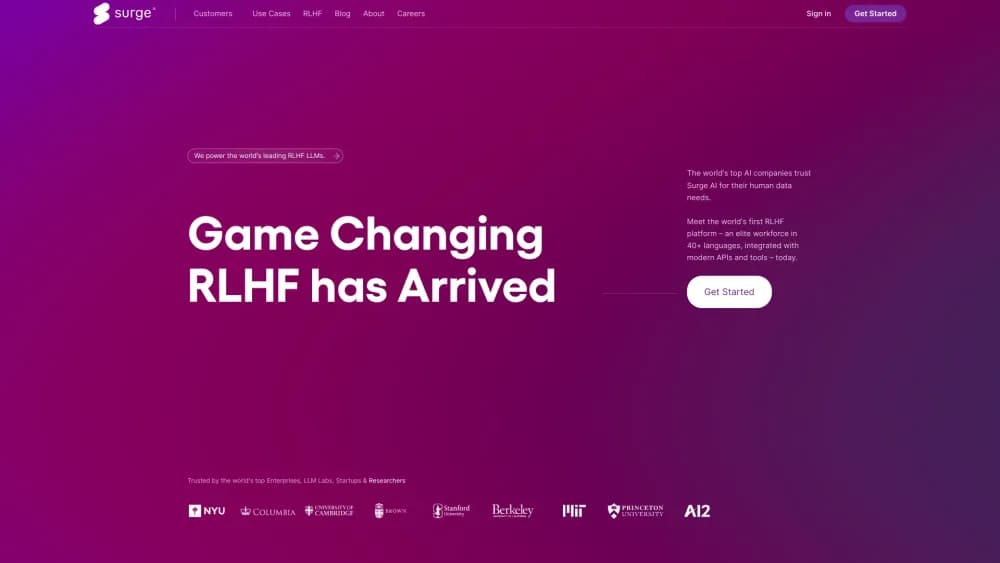
About Surge AI
What Is Surge AI
Surge AI sells the human judgment that models are trained on. A lab that wants a coding agent to think like a staff engineer, or a hospital group that wants an AI to handle insurance paperwork, brings the problem here and gets back tasks, expert demonstrations, rubrics, preference data, and scoring environments built to fix it. The company started in 2020 and spent its first years working quietly with frontier labs; founder Edwin Chen was among the people who pushed public benchmarks such as GSM8K, and he has since become one of the most visible figures in the data industry.
The workforce is the product. Surge draws on a network it describes as 200,000+ PhDs across more than 80 languages and 500 disciplines, plus working professionals in medicine, law, finance, and engineering. Annotator screening and project work run through the company's own platform, and the same infrastructure powers the Off-the-Shelf catalog that companies can buy without a custom run.
The limit is how it's bought. There's no self-serve checkout and no published rate card. You request access, describe the workflow you want to improve, and work with the team on scope. Off-the-Shelf datasets come with a Trusted Program option: train on the full set first, then pay if the metrics move. Small teams that just need a few thousand labels will find this heavier than a typical labeling tool.
Getting Started
- Bring the problem. Describe the workflow, the model you're using, and where it underperforms. Enterprise engagements usually start with an evaluation rather than a dataset order.
- Define what good looks like. Surge works with your technical team and subject-matter experts to pick tasks, failure modes, and scoring criteria before any data gets built.
- Get a pilot. The company says pilot tasks are turned around within a week, which is your first real look at quality and coverage.
- Choose the path. Take an Off-the-Shelf dataset, run a custom post-training program, or both. Custom programs can include supervised fine-tuning data, preference data, RL environments, and verifier design.
- Measure, then scale. Gains get checked against the benchmarks and workflows you care about, and the program expands from there.
Product Information
A quick look at Surge AI's pricing, supported platforms, and performance.
Best for
The users, tasks, and scenarios where this tool fits best.
Users
- Frontier AI labs and post-training teams
- Enterprise AI product teams
- Domain experts and consultants
- Data annotation vendors and resellers
Tasks
- Closing the gap between a good demo and a reliable agent
- Building a model evaluation you can trust
- Putting an agent to work inside real systems
- Adding coding or professional skills without full retraining
- Getting expert feedback on model output at volume
Scenarios
- A lab wants a coding agent that survives real repositories
- An enterprise agent is underperforming and nobody knows why
- A regulated company needs an AI system to meet internal standards
- A startup wants the data without the contract cycle
Key features
Expert Data Annotation at Scale
Surge's main asset is the people grading the output. The company counts 200,000+ PhDs on its network and lists working economists, litigators, NASA engineers, IMO medalists, and clinicians among its contributors. For high-stakes work, that matters more than headcount. A lawyer reading a contract catches errors a crowdworker scrolls past, and that difference shows up in the preference data a model learns from. Access is by discipline, so specialty domains take longer to staff than general ones. It is an expert data annotation service first and a data labeling platform second, which is the reverse of most crowd tools.
RL Environments and Verifiers
This is the part of the catalog aimed at agents. Surge builds multi-step environments with tools, internal systems, and MCP servers, then writes verifiers that score whether the agent actually finished the job. One published setup, a simulated customer-support company, trains models on realistic ticket work; another models corporate policy following across a hundred-page handbook. The value is failure that's cheap to produce: an agent can make the same mistake a thousand times inside a simulation before it touches a real system.
RLHF Data and Rubrics
Rubrics turn a subjective judgment into a score, and they're the engine behind most RLHF data Surge collects. In a preference task, a human picks the better of two answers; in a rubric-graded task, the same human breaks quality into weighted criteria. Surge designs grading schemes that break a response into weighted criteria, so a biography can earn points for tracing a subject's life faithfully and lose them for missing the mystery. That structure lets teams run evaluations at volume without a human rereading everything. It also handles the hard cases, where a pass or fail would hide the difference between competent and excellent.
Off-the-Shelf Frontier Data
The catalog sells the same data used in Surge's frontier work without a custom engagement. Categories cover coding agents, enterprise agents, multimodal reasoning, and expert reasoning, with named datasets such as GDP.pdf, Chartography, and ComplexConstraints inside them. Published results include Kimi K2.7 gaining 20 points on SWE-Marathon after training on the coding set. Trusted Program partners can train first and pay if it works, which lowers the risk of buying data before you've seen it move a number.
Human Evaluation and Benchmarks
Surge publishes its own leaderboards, graded by professionals rather than by another model. Antidote ranks everyday answers on long-term usefulness, Hemingway-bench scores writing on taste and emotional intelligence, and the DAYJOB series tests agents on finance and healthcare work. Riemann-bench draws advanced math problems from working mathematicians. These benchmarks give buyers a common reference point, and they double as a public argument for why expert graders beat automated scoring.
Multilingual and Multimodal Coverage
Surge operates in more than 70 languages, with linguists who design data around grammar, idiom, and local usage rather than translating English prompts. On the multimodal side, the work covers images, audio, video, documents, and interfaces. A legal summary in Korean or a news headline in Brazilian Portuguese gets written by someone who reads it natively, which matters when a model is deployed outside English-speaking markets.
Pros and cons
Pros
- Expert contributors in medicine, law, finance, and engineering give the data a credibility that crowd platforms can't match.
- Published training runs report measured gains on public benchmarks, so you can check the claims before buying.
- Off-the-shelf datasets remove the scoping phase for common use cases like coding agents and document reasoning.
- The Trusted Program lets labs train on a full dataset and pay only if the metrics move.
- Pilot tasks come back within a week, which is fast for enterprise procurement.
Cons
- No public pricing and no self-serve signup. You can't estimate cost without talking to sales.
- The offering is built for labs and large enterprises. A small team with a modest labeling budget will be poorly served.
- Custom programs mean weeks of scoping with your technical and subject-matter staff, not a same-day start.
- The benchmark and blog material leans promotional, so treat the headline point gains as vendor-reported until your own evaluation confirms them.
Frequently asked questions
Surge AI produces expert-written training data, evaluations, and reinforcement learning environments for AI models. Labs and enterprises use it to teach models the judgment and workflows that public internet data can't supply, then measure whether the model actually improved.
Related content
Explore related tools, skills, and articles for Surge AI.
Surge AI Alternatives

Base Code
Base44 (Wix) · Coding · ProductivityBase Code is a shared cloud development environment from Base44. Teammates describe changes to an existing GitHub codebase in chat, preview them live and send them back as pull requests.

Google EmbeddingGemma 2
Google DeepMind · Writing · Image · CodingGoogle EmbeddingGemma 2 is a 740M-parameter open model that turns text, code, images, audio, and video frames into vectors in one 768-dimension space, running on phones and laptops.

GitGlow
GitGlow · Coding · ProductivityGitGlow is a local-first desktop Git client that lets independent developers review their own code and their AI agents' changes in one place before shipping.