

SurrealDB
SurrealDB Ltd · Other
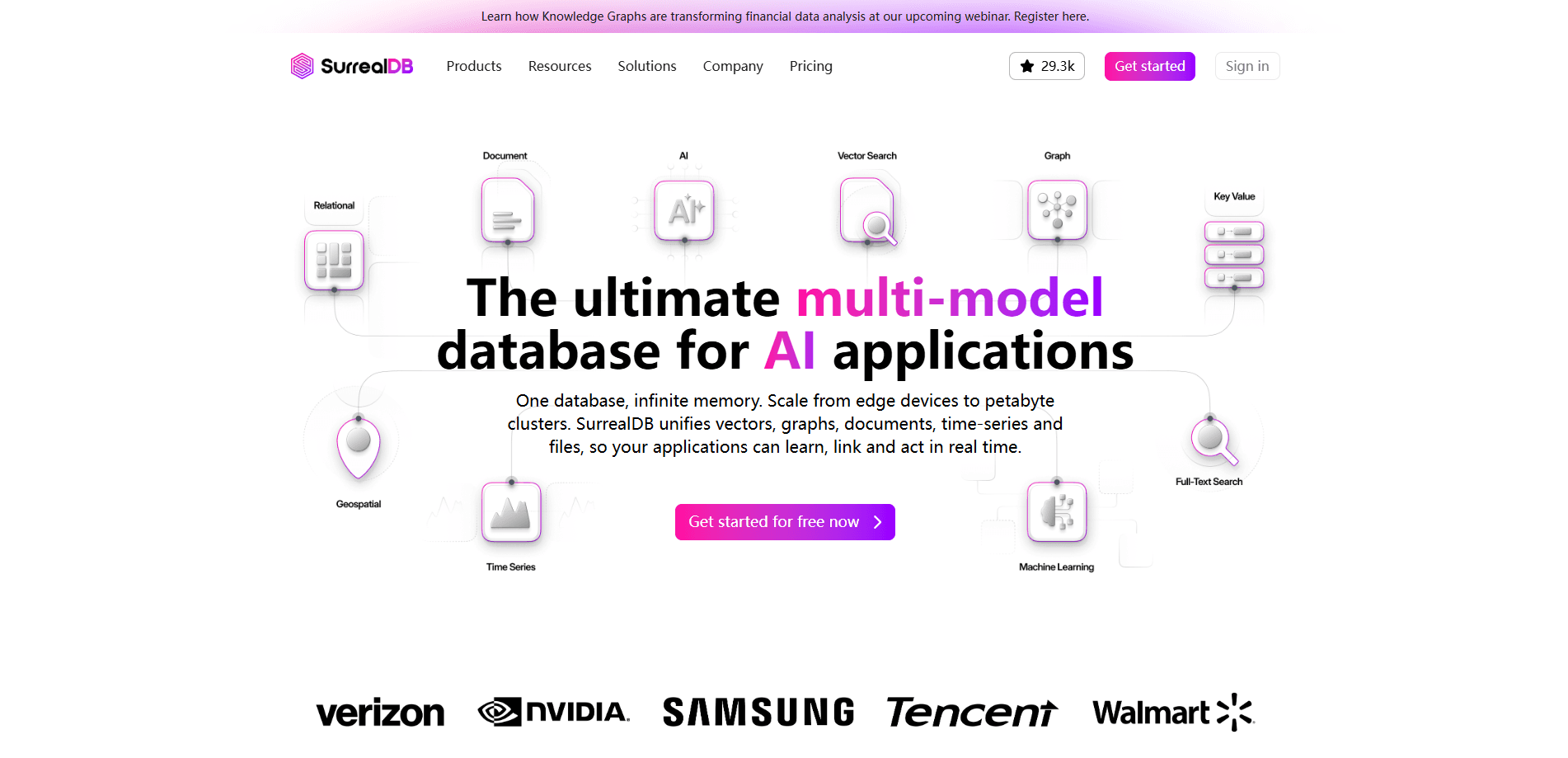
SurrealDB is a multi-model database that puts documents, graphs, vectors and relational data in one engine, queried through SurrealQL in a single ACID transaction.
About SurrealDB
What Is SurrealDB
SurrealDB is a database built by SurrealDB Ltd, a UK company founded in 2022. Its selling point is breadth: instead of running a relational store next to a document store next to a graph database, you keep one engine that handles all three, plus vectors and time-series data. Everything speaks one query language, SurrealQL, and every write lands in a single ACID transaction.
The appeal shows up when a project needs more than one data shape at once. A recommendation feature wants vectors for similarity and a graph to follow relationships. A social feed wants documents for posts and edges for follows. SurrealDB answers both in one statement, against one copy of the data, so there's nothing to sync between systems.
The limits matter too. It's a younger engine than PostgreSQL or MongoDB, so the hiring pool and the stack of battle-tested third-party tools are smaller. The licence (BSL 1.1) also blocks one specific use: running SurrealDB as a managed database service for third parties who create their own schemas. Self-hosting in production is allowed.
Getting Started
- Create a free SurrealDB Cloud account, or install the binary with
curl --proto '=https' --tlsv1.2 -sSf https://install.surrealdb.com | sh. - Start an instance for testing with
surreal start --user root --pass root memory, or deploy a cloud instance from the Studio. - Define a table and its fields in SurrealQL, using
DEFINE TABLEandDEFINE FIELD, then insert records withCREATE. - Query with
SELECT, follow edges with the arrow traversal syntax, or rank results by vector similarity withvector::similarity::cosine. - Connect your app through one of the official SDKs, or use Surrealist, the bundled query tool, to explore data visually.
Product Information
A quick look at SurrealDB's pricing, supported platforms, and performance.
Best for
The users, tasks, and scenarios where this tool fits best.
Users
- Backend developers
- AI engineers building agents
- Small product teams
Tasks
- Building GraphRAG retrieval
- Running real-time dashboards
- Modelling knowledge graphs
- Embedding a database in an app
Scenarios
- Prototyping a feature that mixes structured and unstructured data
- Consolidating a stack of databases
- Shipping an app that must work offline or at the edge
Key features
One engine, every data model
SurrealDB works as a document store, a graph database, a vector database and a relational database at once, and adds time-series storage on top. You query all of them together instead of running separate systems with glue code between them. This is the feature the rest of the product hangs on.
SurrealQL
SurrealQL blends SQL syntax with graph and vector operations. A single statement can traverse a relationship, rank by cosine similarity and filter on a field. It's close enough to SQL to learn quickly, but not close enough that existing queries run unchanged.
Live queries
LIVE SELECT turns the database into a real-time database. When a matching row changes, the server sends the update to subscribed clients over WebSocket, with diff and patch support to keep payloads small. For chat, dashboards and monitoring, this removes a polling layer.
Fine-grained access control
Permissions can be set at the role, table, record and field level, and rules are written in SurrealQL. A user, service or agent sees only the records it's allowed to touch. This matters when the frontend connects to the database directly.
Embeddable and distributed
The same engine runs embedded in your app, as a self-hosted database server, or as a distributed cluster backed by TiKV. You can start in memory, move to disk with RocksDB, and scale out without rewriting queries.
Managed cloud and agent memory
SurrealDB Cloud runs the infrastructure, backups and monitoring for you, billed by usage. Agent Memory, a newer product, stores what an AI agent learns with its source and timestamp, on the same engine.
Pros and cons
Pros
- Collapses several databases into one engine, which cuts deployment and sync work.
- Queries documents, graphs, vectors and relational data in one ACID transaction.
- Live queries push changes to clients without a separate message layer.
- Runs embedded, self-hosted or in a managed cloud, using the same queries.
- Free tier includes 1 GB of storage, with no expiry.
Cons
- The tooling around it is younger than PostgreSQL or MongoDB, so fewer third-party tools and less community documentation exist.
- SurrealQL isn't standard SQL, so existing queries need rewriting and teams face a learning curve.
- The BSL 1.1 licence forbids offering SurrealDB as a managed database service to third parties, which rules out some business models.
- Managed cloud runs on AWS only for now, with Azure still to come.
Frequently asked questions
Yes. The engine is free to use, modify and self-host, including in production, and SurrealDB Cloud has a free tier with 1 GB of storage that doesn't expire. Only running it as a managed service for third parties is restricted under the BSL 1.1 licence.
Related content
Explore related tools, skills, and articles for SurrealDB.
SurrealDB Alternatives

Odyssey 3
Odyssey · OtherOdyssey-3 is Odyssey's foundation world model. It simulates physics in real time, turns a prompt into an interactive environment, and adapts to robots, cars and games.

JarvisCore
Prescott Data · Coding · Productivity · OtherJarvisCore is an open source Python runtime where AI agents work as equal peers on an agent mesh, claim tasks from a shared ledger, and reach external services through a zero-trust broker.
Clef
Cloudflare · Business · OtherClef is Cloudflare's open-source decision model for Workers AI. It returns calibrated probabilities for typed questions, not generated text, so agents can classify, route, and act fast.