

Sutra
Sutra · Coding · Productivity
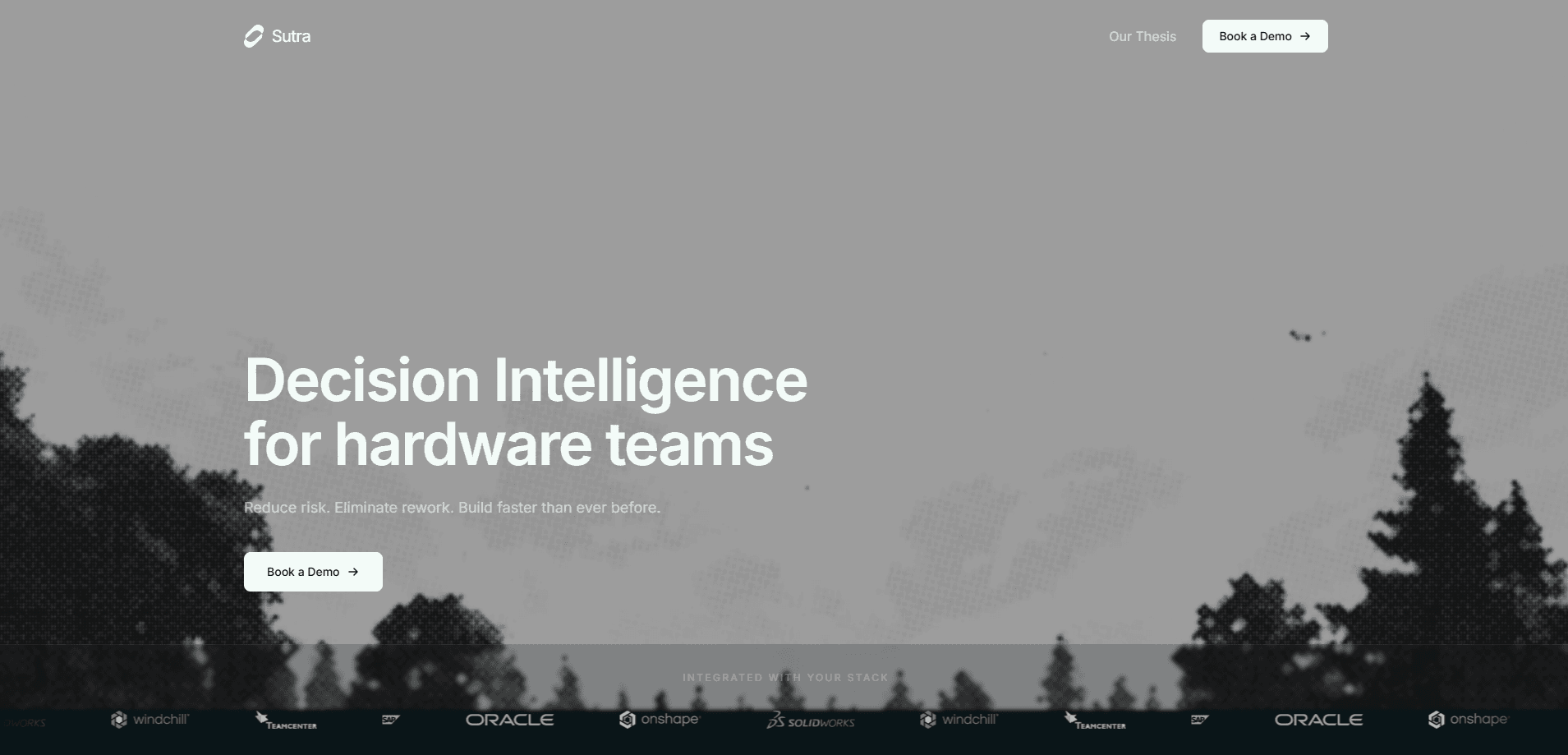
Sutra is a decision intelligence platform built for hardware engineering teams. The company bills it as a product development platform that pulls context from the systems engineers already use, like PLM, ERP, MES, email, and spreadsheets, then simulates what a change will do downstream before anyone commits to it. The point is simple: stop rework before it happens, and keep every part of a program working from the same picture. What makes it different from a plain dashboard? It reasons across systems rather than just reporting from one.
About Sutra
What Is Sutra
Sutra targets a specific problem in hardware development. When one engineer changes a shared part, the teams working on connected components often don't find out until weeks later, in a review meeting. By then, work built on the old assumption has to be thrown out. Sutra's answer is to read across your existing systems and flag the ripple effects of a change while there's still time to react.
The platform connects to the tools a hardware company runs on, including PLM, ERP, MES, Slack, and email, and builds a single view of how parts, processes, and people relate. From there it simulates downstream impact and pushes the resulting workflows, such as engineering change requests, approvals, and traceability records, where they need to go. No more guesswork. Changes route through the platform, not through someone's inbox.
It's worth being clear about who this is for. Sutra isn't a consumer app. It isn't a small-team utility either. The company behind it works with large manufacturers, and the product assumes an existing stack of enterprise systems to connect to. If your team doesn't run a PLM or ERP, most of what Sutra does won't have anything to hook into.
Getting Started
- Request a demo through the official site and set up a discovery call with the Sutra team.
- Connect your core systems, starting with PLM, then add ERP, MES, and communication tools like Slack and email.
- Let Sutra map the relationships between parts, processes, and teams across those sources.
- Run a change scenario to see the simulated downstream impact before committing.
- Turn on the follow-on workflows, such as ECRs and approvals, so changes route through Sutra automatically.
Product Information
A quick look at Sutra's pricing, supported platforms, and performance.
Best for
The users, tasks, and scenarios where this tool fits best.
Users
- Hardware engineering managers
- Mechanical and electrical engineers
- Operations and supply chain teams
Tasks
- Running change impact analysis across PLM, ERP, and MES before an ECR is filed
- Tracing which parts, subassemblies, and teams a modification affects
- Automating follow-on workflows like approvals and traceability records after a decision
- Pulling engineering context out of scattered email and spreadsheet threads into one place
Scenarios
- A shared component change that could stall a parallel program working on a connected assembly
- Late-stage design revisions where rework cost climbs fast
- Programs with many teams touching the same parts across a long development cycle
- Onboarding a new engineer who needs the full history behind a part, not just its current spec
Key features
Cross-System Context Pulling
Sutra reads from the systems a hardware team already runs: PLM for part and BOM data, ERP for sourcing and cost, MES for production, plus email and spreadsheets where a lot of the real context hides. Instead of asking engineers to consolidate data by hand, it builds one connected view. The practical payoff is that a decision maker sees the same facts everyone else does.
Change Impact Simulation
The core capability is asking "what happens if we change this?" before the change is made. Sutra traces how a modification moves through downstream parts, processes, and programs, and surfaces the conflicts that would otherwise wait to appear in a review meeting. That's the difference between fixing a problem in an afternoon and rebuilding a month of work. Late caught, it's brutal.
Automated Follow-On Workflows
Once a decision is made, Sutra handles what comes next, including engineering change requests, approval routing, and traceability records. Think of it as ECR automation plus the approval chase that follows every change. The follow-on steps that usually get tracked in ad hoc spreadsheets run through the platform instead. That cuts the manual work that eats engineering time.
Decision Traceability
Every change carries a record of what was decided, why, and what it affected. When someone revisits a part six months later, or when an auditor asks how a spec evolved, the trail is already there. Traceability like this matters most in regulated hardware, where proving why a change happened is as important as making it. Good engineering change management lives or dies on records like these.
Works Alongside Existing Tools
Sutra isn't a replacement for PLM or ERP. It sits alongside them and makes them talk to each other plus the informal channels. Teams keep their existing systems and get a layer that reasons across them. That keeps switching costs low and avoids forcing a rip-and-replace on an already complex stack.
Pros and cons
Pros
- Pulls context from systems teams already use, so there's less manual data gathering
- Simulates downstream change impact, which can prevent expensive late-stage rework
- Automates ECRs, approvals, and traceability instead of leaving them to spreadsheets
- Targets large hardware programs where cross-team coordination is the real bottleneck
- Doesn't require replacing your PLM or ERP stack
Cons
- Geared toward large manufacturers, so small teams or shops without a PLM/ERP get little value
- Pricing isn't public, which makes budgeting hard without a sales conversation
- Value depends on connecting multiple systems, so setup takes real integration effort up front
- No public API documentation, so custom integrations are unproven from the outside
Frequently asked questions
Sutra is a decision intelligence platform for hardware engineering teams. It gathers context from PLM, ERP, MES, email, and spreadsheets, simulates how a change ripples downstream, and then automates the follow-on steps like change requests and approvals.
Related content
Explore related tools, skills, and articles for Sutra.
Sutra Alternatives
Forefront
Forefront · CodingForefront is a web platform for building with open-source AI. It lets you fine-tune leading open-source language models on your own data, evaluate how they perform, and run them through an API or export them to host yourself. Developers who want the convenience of a closed-source platform but insist on owning their models and data are the target audience here.

Startkit
StartKit.AI · CodingStartkit is a boilerplate for building AI SaaS and AI wrapper products. Think of it as an AI startup boilerplate with the boring parts already wired up: authentication, Stripe and Lemon Squeezy payments, usage limits, transactional email, and an AI API starter that talks to OpenAI, Anthropic, Groq, or Llama. You clone the repo, set your price, and start on the part of your product that people actually pay for. It's Next.js under React and Tailwind, so most of the boilerplate code already feels familiar.
Testim
Tricentis · CodingTestim is an AI-powered test automation platform for building and running end-to-end tests across web, mobile, and Salesforce applications. It leans on machine learning to keep tests stable when an interface changes, so teams spend less time fixing broken selectors. Not bad for an automated testing tool you can start using today. You create tests by recording actions in a browser, then optionally add JavaScript when you need more control. It's a solid pick for busy QA teams.