

SwiftERM
SwiftERM Limited · Other
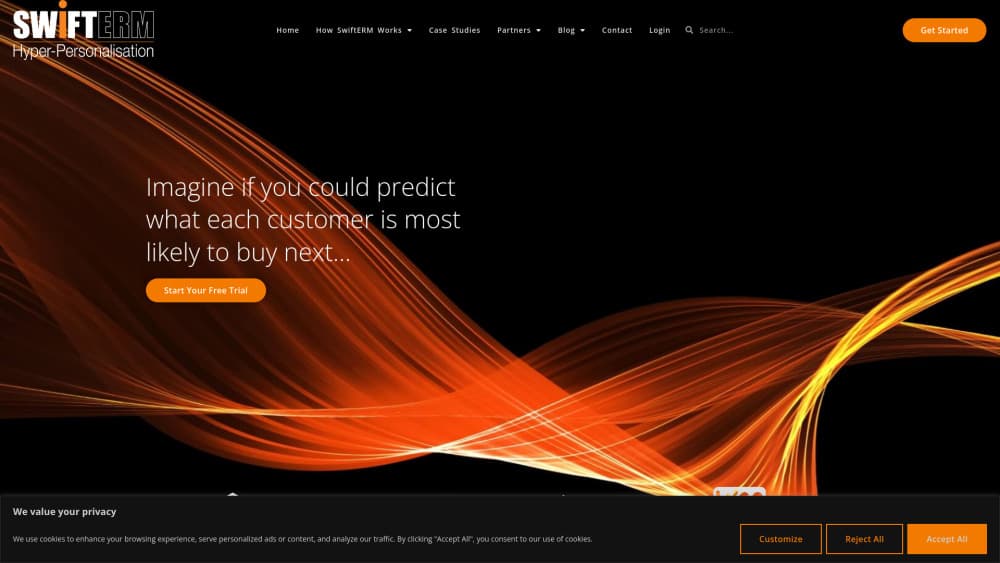
SwiftERM is predictive personalisation software for online stores. It works out which products each customer is likely to buy next and emails that selection at the moment they tend to respond.
About SwiftERM
What Is SwiftERM
SwiftERM is a subscription service from SwiftERM Limited, a UK company registered in 2014. It sells hyper-personalisation software with one job for online retailers: more repeat purchases from customers you already paid to acquire, without adding campaign work to your team.
In plain terms, this is AI email marketing narrowed to one decision per customer. The engine reads the evidence your store already holds. Order history, the products someone keeps viewing, how often they come back, and how their interests shift. From that it builds a separate prediction for each person and ranks products by how likely that individual is to buy them.
Then it does the part most tools leave to you. It assembles the email, picks the products, and holds the send until the recipient's own response pattern says they're likely to open. Your team doesn't build a segment, a flow, or a trigger for any of it.
Three limits matter before you sign up. It's email-first, so the value shows up in inbox revenue rather than onsite banners. It needs a working store integration and tidy product data to make useful picks. And the vendor's headline 10.26% average sales uplift is a historical client average, not a forecast for your shop.
Getting Started
- Register on the SwiftERM site. The account generates a key code for your store.
- Pick your ecommerce platform from the supported list and install the app on your store backend.
- Paste the key code into the app, then let SwiftERM ping your site to confirm the install.
- Approve the DNS setup the vendor configures for your sending domain, which covers email authentication.
- Wait for your customer and catalogue data to populate. The free 30-day trial starts once the install is verified.
Product Information
A quick look at SwiftERM's pricing, supported platforms, and performance.
Best for
The users, tasks, and scenarios where this tool fits best.
Users
- Ecommerce marketing managers at stores with 5,000 to 100,000 contacts
- Owner-operators after Shopify email personalisation or WooCommerce personalisation without a developer
- Retention and CRM specialists
- Agencies running email for retail clients
Tasks
- Winning back customers who bought once and drifted
- Filling the quiet weeks between scheduled campaigns
- Testing whether predictive email pays for itself
- Cutting list segmentation chores
Scenarios
- A fashion store with 15,000 contacts and a large size and colour grid, where generic bestseller emails stopped working.
- A wine merchant with repeat buyers whose taste moves between regions, which is exactly where order-history-only logic fails.
- A seasonal peak such as Black Friday, when you want more revenue from the existing list rather than a bigger ad budget.
Key features
Individual Product Prediction
Each customer gets their own ranked product list, rebuilt as new browsing and buying evidence arrives. Two people with the same past order can receive different selections once their behaviour diverges. That's the core difference from segment-based email marketing, where everyone in a group sees the same block of products. Think of it as a product recommendation engine that writes to inboxes instead of filling a widget.
Hidden Affinity Detection
SwiftERM says it looks for signals it calls hidden affinity markers, drawn from transaction history, product variants, and how quickly someone moves through your catalogue. The idea is to catch an interest forming before a purchase confirms it. Treat the label as vendor language and judge it on attributed sales in your trial.
Send-Time Optimisation
Choosing the right products solves half the problem, and plenty of ecommerce personalisation tools stop there. Send-time optimisation models each recipient's response pattern and releases the email when that person is likely to engage, and the timing shifts as behaviour changes. A shared 10am Tuesday send treats a night owl and a lunchtime browser the same way.
Autonomous Email Assembly
The system builds the email itself, then sends it. No campaign is created, no basket or purchase event has to fire first, and no one writes copy for each send. Your existing newsletters and flows keep running in parallel, so this is extra output rather than a replacement schedule.
Runs Beside Your Email Platform
SwiftERM is built to sit alongside the email software you already use, which means your list, templates, and reporting don't have to move. The vendor is explicit that this isn't a certified integration with every provider, so confirm your setup before installation. That conversation decides whether the project is a fortnight or a headache.
Attributed Sales Reporting
Reporting ties revenue back to the sends, which is the only honest way to judge a personalisation tool. What other ecommerce personalisation vendors call a dashboard, this one uses to argue for its own renewal. Published case studies show the shape of it, including a WooCommerce retailer on 7,117 contacts paying £100 a month with £2,280.70 in attributed sales over 30 days and an 8.02% click-through rate.
Pros and cons
Pros
- Free 30-day trial with free installation, so you can test on live customers before paying.
- Monthly pricing starts at £100 for databases under 20,000 contacts, low enough for small retailers to try.
- Sends one individual product selection per customer, which segment-based email can't match at scale.
- Combines product prediction with send-time optimisation in one automated process, removing two manual steps.
- No long-term lock-in, and cancellation blocks future renewals rather than trapping you in a year.
Cons
- Email only. If you want onsite banners, search merchandising, or app push, you'll need another tool.
- No public API documentation, so custom integrations and data pulls depend on the vendor.
- Pricing scales with database size, which makes costs harder to predict as your list grows.
- The 10.26% average uplift is vendor-reported and comes with no per-store guarantee, so your own trial numbers are the real test.
Frequently asked questions
It predicts which products each customer is most likely to buy next, builds an email around that individual selection, and sends it when that person tends to respond. You keep your store, your list, and your existing email platform.
Related content
Explore related tools, skills, and articles for SwiftERM.
SwiftERM Alternatives

Odyssey 3
Odyssey · OtherOdyssey-3 is Odyssey's foundation world model. It simulates physics in real time, turns a prompt into an interactive environment, and adapts to robots, cars and games.

JarvisCore
Prescott Data · Coding · Productivity · OtherJarvisCore is an open source Python runtime where AI agents work as equal peers on an agent mesh, claim tasks from a shared ledger, and reach external services through a zero-trust broker.
Clef
Cloudflare · Business · OtherClef is Cloudflare's open-source decision model for Workers AI. It returns calibrated probabilities for typed questions, not generated text, so agents can classify, route, and act fast.