

SymphonyAI
SymphonyAI · Coding
SymphonyAI sells vertical AI applications for retail, financial services, industrial operations and IT. Teams forecast demand, investigate financial crime and spot equipment failures faster.
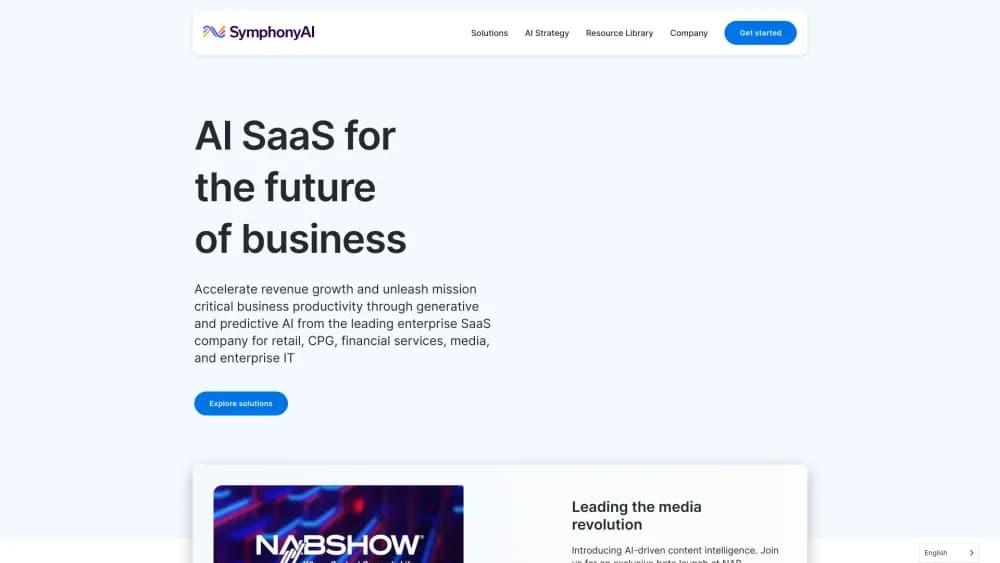
About SymphonyAI
What Is SymphonyAI
SymphonyAI is an enterprise AI software company that builds applications for one industry at a time. Retail teams use it to forecast demand and plan shelves, banks use it to screen transactions for financial crime, and manufacturers use it to catch a failing pump before a line stops. The same company sells all three, which is unusual in a market split between general-purpose chatbots and narrow point tools.
The pitch rests on data the vendor knows you already own: point-of-sale records, transaction logs, sensor streams. Instead of asking a general model to reason about a factory, SymphonyAI trains models on that industry's patterns and hands the output to a person with a job to do. The Eureka platform underneath is the build layer, where customers and the vendor's own engineers assemble predictive models, agents and apps on top of cleaned, context-tagged data.
Pricing follows the enterprise model, which is the first thing to understand. There's no card checkout and no published rate. Most deals run through a sales conversation, a pilot, then a contract, so the cost lands closer to a multi-year software rollout than a monthly subscription. A small team looking for a self-serve AI tool won't find one here, and that's a deliberate design choice rather than a gap.
Getting Started
- Request a demo through the SymphonyAI site and pick the industry track that matches your team, since retail, financial services, industrial and enterprise IT run on separate product lines.
- Walk through a scoping call. The team maps your data sources, current systems and the specific workflow you want to change, such as alert triage or downtime prediction.
- Run a pilot on a slice of real data. Expect the first phase to measure accuracy and false positives against your existing process rather than to go live everywhere.
- Roll out by module. Financial crime prevention, merchandising, supply chain and asset performance are licensed separately, so you can start with one.
- Extend with the Eureka platform. Data scientists and developers can build custom predictive models, agents and applications on the same foundation once the first deployment is running.
Product Information
A quick look at SymphonyAI's pricing, supported platforms, and performance.
Best for
The users, tasks, and scenarios where this tool fits best.
Users
- Retail merchandising and supply chain teams at chains with dozens to thousands of stores
- Financial crime and compliance analysts at banks and payment firms
- Plant and reliability engineers in manufacturing, energy and chemicals
Tasks
- Forecasting demand and planning promotions
- Investigating suspicious transactions
- Screening customers and counterparties
- Predicting equipment failure
- Building a custom model or agent
Scenarios
- A regional grocer fighting stockouts
- A bank under pressure to reduce false positives
- A plant running a pilot on one production line
- A data team with a use case the vendor doesn't sell off the shelf
Key features
Vertical AI Applications by Industry
SymphonyAI doesn't sell one product with add-ons. It runs separate application lines for retail and CPG, financial services, industrial operations, enterprise IT and media, and each one is built around that sector's vocabulary, data shape and compliance rules. A retail forecast talks about planograms and assortments; a financial crime model talks about alert dispositions and SARs. That specificity is the main reason teams pick it over a general model.
Financial Crime Prevention
The financial services line covers transaction monitoring, fraud detection, entity screening and case management, and works as AML software for banks and payment firms. SymphonyAI claims 85 percent fewer false positives and 70 percent faster investigations, along with fraud scoring under 50 milliseconds, all figures from the vendor. Buyers usually shortlist it as financial crime prevention AI that has to survive an audit rather than as a generic detector. What matters in practice is the explanation layer: every flag carries the reason behind it, which is what an auditor asks for and what a general model often can't produce on demand.
Retail and CPG Demand Planning
Retail planning is where the joined-up design shows first. Forecasting, merchandising and supply chain execution all draw on the same records. A promotion decision and an inventory order stop being two separate spreadsheet exercises. Assortment, pricing, promo effectiveness and shelf planning are treated as connected decisions. SymphonyAI reports a 3.5 percent sales lift and 98 percent forecast accuracy across its retail customers, numbers the company publishes on its own site. Buyers often compare this retail AI software against standalone forecasting tools and find the joined-up view is the reason it wins.
Industrial Predictive Maintenance
The industrial line connects plant data from PLCs, historians and ERP systems. Pre-trained models scan that stream for anomalies and flag likely failures before a line stops. For teams comparing predictive maintenance AI vendors, the selling point is that the models ship trained on industrial patterns instead of needing a long data science project. Root cause analysis aims at the question operators actually ask when output drops: what changed. Deployments can run at the edge, in a hybrid setup or in the cloud, which matters for sites that can't move operational data off premises.
Eureka Vertical AI Platform
Eureka is the build layer under every industry app, and it opens three paths into that layer. Data scientists get a pro-code environment for predictive models. Ops teams get a low-code visual builder for multi-step agents. Anyone else gets a prompt-based environment for generative applications. Underneath sits a data foundation. It handles ingestion and cleaning, plus ontology tagging, so a customer's data arrives structured rather than raw. Teams can use Eureka to build something SymphonyAI doesn't sell. That's the main argument for buying the platform instead of just an app.
Enterprise Delivery and Data Governance
Because the customers are banks, manufacturers and large retail chains, the delivery model matters as much as the model. SymphonyAI runs on Microsoft Azure and was named Microsoft's AI Partner of the Year, so deployments can inherit existing cloud agreements and security reviews. Enterprises that standardize on Azure treat this as a working definition of an enterprise AI platform. On top of that, every flag, score and recommendation carries the logic behind it. Audit trails sit inside the workflow, not in a separate log nobody reads, and the company positions these systems for regulated environments where a black box fails review.
Pros and cons
Pros
- Industry-specific models and interfaces, so teams don't spend months adapting a general model to their data.
- Financial crime workflows include explanations and audit trails, which many general AI tools handle poorly.
- Modular licensing lets a customer start with one use case, such as alert triage or a single production line, before committing across the business.
- Runs on Microsoft Azure and holds Microsoft partner status, which simplifies procurement for organizations already on that stack.
- The Eureka platform lets in-house teams build models and agents that the vendor doesn't sell as a packaged app.
Cons
- No self-serve trial, free tier or published pricing. Evaluation requires a sales conversation and typically a pilot, which can take weeks.
- The product is aimed at large organizations. A mid-sized company without a data team or clean transaction records will struggle to get value.
- Five separate industry lines mean the experience varies by sector, and features in one don't carry over to another.
- Performance figures like fewer false positives and sales lift come from the vendor, so buyers should verify them against their own baseline.
Frequently asked questions
SymphonyAI builds AI applications for specific industries: retail and CPG, financial services, industrial operations, enterprise IT and media. The applications handle tasks like demand forecasting, financial crime investigation and predictive maintenance. The Eureka platform underneath lets customers build their own models, agents and apps.
Related content
Explore related tools, skills, and articles for SymphonyAI.
SymphonyAI Alternatives

Base Code
Base44 (Wix) · Coding · ProductivityBase Code is a shared cloud development environment from Base44. Teammates describe changes to an existing GitHub codebase in chat, preview them live and send them back as pull requests.

Google EmbeddingGemma 2
Google DeepMind · Writing · Image · CodingGoogle EmbeddingGemma 2 is a 740M-parameter open model that turns text, code, images, audio, and video frames into vectors in one 768-dimension space, running on phones and laptops.

GitGlow
GitGlow · Coding · ProductivityGitGlow is a local-first desktop Git client that lets independent developers review their own code and their AI agents' changes in one place before shipping.