

Synthace
Synthace Limited · Business
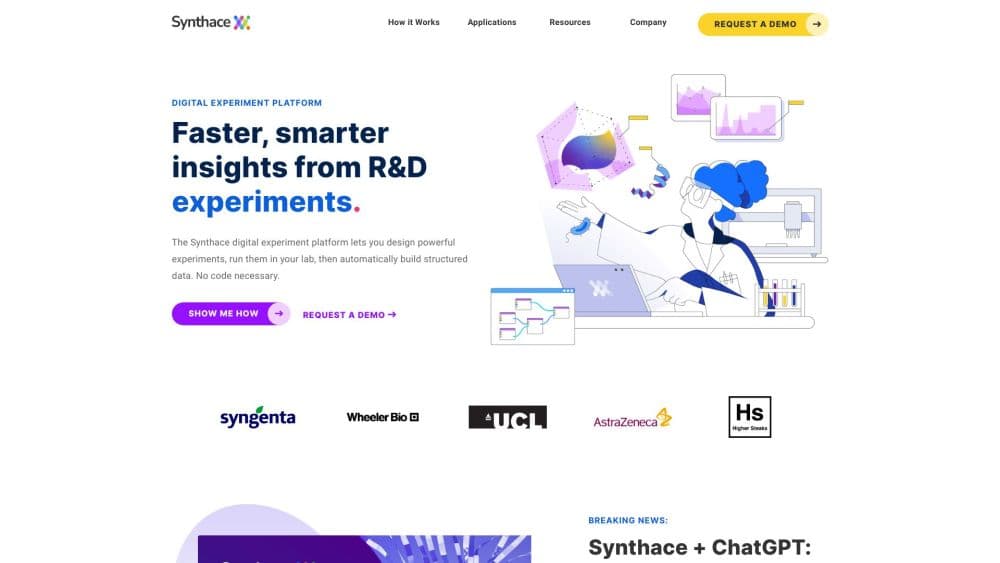
Synthace is a cloud platform for designing multivariate life science experiments, turning those designs into liquid handler instructions and AI-ready data.
About Synthace
What Is Synthace
Synthace is a digital experiment platform for biology labs. Scientists plan an experiment in a browser, the software works out every volume and concentration, and it hands back instructions a liquid handler can run. The company sells this as life science R&D software with training and on-site support attached, so the tool arrives with people who know how to use it.
The pitch rests on a gap most labs know well. Testing one variable at a time uses a whole plate to answer one question. Design of experiments squeezes many variables into the same plate, but the statistics are fiddly and the automation scripts take days to write. Synthace does that math for you and produces the run files itself. That's the whole product in one sentence.
Two limits matter before you book a demo. There's no self-serve signup and no public price list, so budgeting means a sales conversation. And the automation half only pays off if your lab already has liquid handling hardware on the bench.
Getting Started
- Request a demo through the Synthace site. Expect a scoping call rather than a download link.
- Pick one live project with the field application team. They run a starter experiment with your own scientists and your own instruments.
- Confirm your liquid handlers and dispensers are on the supported list. Synthace writes instructions per device, and older hardware needs a check first.
- Build the first design in the browser: plate layout, dilution series, reagents, devices. The software fills in the volumes.
- Run the protocol, then open the results in the cloud workspace. Data lands linked to the design, ready to analyze or export.
Product Information
A quick look at Synthace's pricing, supported platforms, and performance.
Best for
The users, tasks, and scenarios where this tool fits best.
Users
- Discovery biologists at pharma and biotech companies
- Process and purification scientists
- Lab automation and informatics leads
Tasks
- Assay development with several variables at once
- Media optimization for cell culture
- Miniaturized purification
- Building a dataset for machine learning
Scenarios
- A method that has to travel between sites
- A pilot before an enterprise rollout
- Handing experiments to a junior scientist
Key features
Code-Free Experiment Design
You describe the plate, the dilution conditions and the devices in a browser form. There's no scripting step and no macro to debug. That matters because the people who understand the biology are rarely the people who write the automation code.
Multivariate Design of Experiments
The platform plans runs where several factors change together, which is what DOE software is supposed to do but often makes you build the matrix yourself. You get a workable design and a clear picture of what each condition tests. Fewer plates, more answers per plate.
Automatic Volume and Concentration Math
Synthace calculates stocks, dilutions and transfer volumes across the whole plate. It also produces a materials overview for the run. Manual spreadsheet work is where dilution errors creep in, and a single bad column can waste a day of bench time.
Click-to-Run Automation Instructions
The design converts into run files for supported liquid handlers and dispensers, which is the practical heart of liquid handler automation. Different vendors use different software, and Synthace absorbs that difference instead of asking you to. Labs running two instrument brands stop maintaining two sets of scripts.
Context-Rich Structured Data
Results come back with the design attached: which well held which condition, which protocol version ran, which device executed it. The company calls this AI-ready data, and the label holds up in one narrow sense. A model trained on it sees structured features, not a folder of renamed CSV files.
Method Sharing Across Sites
Methods can be shared between people, devices and locations, and the execution layer adjusts to whatever hardware is at the other end. For groups with labs in several countries, that turns a method transfer from a week of email into a template someone opens.
Pros and cons
Pros
- Non-programmers can build multivariate experiments. The design interface carries the statistics, so a biologist doesn't need a statistician in the room for a routine optimization run.
- Instructions adapt to the instruments you already own. That protects hardware investments and avoids locking a lab into one vendor's software stack.
- Data keeps its context. Concentration, plate position and protocol version travel with each result, which saves the cleanup work that usually precedes any modeling project.
- Human support is part of the deal. Field application scientists run starter projects alongside your team, which is more hands-on than a typical software subscription.
- Multivariate runs cut experiment count. Teams report getting answers from fewer plates. The size of that gain still depends on how the assay behaves.
Cons
- No public pricing and no self-serve tier. You can't test the software alone on a Sunday, and budget approval depends on a sales cycle you don't control.
- The automation value needs hardware. Without a liquid handler or dispenser on site, Synthace is a design and data tool, and a large part of the pitch goes unused.
- Cloud-only delivery. Regulated teams will want a security review, and any group that needs on-premise hosting has no option here.
- No documented public API. Connecting Synthace to an ELN or LIMS goes through the company's team, so plan for a services conversation rather than a developer integration.
Frequently asked questions
Synthace is a cloud platform for planning and running biology experiments. Scientists design a protocol in the browser, the software calculates the liquid handling math, and the run executes on lab automation hardware with structured data coming back.
Related content
Explore related tools, skills, and articles for Synthace.
Synthace Alternatives
Knocket
Knocket (Tencent RTC team) · Productivity · Business · ChatbotKnocket is a free live chat and contact page tool that lets visitors message you from your website, app, or a shareable link, with every reply handled from Telegram or one inbox.

shippedit.me
Krawlup · Marketing · Businessshippedit.me now redirects to Krawlup, a web platform that audits SEO, AEO and page speed every week, then hands the fixes to AI coding agents over MCP.

Ayven
Alknoma · Productivity · BusinessAyven is an AI control centre by Alknoma that turns a plain-language goal into a dated plan, hands the work to your people and AI agents, and asks for your approval only when the call is yours.