

Synthflow AI
AgentFlow AI GmbH (Synthflow AI) · Voice & Language · Coding
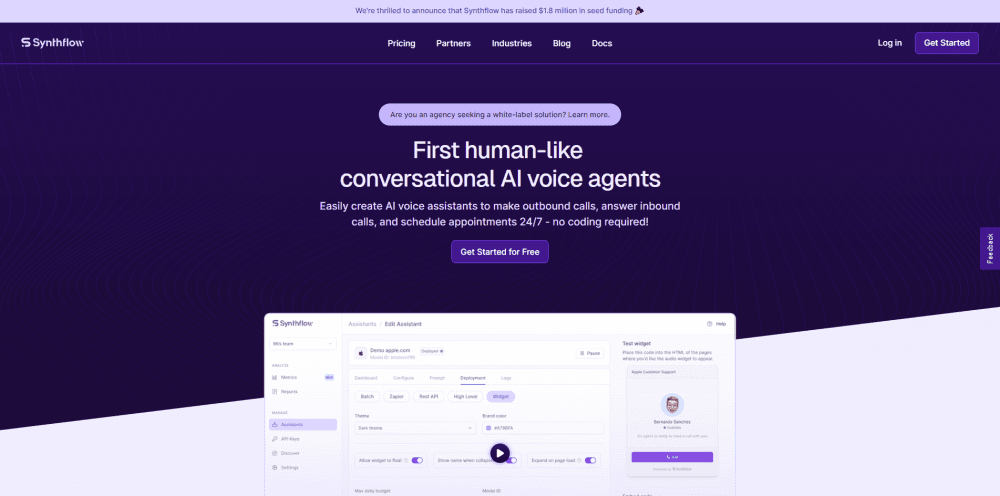
Synthflow AI is a voice agent platform that builds AI phone agents for inbound and outbound calls, with a visual flow designer, built-in telephony, and 200+ integrations.
About Synthflow AI
What Is Synthflow AI
Synthflow AI turns a written script into an agent that picks up the phone and has a real conversation. You describe what the agent should do, connect the tools it needs, hand it a phone number, and it starts answering or dialing. The company behind it, AgentFlow AI GmbH, started in Berlin in 2023.
The problem it targets is narrow but expensive. A support desk spends hours on questions it has answered a thousand times. A sales team burns afternoons chasing leads who never pick up. Synthflow puts those calls on an agent that doesn't take breaks, and hands the messy ones to a person through a warm transfer.
The catch sits in the pricing model. There is no cheap monthly seat to buy. You build and test for free, then pay per minute once calls go live, and the self-serve plans that used to exist are no longer sold. Today the platform is aimed at companies that can commit to a real phone operation, with enterprise contracts starting at $30,000 a year.
Getting Started
- Sign up at synthflow.ai and open the Agents tab to create a new voice agent, choosing inbound, outbound, or a website voice widget.
- Pick a mode: Prompt Builder for a single instruction that drives the conversation, or Flow Designer when the call has branches and handoffs.
- Feed the agent its knowledge: paste documents, crawl your site, or connect a help center so it can answer from your own content.
- Attach actions such as calendar booking, custom API calls, call transfers, and post-call SMS, then run a test call from the editor or the Test Center.
- Buy or import a phone number, assign it to the agent, and switch the number live when the tests look right.
Product Information
A quick look at Synthflow AI's pricing, supported platforms, and performance.
Best for
The users, tasks, and scenarios where this tool fits best.
Users
- Support and operations teams drowning in repeat calls
- Sales and appointment-driven businesses
- BPOs and agencies reselling voice services
Tasks
- Answering a busy inbound line after hours
- Running a batch of outreach calls
- Collecting structured data on calls
Scenarios
- A clinic with constant rescheduling
- A company that already runs a PBX
- A regulated team in finance or healthcare
Key features
Visual Flow Designer
Flow Designer lays a conversation out as nodes and branches instead of one long prompt. You place a question, define what happens on each answer, and route the call down the path you drew. For booking, verification, or escalation calls, that structure keeps the agent from wandering.
Prompt Builder for Quick Agents
When one instruction is enough, this voice agent builder skips the diagram and lets you describe the job in plain language. It suits FAQ lines and first prototypes, and the model can improvise when a caller says something unexpected. You pick one mode per agent, so a simple agent doesn't carry the weight of a full flow.
Built-In Telephony and SIP Options
Synthflow runs its own phone network and also lets you bring your own carrier or SIP trunk. That means you can deploy on a Synthflow number, on Twilio, or behind an existing PBX, and the platform keeps routing and latency under its own control rather than waiting on a third party. The company says latency stays below 100 ms on its infrastructure, a claim worth testing on your network before launch.
Knowledge Base with Live Crawls
You can load PDFs, paste documents, add single URLs, or crawl a whole site into a knowledge base, then set the conditions that trigger a lookup. Repeated crawls can be scheduled, so changing prices or opening hours reach the agent without a manual upload. Answers come from your material, which reduces the odds of an invented policy.
Actions, CRM Sync, and Handoffs
Agents don't just talk. They book through calendar integrations, send HTTP requests to your own APIs, write to Salesforce or HubSpot, send SMS during or after the call, and push the call to a human with a warm or cold transfer. Every action result becomes a variable the agent can use later in the same conversation.
Test Center and Auto-QA
The Test Center runs simulated calls against your agent and scores the replies, so quality problems show up before a customer hears them. Once live, analytics track outcomes, sentiment, and prompt reuse, and custom evaluations score calls against your own criteria. You can change a prompt, rerun the suite, and see what broke.
Multilingual Agents and 200 Voices
A single agent can speak more than 30 languages, including English, Spanish, Portuguese, German, French, Japanese, Korean, and Mandarin. Synthflow's own text to speech engine offers 200 voices that keep their character across languages, so a caller who switches mid-call doesn't hear a stranger.
Open API and Developer Tooling
The Platform API covers agents, calls, campaigns, knowledge bases, phone numbers, and analytics, with an official MCP server and a ChatGPT plugin. Teams that want voice inside their own product can start a WebSocket call with one request, without handling WebRTC signaling in the client. Synthflow pricing sits outside all of it, since only the sales team quotes a per-minute rate.
Pros and cons
Pros
- The flow designer and the prompt mode cover both simple hotlines and multi-step calls, so you don't need a second tool as processes get complicated.
- Owning its telephony means one vendor handles routing, numbers, and latency, which shortens the troubleshooting chain when a call fails.
- Native booking, CRM, and SMS actions turn the agent into something that finishes tasks, not just one that talks.
- Test Center and custom evaluations give a measurable quality bar before launch, which is the part most voice bot projects skip.
- Subaccounts and white-labeling support BPOs and agencies that sell voice services under their own brand.
Cons
- Self-serve plans are gone. Pricing now runs on per-minute usage plus enterprise contracts from $30,000 a year, and the pricing page no longer lists rates, so you have to talk to sales before you can budget.
- Deep configuration is spread across prompts, flows, actions, and voice settings. A day-one user can get an agent talking, but production quality takes real setup time.
- Warm transfers count against your call-per-second limit, so outbound campaigns that end in handoffs can stall unless you raise the limit or plan capacity.
- Synthflow TTS keeps English delivery habits in multilingual mode, which means callers get a slight accent unless you set a single target language.
Frequently asked questions
Synthflow AI runs AI voice and chat agents that handle customer phone calls. The agents answer questions, qualify leads, book appointments, route calls to the right person, and update your CRM, all inside one conversation.
Related content
Explore related tools, skills, and articles for Synthflow AI.
Synthflow AI Alternatives

Foley
Hanamori Labs, LLC · Voice & Language · Productivity · AI AssistantFoley is a voice to-do list that turns a spoken sentence into a filed task, complete with project, date and time, then helps you plan the day around what is already there.

HireKey
HireKey · Voice & Language · Productivity · LeaningHireKey is an AI job search copilot built by a former tech recruiter. It checks role fit, tailors resumes, runs interview practice and tracks every application.

Fluence
Yay Software (Yannick Huchard) · Writing · Voice & Language · ProductivityFluence is an Android app that reads PDFs, EPUBs, Word files and web articles aloud, follows each sentence as it speaks, and answers questions about the text on the phone itself.