

Talent Protocol
Talent Protocol (acquired by IPTS, with support from Protocol Labs) · Business
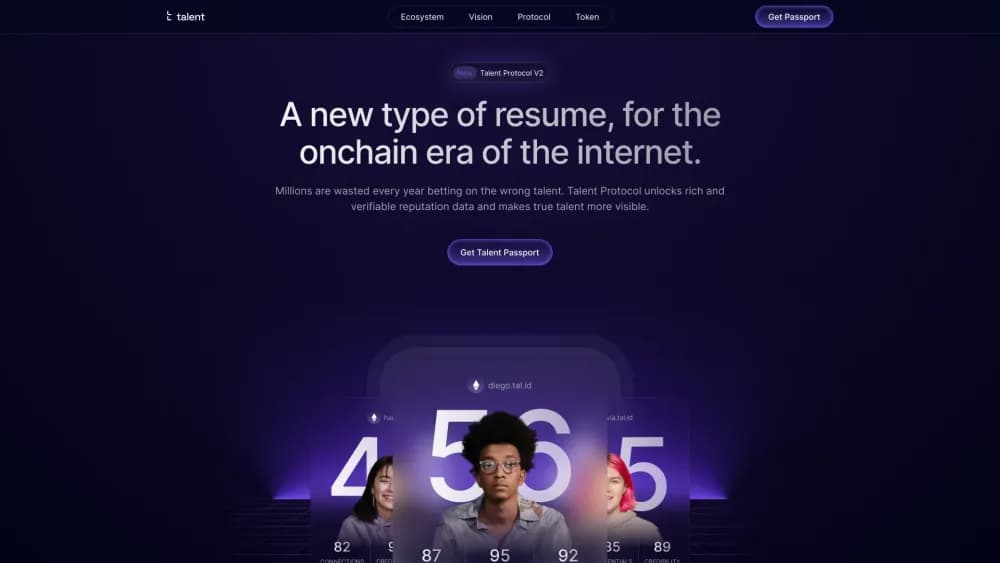
Talent Protocol is a reputation tool that turns public GitHub and blockchain activity into an explainable Builder Score you can recompute in your browser, with optional onchain proof on Base.
About Talent Protocol
What Is Talent Protocol
Talent Protocol is an open reputation project for software builders. Its current app computes a Builder Score from public data: GitHub metrics plus onchain activity across four chains. The point is simple. A recruiter, a grant program, or a fellow builder can look at one number and see a defensible record of what someone has actually shipped. The goal is to make verified builder activity visible instead of self-reported.
The scoring logic is public. Every point on a score card comes with the exact formula that produced it, so you can trace a total back to the raw inputs. Nothing runs on a hidden server. Your browser queries public RPC endpoints and the GitHub API directly, and the same inputs always produce the same score.
The project changed hands recently, and that shapes what it is today. Talent Protocol was acquired by IPTS, with support from Protocol Labs, and the team now maintains the Builder Score app as a free public good on a part-time basis. There are no accounts and no fees. One tradeoff follows from that: the operators plan to keep it running through the end of 2026 but offer no service-level commitment beyond that.
Getting Started
- Open the Builder Score app in a supported browser and skip any signup step.
- Enter a wallet address or ENS name, and add a GitHub handle if you want those credentials counted.
- Let the page query public data across four chains and GitHub, then read the per-credential breakdown.
- Optionally connect a wallet and publish an EAS attestation on Base so anyone can verify the score later.
- Share the score card or send the attestation UID to whoever needs to check it, or paste a UID into the verify page to audit someone else's.
Product Information
A quick look at Talent Protocol's pricing, supported platforms, and performance.
Best for
The users, tasks, and scenarios where this tool fits best.
Users
- Crypto and open source developers who want their shipped work to count as a verifiable record instead of a self-written bio
- Grant program and community teams screening applicants who need a fast, recomputable read on a wallet's history
- Recruiters and founders scouting technical talent who want proof behind a claim, not just a profile page
- Hackathon and builder community members who already hold event credentials and want those turned into visible standing
Tasks
- Checking a Builder Score
- Verifying someone else's score
- Aggregating a score across multiple wallets
- Publishing onchain proof
Scenarios
- Applying to a grant or accelerator program that asks for proof of building activity rather than a pitch deck
- Evaluating an unfamiliar wallet before a collaboration, a hire, or an investment conversation
- Tracking your own standing over time and seeing which credentials you can realistically push higher
- Comparing builder reputations inside a community where several people hold similar hackathon and event records
Key features
Explainable Scoring
Talent Protocol shows the exact formula behind every point, so a score is never a black box. Each credential lists what it measures and how the math caps out, such as new followers counting less the further you go. If a number looks wrong, you can follow it back to the raw input that produced it.
Browser-Side Computation
The app runs the whole calculation in your browser. It calls public RPC endpoints and the GitHub API directly, with no backend account and no database of people. That means your queries leave your machine, but your identity and the results stay with you.
Onchain Attestation on Base
A completed score can be published as an EAS attestation on the Base network with one click. The record is public and permanent, and anyone can check it by recomputing the score from the same public inputs. It is the closest thing here to a tamper-proof receipt.
Eighteen Credentials and Badges
A Builder Score draws on eighteen credentials worth up to 285 points, grouped into onchain holdings, hackathon records, GitHub activity, and EAS attestations. Badges sit alongside a score as extra context and carry no points, so reaching a milestone never quietly inflates your total.
Multi-Wallet Aggregation
You can add up to four more wallets and combine them into one score. The app takes the best wallet count per credential instead of simply summing everything, which stops duplicates from padding a total. Handy when your building history is spread across a few addresses.
Open Source Verification
The scoring logic is open source, and there is a dedicated verify page that recomputes any attestation on the spot. The scoring code and the public documentation both live on GitHub, so you can read the rules yourself instead of taking a description's word for it.
Pros and cons
Pros
- Every point is traceable to its formula, so you can see exactly why a score landed where it did
- No account or signup is needed for a basic check, which keeps a first look fast
- Scoring runs in your browser against public data, so the project does not hold your personal record
- Optional Base attestation gives the score a portable proof that third parties can verify independently
- Coverage spans GitHub plus four chains, with eighteen credentials that are spelled out on one page
Cons
- A score reflects only what those specific public sources can see, so work on private repos does not count and the total can look lower than reality
- The operators plan to keep the app running through the end of 2026 with no service-level commitment, so long-term availability is not guaranteed
- Reading the per-credential math takes some patience, and anyone who just wants a single number has to dig through several sections
- Publishing an attestation is permanent, so a score you later regret stays visible unless you revoke it and even then the record is not erased
Frequently asked questions
It measures verifiable building activity from public data, combining GitHub metrics like account age, stars, and repositories with onchain holdings such as hackathon records and event NFTs. Eighteen credentials feed the total, which can reach 285 points.
Related content
Explore related tools, skills, and articles for Talent Protocol.
Talent Protocol Alternatives

Knocket
Knocket (Tencent RTC team) · Productivity · Business · ChatbotKnocket is a free live chat and contact page tool that lets visitors message you from your website, app, or a shareable link, with every reply handled from Telegram or one inbox.

shippedit.me
Krawlup · Marketing · Businessshippedit.me now redirects to Krawlup, a web platform that audits SEO, AEO and page speed every week, then hands the fixes to AI coding agents over MCP.

Ayven
Alknoma · Productivity · BusinessAyven is an AI control centre by Alknoma that turns a plain-language goal into a dated plan, hands the work to your people and AI agents, and asks for your approval only when the call is yours.