

Talent Score
Talent Score · Business
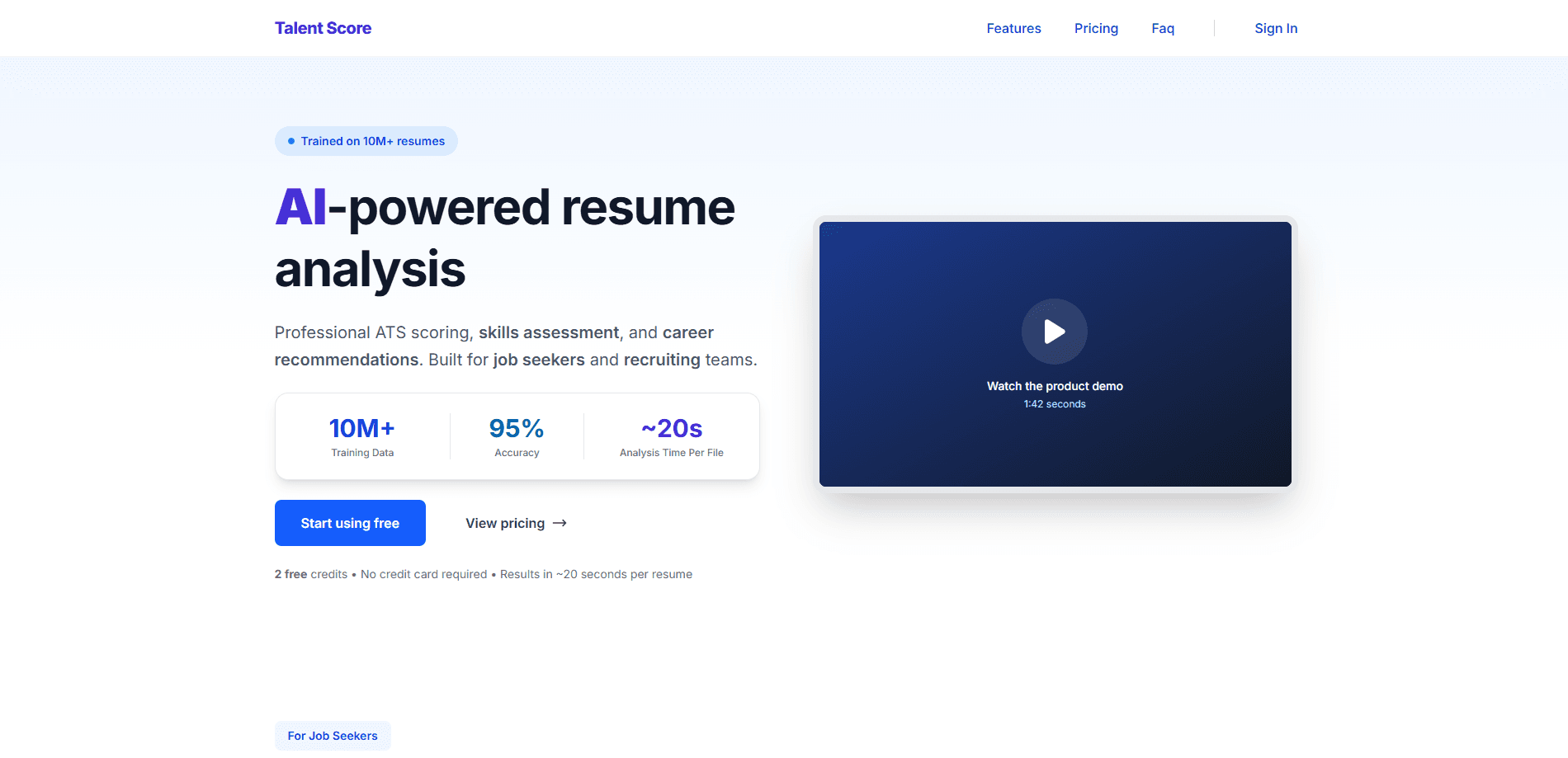
Talent Score is an AI platform that analyzes resumes and scores them against Applicant Tracking Systems. Job seekers upload a file and get a 0-100 ATS compatibility score with a breakdown across formatting, keywords, experience, and skills, plus a ranked list of fixes. Recruiters use the same engine to screen whole candidate pools, rank applicants automatically, and cut the time spent reading files one by one.
About Talent Score
What Is Talent Score
Talent Score is an AI resume analysis service built for two very different users: people trying to get hired and the teams doing the hiring. It reads a resume, compares its structure and content against patterns drawn from a large training set, and returns a score that estimates how well the document survives automated screening. Think of it as a resume checker that works from data, not gut feel.
The core problem it targets is the black box of applicant tracking systems. Most large employers run resumes through software before a human sees them, and that software silently drops files for reasons job seekers can't see. Talent Score tries to make that hidden filter visible by grading your resume and telling you what to fix, in order of impact.
The limitation worth knowing up front: this is a prediction tool, not a guarantee. A high score means your resume should pass ATS screening more cleanly, but it can't promise an interview call, and it won't know the specific quirks of every employer's system. Treat it as a signal to improve, not a verdict. So what should you expect on the first run?
Getting Started
- Create a free account at talentscore.cloud. New users get 2 free credits and no credit card is required.
- Upload your resume in one of the supported file formats.
- Wait roughly 20 seconds while the platform parses the document and runs its analysis.
- Read your 0-100 ATS compatibility score and the category breakdown, then work through the high, medium, and low priority suggestions.
- For recruiter accounts, batch upload up to 10 resumes at once and review the automated ranking.
Product Information
A quick look at Talent Score's pricing, supported platforms, and performance.
Best for
The users, tasks, and scenarios where this tool fits best.
Users
- Job seekers
- Recruiters and HR teams
- Hiring managers evaluating technical roles
Tasks
- Checking a resume against ATS screening
- Fixing formatting problems
- Matching skills to job titles
- Ranking a candidate pool
Scenarios
- A final check before hitting submit on an application
- Screening a shortlist of applicants for an open role
- Planning a career move
- Rewriting an old resume for a new industry
Key features
ATS Compatibility Scoring
Talent Score grades a resume on a 0-100 scale meant to mirror how applicant tracking systems judge a document. The score isn't a single number with no explanation behind it. It splits into separate ratings for formatting, keywords, skills, and experience, so a user can see whether the problem is a layout hiccup or missing job terms. That breakdown is what makes the score useful. Just a number would only discourage you.
Prioritized Improvement Suggestions
Every resume gets a list of suggested fixes ranked as high, medium, or low priority. The ranking matters more than the raw list. Most resume tools dump twenty tips on you with no order, and you end up polishing a font choice while a missing keyword sinks the file. Here the high-priority items are the ones most likely to move the score, so you can fix the few things that count and stop. Fix those first. The rest can wait.
AI Career Guidance and Job Matching
Beyond scoring, the platform suggests job positions that fit a user's skill set, experience level, and background. Each match comes with a match score and some commentary on where a career could head next, so it reads more like a second opinion on where a resume points than a generic job board feed. It's most useful for people who aren't sure what titles their experience actually opens up. That's a common spot to be stuck in.
Batch Resume Processing for Recruiters
Recruiter accounts can upload up to 10 resumes at once and let the system process the whole pool. The platform then ranks candidates automatically, showing each applicant's score so a hiring manager can spot the strongest files without opening every one. It's fast. For anyone who's spent an afternoon triaging a folder of PDFs, this is the part that saves the most time.
Team Collaboration and Shared Workspaces
Team features are listed as coming soon. The planned setup covers shared credit pools, side-by-side candidate comparison, and real-time collaboration across a hiring team. It isn't live yet, so teams that need it today should plan around its absence rather than assume it works.
Advanced Analytics and Custom Reports
Also marked coming soon: analytics for tracking team performance and generating custom hiring reports. The pitch is data-driven decisions across a whole recruiting pipeline. Until it ships, treat this as a roadmap item, not a current capability. Don't count on it yet.
Pros and cons
Pros
- Free tier with 2 credits and no credit card, so you can test the score before paying anything.
- The 0-100 score breaks into four visible categories, which tells you where to focus instead of just that something's wrong.
- Processing runs around 20 seconds per file, fast enough to re-check a resume after each round of edits.
- The same platform serves job seekers and recruiters, so a small hiring team can score candidates in the same place candidates check their own resumes.
- Suggestion priorities rank by impact, which keeps the fix list short and focused.
Cons
- Team collaboration, shared workspaces, and analytics are all marked coming soon, so teams needing those today can't rely on them yet.
- Batch upload caps at 10 resumes per run, which is tight for recruiters screening hundreds of applicants.
- The score predicts ATS behavior but can't account for the specific configuration of every employer's system, so a good score is a signal, not a guarantee.
- No public API is documented, so it can't be wired into an existing hiring workflow.
Frequently asked questions
It analyzes a resume and gives it a 0-100 ATS compatibility score, broken into formatting, keywords, experience, and skills. It also suggests prioritized fixes and, for recruiters, ranks batches of candidates by score.
Related content
Explore related tools, skills, and articles for Talent Score.
Talent Score Alternatives

Knocket
Knocket (Tencent RTC team) · Productivity · Business · ChatbotKnocket is a free live chat and contact page tool that lets visitors message you from your website, app, or a shareable link, with every reply handled from Telegram or one inbox.

shippedit.me
Krawlup · Marketing · Businessshippedit.me now redirects to Krawlup, a web platform that audits SEO, AEO and page speed every week, then hands the fixes to AI coding agents over MCP.

Ayven
Alknoma · Productivity · BusinessAyven is an AI control centre by Alknoma that turns a plain-language goal into a dated plan, hands the work to your people and AI agents, and asks for your approval only when the call is yours.