

Tamarind Bio
Tamarind Bio · Coding
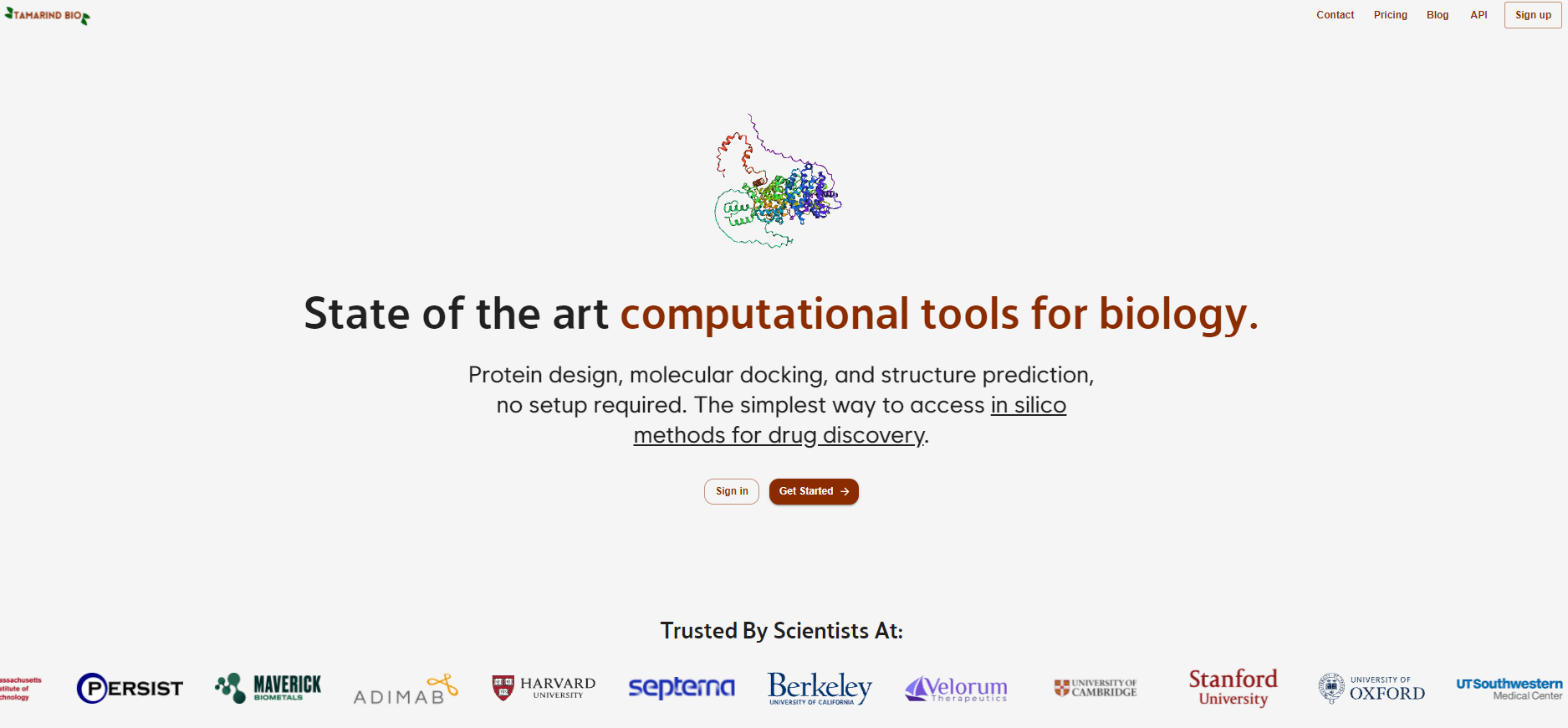
Tamarind Bio is a cloud platform for AI protein design. It gives research teams one web interface and API to run 300+ tools like AlphaFold, RFdiffusion, and BindCraft without touching a GPU.
About Tamarind Bio
What Is Tamarind Bio
Tamarind Bio is an AI protein design platform built for scientists who want to use published models without becoming infrastructure engineers. The hard part of computational biology usually isn't picking a model. It's getting the model installed, fed with the right inputs, and running across enough GPUs before your deadline. Tamarind sells that missing layer.
The catalog covers structure prediction, binder design, protein and ligand scoring, and molecular dynamics. Named tools on the platform include AlphaFold2, Boltz-2, Chai-1, Protenix, ESMFold2, RFD4-Proteina, BindCraft2, ProteinMPNN, ImmuneBuilder, and GROMACS. You pick a task, upload sequences or structures, and the platform handles parallelization and job orchestration.
The company says it supports more than 10,000 scientists across biotech and large pharma. Data sits in a SOC 2 compliant cloud, each computation runs isolated, and you keep ownership of inputs and anything derived from them. The limitation is scope. This is a research tool for people who understand targets, assays, and candidates. It won't tell you which protein to make.
Getting Started
- Create a free account at app.tamarind.bio with a work or academic email.
- Pick a task from the catalog, such as structure prediction or de novo binder design.
- Upload your sequence, PDB, or SMILES file and set the parameters the model expects.
- Submit the job and watch it run, then download structures and scores when it finishes.
Product Information
A quick look at Tamarind Bio's pricing, supported platforms, and performance.
Best for
The users, tasks, and scenarios where this tool fits best.
Users
- Protein engineers
- Antibody discovery teams
- Academic labs
- Small biotech startups
Tasks
- Protein structure prediction
- De novo protein design
- Enzyme engineering
Scenarios
- A target arrives on Friday and the team needs a binder hypothesis by Monday
- You want to reproduce a paper before building on it
- Your pipeline needs to run unattended
Key features
A Single Catalog of 300+ Models
Tamarind collects published tools in one place, from AlphaFold2 and ESMFold2 to RFdiffusion variants and BindCraft2. Each entry lists inputs, outputs, and expected runtime, so you can judge fit before spending compute. The value is comparison: the same target through three models takes minutes, not a week of environment setup.
Managed GPU Scale
You send one job or a hundred thousand. The platform provisions GPUs, splits work across machines, and returns results in a queue you can monitor. For a lab that runs seasonal design campaigns, this removes the usual choice between idle hardware and rental spikes.
Antibody and Nanobody Workflows
The antibody track covers structure prediction for immune proteins, CDR redesign against a chosen antigen, binding pose prediction, and de novo nanobody design. Developability scoring for thermostability and solubility sits in the same flow, which is where most antibody programs actually lose candidates.
Sequence and Structure Scoring
Protein scoring tools rank sequences and structures in minutes, and ligand scoring handles SMILES or SDF inputs for small molecule work. Teams use this as a filter between generation and expensive validation, so weak designs get dropped early.
API and MCP Access
Everything in the web app is reachable through an API, and Tamarind also ships an MCP server for agent workflows. That makes it possible to wire protein structure prediction into an internal pipeline or let a coding agent submit and fetch jobs. API access is a paid feature.
Data Ownership and Isolation
Inputs and derivatives belong to you, and each computation runs in its own container. The company publishes a trust center and offers custom security audits on Enterprise. For pharma teams, that paperwork is often the difference between a pilot and a signed contract.
Pros and cons
Pros
- One login covers structure prediction, binder design, scoring, and molecular dynamics, which cuts tool sprawl.
- Free plan includes the full model catalog, so you can validate the platform on real work before paying.
- Batch jobs handle hundreds of thousands of inputs, which suits library-scale screening.
- API and MCP server support make it scriptable, not just clickable.
- Clear data ownership terms plus SOC 2 compliance fit the way biotech procurement works.
Cons
- Premium and Enterprise prices aren't published. You have to book a call to learn what your workload costs.
- The platform assumes domain knowledge. Newcomers get model parameters and confidence metrics with little guidance on what good looks like.
- Model versions follow the research community, so a pipeline you validated can shift when a default changes.
- Heavy GROMACS simulations still take hours, and queue position depends on your plan.
Frequently asked questions
It runs published AI models for protein and molecule design on cloud GPUs and returns structures, sequences, and scores. Think of it as a hosted workspace for computational biology tools, not a model developer.
Related content
Explore related tools, skills, and articles for Tamarind Bio.
Tamarind Bio Alternatives

Base Code
Base44 (Wix) · Coding · ProductivityBase Code is a shared cloud development environment from Base44. Teammates describe changes to an existing GitHub codebase in chat, preview them live and send them back as pull requests.

Google EmbeddingGemma 2
Google DeepMind · Writing · Image · CodingGoogle EmbeddingGemma 2 is a 740M-parameter open model that turns text, code, images, audio, and video frames into vectors in one 768-dimension space, running on phones and laptops.

GitGlow
GitGlow · Coding · ProductivityGitGlow is a local-first desktop Git client that lets independent developers review their own code and their AI agents' changes in one place before shipping.