

TanStarter
TanStarter · Coding
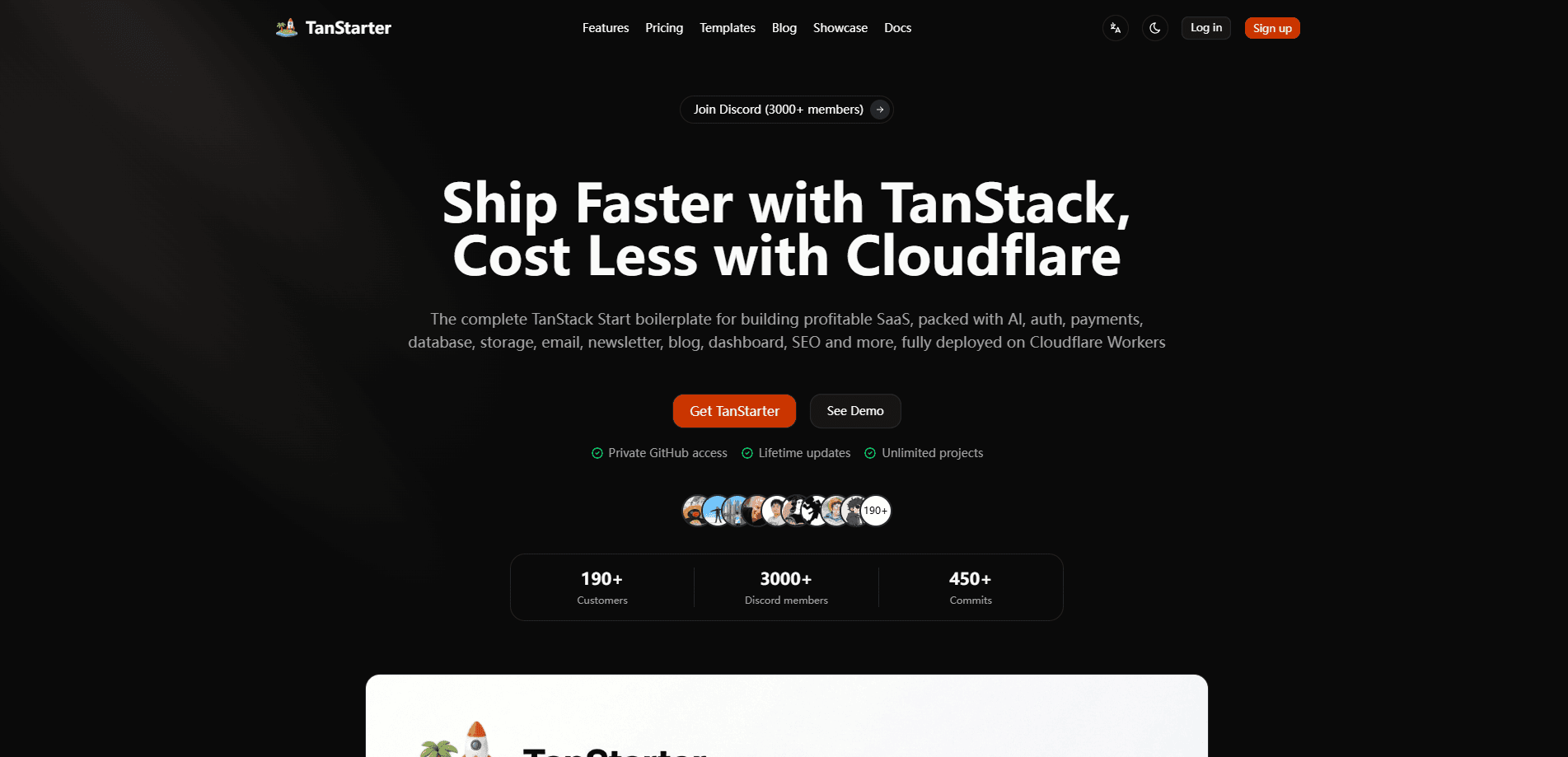
TanStarter is a full-stack SaaS boilerplate built on TanStack Start and Cloudflare Workers. This TanStack Start boilerplate ships with authentication, Stripe billing, a database layer, file storage, a blog, transactional email, and AI hooks already wired together. It works as a React full-stack starter for people who want the boring parts done. Instead of spending weeks gluing libraries into a working app, you clone one repository, set your environment variables, and start building. It also covers Stripe billing starter needs, so payments aren't a route you have to chart on your own. It targets solo developers and small teams. The whole thing runs on Cloudflare's edge network. Latency stays low, and hosting costs stay predictable.
About TanStarter
What Is TanStarter
TanStarter is a production-oriented boilerplate for building full-stack React applications. It bundles TanStack Start for routing and server functions, Cloudflare Workers for compute, D1 for the relational database, R2 for object storage, and Stripe for payments. The project also supports Creem and Waffo as alternative payment providers through a shared provider interface.
The pitch is simple: every SaaS needs the same foundations. Rebuilding them from scratch is wasted effort. TanStarter gives you those foundations as editable code you own, not a black-box service you rent. Payments cover subscriptions, one-time lifetime purchases, and free trials. So why not start from a working base? Users handle billing through the Stripe Customer Portal. Email, newsletter, and notification modules follow the same provider pattern, so swapping vendors means implementing one interface rather than rewriting your app.
Getting Started
- Install Git, Node.js 18+, and pnpm on your machine.
- Clone the repository, then copy
.env.exampleto.env. - Run
pnpm installto pull dependencies, thenpnpm devto start the local server athttp://localhost:3000. - Set your project name, custom domain, and D1/R2 bindings in
wrangler.jsonc. - Push secrets with
pnpm wrangler secret bulk .env.productionand deploy withpnpm run deploy.
Product Information
A quick look at TanStarter's pricing, supported platforms, and performance.
Best for
The users, tasks, and scenarios where this tool fits best.
Users
- Solo founders building a paid product without a backend team
- Small engineering teams that want to skip repeated setup work
- React developers moving from Next.js to TanStack Start
- Indie hackers shipping multiple small SaaS projects
Tasks
- Launching a subscription or one-time-payment web app
- Adding auth, billing, and file uploads to an existing idea
- Prototyping an AI feature on Cloudflare Workers AI or Fal.ai
- Standing up a content blog alongside an app
Scenarios
- Validating a SaaS idea on a weekend without wiring infrastructure
- Migrating a side project off a heavier framework to a leaner stack
- Building an internal tool that needs logins and payments
- Testing Cloudflare's free plan before committing to paid hosting
Key features
TanStack Start Foundation
The template runs on TanStack Start. It handles file-based routing, server functions, and data loading in one framework. Server routes and client routes live together, so you don't juggle two mental models. If you already know React and TypeScript, the learning curve is short.
Cloudflare Workers Hosting
Everything deploys to Cloudflare's edge network. Workers run close to your users, and the free plan allows uncompressed Worker bundles up to 64 MiB, which is more than enough headroom for a typical app. D1 covers relational data and R2 covers file storage, both with bindings declared in wrangler.jsonc. That combination means you never have to provision a separate database server or object store just to get a first version online.
Multi-Provider Payments
Stripe is the default, but the payment module sits behind a provider interface, so Creem and Waffo work too. You get monthly and yearly subscriptions, lifetime one-time payments, and free trials, while billing management runs through the Stripe Customer Portal, and WeChat Pay and Alipay are available when enabled in Stripe settings.
Built-In AI Hooks
Cloudflare Workers AI and Fal.ai power the AI capabilities that ship out of the box. You can add summarization, generation, or similar features without standing up another vendor account. The AI layer is optional, so you can leave it off if your product doesn't need it.
Auth, Email, and Notifications
User accounts and sessions come preconfigured. Email, newsletter, and notification modules share the same provider pattern as payments, so you keep one consistent way to swap services, and transactional email for signups, receipts, and password resets works from day one.
Blog and Content System
Drop a Markdown file into content/blog/ with frontmatter for title, description, date, category, and image, and it appears on the blog page automatically. That gives you a content channel for SEO without bolting on a separate CMS. If you plan to publish regularly, this keeps the workflow inside the same repository you already deploy from.
Analytics Integrations
Google Analytics, Umami, Plausible, and Microsoft Clarity are supported, and you can run any combination. Set the environment variables and they switch on in production, which means no custom tracking code and no extra work when you want to compare tools.
Template Updates
You can pull upstream improvements by adding the template repository as a Git remote, fetching, and merging. After resolving conflicts, run pnpm install, apply any new migrations, and test. Keeping your copy current stays a routine merge rather than a migration project.
Pros and cons
Pros
- Ships auth, billing, storage, and email already connected, so you start on product code
- Runs on Cloudflare's edge, which keeps hosting costs low and predictable
- Payment, email, and notification modules swap through one provider interface
- You own the code, so there's no vendor lock-in on the app itself
- Free plan on Cloudflare is enough to deploy a real app
Cons
- No built-in i18n; you get English and Chinese via a build-time messages module, then wire the rest yourself
- Locked to the TanStack Start and Cloudflare stack, which won't suit teams on Next.js or AWS
- Requires comfort with TypeScript, Git, and command-line deploy steps
- You pay once for the template on top of whatever hosting and payment fees your app incurs
Frequently asked questions
Git, Node.js 18 or newer, and pnpm. Clone the repo, copy .env.example to .env, run pnpm install, then pnpm dev. The app starts at http://localhost:3000.
Related content
Explore related tools, skills, and articles for TanStarter.
TanStarter Alternatives
Forefront
Forefront · CodingForefront is a web platform for building with open-source AI. It lets you fine-tune leading open-source language models on your own data, evaluate how they perform, and run them through an API or export them to host yourself. Developers who want the convenience of a closed-source platform but insist on owning their models and data are the target audience here.

Startkit
StartKit.AI · CodingStartkit is a boilerplate for building AI SaaS and AI wrapper products. Think of it as an AI startup boilerplate with the boring parts already wired up: authentication, Stripe and Lemon Squeezy payments, usage limits, transactional email, and an AI API starter that talks to OpenAI, Anthropic, Groq, or Llama. You clone the repo, set your price, and start on the part of your product that people actually pay for. It's Next.js under React and Tailwind, so most of the boilerplate code already feels familiar.
Testim
Tricentis · CodingTestim is an AI-powered test automation platform for building and running end-to-end tests across web, mobile, and Salesforce applications. It leans on machine learning to keep tests stable when an interface changes, so teams spend less time fixing broken selectors. Not bad for an automated testing tool you can start using today. You create tests by recording actions in a browser, then optionally add JavaScript when you need more control. It's a solid pick for busy QA teams.