

Tensorlake
Tensorlake Inc · Coding · Other
Tensorlake is an infrastructure platform that runs isolated microVM sandboxes for AI agents, giving each one a full Linux computer, a versioned filesystem and managed Git.
About Tensorlake
What Is Tensorlake
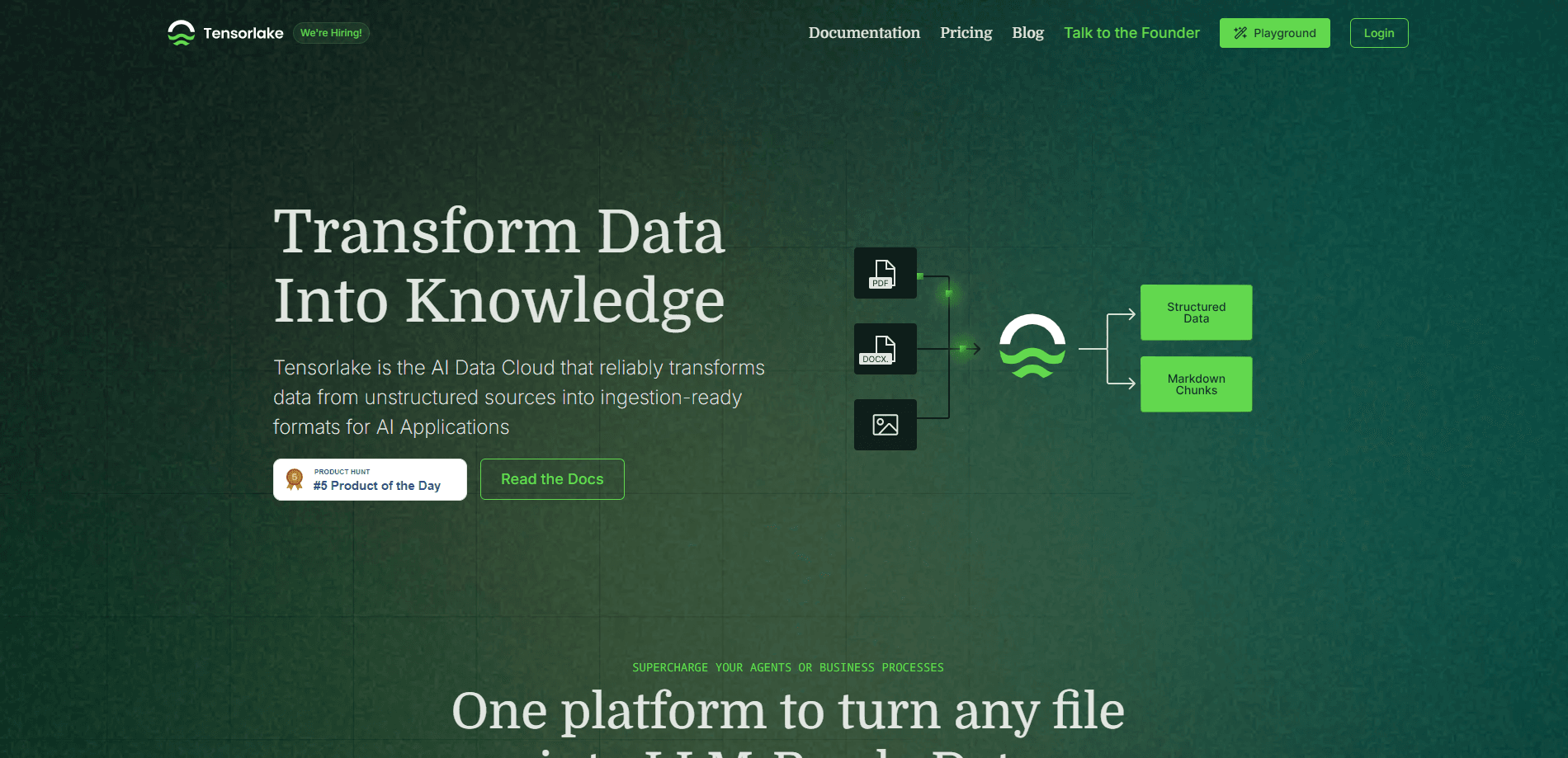
Tensorlake is an agent infrastructure service from Tensorlake Inc, a startup founded by Diptanu Gon Choudhury. It gives AI agents their own computers: isolated microVMs that boot in a few hundred milliseconds, hold a real Linux software stack, and survive sleep cycles without losing state. The company previously shipped an open-source data framework called Indexify, and the current product folds that lineage into a wider agent platform.
The problem it goes after is infrastructure sprawl. Teams building agents usually glue together a compute layer, a queue, a sandbox and a document pipeline before anything ships. Tensorlake replaces several of those pieces with one platform, so a workflow written in plain Python can be deployed as an API and scaled on demand.
The limits are real. It's a developer platform, not a no-code tool, so you need to be comfortable with Python, TypeScript or a CLI. The free tier runs a single sandbox at a time with 2 hours per session. And most of the useful scale sits behind the Pro plan at $250 a billing cycle or an Enterprise contract.
Getting Started
- Create an account at cloud.tensorlake.ai and generate an API key, then install the SDK with
pip install tensorlakeornpm i @tensorlake/sdk. - Start a sandbox in a few lines of Python or TypeScript, picking an image such as
tensorlake/ubuntu-minimaland setting CPUs and memory. - Mount a durable volume or a Git repository into the sandbox so files persist and each settled write saves itself.
- Run your build, tool calls or agent loop inside the sandbox, then snapshot the state if you want a permanent checkpoint.
- Suspend the sandbox when idle, resume it by name, or deploy the whole workflow as a callable application with
tl app deploy.
Product Information
A quick look at Tensorlake's pricing, supported platforms, and performance.
Best for
The users, tasks, and scenarios where this tool fits best.
Users
- Backend and platform engineers running coding agents
- AI research teams running RL rollouts and evals
- Data and document teams processing PDFs, scans and contracts
- DevOps teams building CI pipelines
- Solo developers testing an agent idea
Tasks
- Executing model-generated code safely
- Running agent harnesses and tool calls
- Versioning agent output
- Scaling evals and rollouts
Scenarios
- Building a coding agent that needs its own dev box
- Running a long training or eval job overnight
- Converting a document pile into structured data
- Cutting cloud egress and meeting data rules
Key features
Isolated microVM sandboxes
Every tool call or harness runs in its own Firecracker microVM, with no shared kernel between tenants. The default image boots in a few hundred milliseconds, and a full systemd image takes about a second. For anyone running model-written code, that separation is the difference between a contained error and a broken server.
A versioned filesystem you mount like a disk
Mount a durable volume and it appears as an ordinary POSIX directory, with reads and writes hitting local NVMe. Settled changes replicate to durable storage by themselves, so an agent keeps a versioned working state without ever learning Git. Snapshots pin a permanent checkpoint, and you can restore or fork the whole tree from any point you kept.
Managed Git that scales
Tensorlake runs hosted Git you use the way you already do: clone, branch, commit, merge and push over Git smart HTTP. You can also mount a repository into a sandbox with no clone at all, since content streams in as it's read. Merges run server side, and the company says you pay for the paths that changed rather than the size of the repo.
Suspend, resume and fork a whole machine
A sandbox can freeze on idle with memory, processes and filesystem intact, and the meter stops while it's paused. Resume by name in about a second, or let it wake automatically when a request arrives. You can also fork a running VM, memory and all, to fan out identical copies for parallel jobs.
Sandbox-native orchestration
Once sandbox usage turns into a real application, the orchestrator adds endpoints, durability, fan-out, retries and application-level observability on top of execution. Durable queues and timers carry long-running agent flows, and each session gets its own sandbox so state never leaks between runs.
Runs across clouds and the agent stack
The platform integrates with the harnesses and coding agents teams already run, and can be deployed inside your own AWS, GCP or Azure account when you need lower egress or stricter network boundaries. It's SOC 2 Type II compliant on every tier and HIPAA compliant on Pro and above.
Pros and cons
Pros
- Isolated microVMs keep LLM-generated code away from the host runtime, which matters for any agent that actually executes its own output.
- Sandboxes boot in hundreds of milliseconds, so scaling to many concurrent sessions doesn't stack up cold-start waits.
- The versioned filesystem and managed Git remove the need to bolt on separate storage and versioning tools.
- Suspend and fork keep long agent sessions cheap by pausing the meter and cloning warmed environments.
- A free tier with no credit card lets you test the workflow before spending anything.
Cons
- It's a developer platform, so non-technical users have no path in without the Python, TypeScript or CLI tools.
- The free tier caps you at one sandbox at a time and 2 hours per session, which rules out anything close to production load.
- Useful scale starts with the $250 per cycle Pro plan or an Enterprise contract, which is a steep jump from free.
- Usage is metered by CPU, RAM, disk and snapshot storage, so costs scale with activity and reward careful sizing.
Frequently asked questions
Tensorlake is an AI agent sandbox. You use it to execute model-generated code safely, give an agent a persistent computer for tool calls, and store everything the agent produces in a versioned filesystem or a managed Git repository.
Related content
Explore related tools, skills, and articles for Tensorlake.
Tensorlake Alternatives

Base Code
Base44 (Wix) · Coding · ProductivityBase Code is a shared cloud development environment from Base44. Teammates describe changes to an existing GitHub codebase in chat, preview them live and send them back as pull requests.

Google EmbeddingGemma 2
Google DeepMind · Writing · Image · CodingGoogle EmbeddingGemma 2 is a 740M-parameter open model that turns text, code, images, audio, and video frames into vectors in one 768-dimension space, running on phones and laptops.

GitGlow
GitGlow · Coding · ProductivityGitGlow is a local-first desktop Git client that lets independent developers review their own code and their AI agents' changes in one place before shipping.