

TestAI
nBula · Voice & Language · Coding
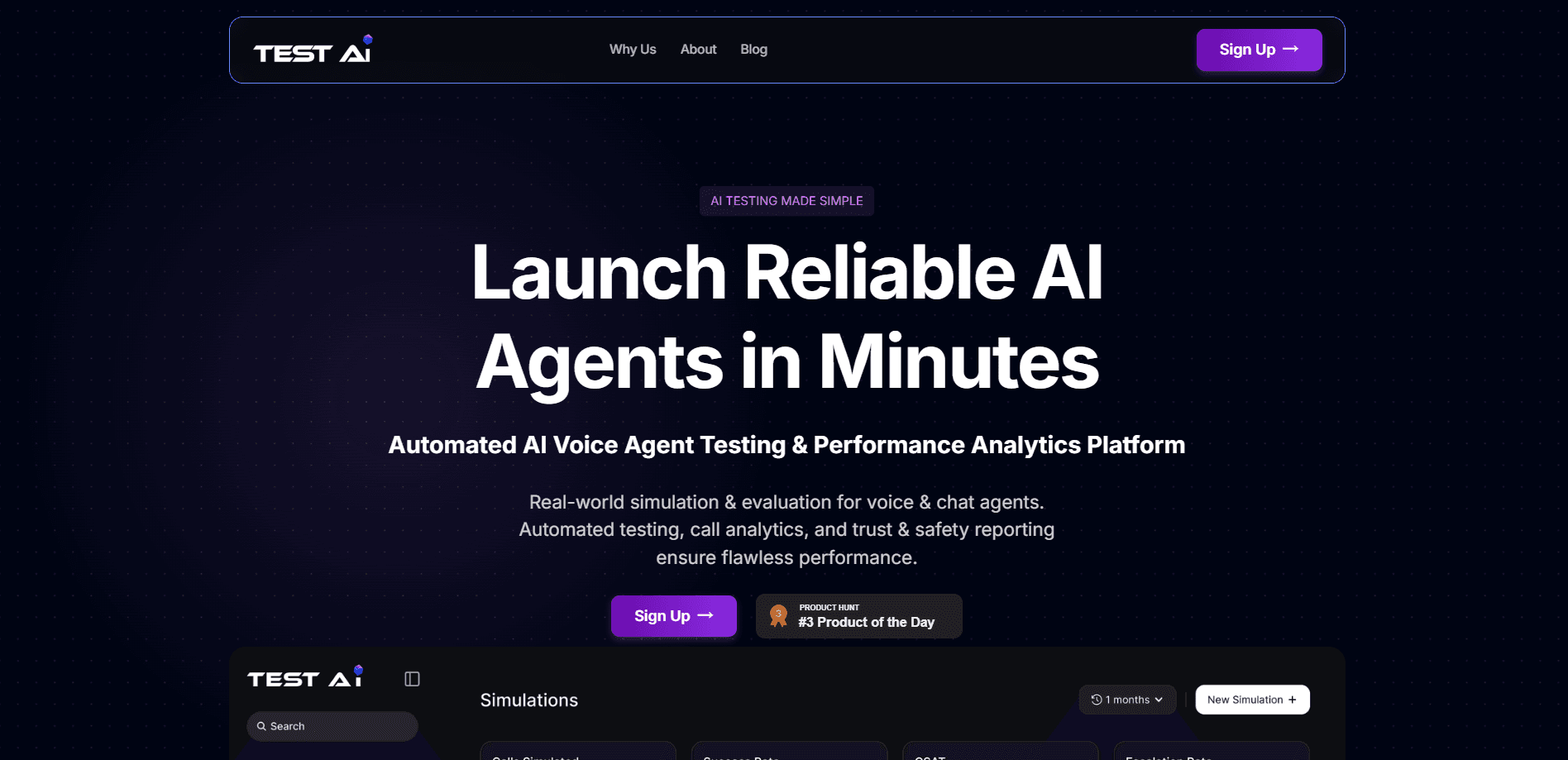
TestAI is an automated testing platform for AI voice and chat agents that simulates real user behavior to catch bugs, hallucinations, and broken flows before you ship.
About TestAI
What Is TestAI
TestAI is a pre-launch safety net for teams that build AI voice agents and chatbots, and it doubles as an AI agent testing platform for anyone shipping conversational products. Instead of a person sitting through calls and pasting replies into a spreadsheet, you hand it a link or endpoint and it runs hundreds of simulated conversations against your agent. You get transcripts, bug reports, and suggestions back in minutes.
It sits in a crowded field of agent testing tools, and its angle is coverage without scripting. You don't write test cases by hand. TestAI generates user personas on its own, from calm shoppers to angry customers, then walks your flow the way those people would. The team reports a 4.6 out of 5 rating on G2, and its customers include QA leads at fintech and healthcare companies.
Know what you're walking into. The platform is a QA layer, not a bot builder, so it can't fix the flow for you. Test results are only as good as the agent link you feed it, and some of the deeper features like competitor benchmarking and multilingual QA need setup before they're useful.
Getting Started
- Sign up at app.nbulatest.ai, or run a test without an account on the free tier.
- Paste the link or endpoint for the voice or chat agent you want to test.
- Choose the model behind the agent and pick a test suite or persona set.
- Launch the run and wait a few minutes for transcripts, bug flags, and improvement suggestions.
Product Information
A quick look at TestAI's pricing, supported platforms, and performance.
Best for
The users, tasks, and scenarios where this tool fits best.
Users
- QA engineers
- AI product teams
- CX and support leaders
Tasks
- Automated testing
- Chatbot QA and debugging
- Multilingual QA
- A/B agent evaluation
Scenarios
- Pre-launch checks
- Regression testing after a model swap
- Internal bot audits
Key features
Automated testing engine
TestAI runs automated and continuous voice agent testing against your AI chat and voice agents. You paste an agent link, pick a model, and the engine fires off hundreds of conversations on its own. Manual call listening is slow and easy to skip, and that's the gap this feature closes. You get pass and fail results organized by bug type, agent, model, or date.
Auto-generated user personas
The platform builds its own personas instead of asking you to script test cases. Personas vary by intent, communication style, emotion, and context, so you can throw angry customers, polite technical users, or confused shoppers at your agent. It also generates edge-case prompts that humans rarely think to test. This is the feature that makes coverage feel broad without manual effort.
Flow validation and debugging
TestAI validates multi-turn logic, finds dead ends, and suggests improvements to flow structure, fallback handling, and re-engagement. When something breaks, you can dig into test logs, flag model-specific errors, and isolate the faulty node or prompt. Traceability goes down to the token, which matters when a single word on a branch sends the conversation sideways.
Bug and tone detection
The platform detects prompt leakage, silent failures, hallucinated content, tone mismatches, memory lapses, and voice problems like latency or audio glitches. It runs classifiers to catch off-tone replies, robotic responses, and sentiment shifts. For voice agents, it also tracks latency metrics, tone charts, and voice sync data so you can tune performance.
LLMs playground and model comparison
The playground benchmarks agents across GPT-4, Claude, Llama, and other models. You can A/B test tone, accuracy, and speed under the same prompt and watch where each model breaks. Different models behave differently under pressure, and this feature exposes that before you commit to one. It's aimed at teams still deciding which model to build on.
Multilingual and competitive QA
Multilingual QA pushes your agent through languages, local dialects, and cultural tone variants to catch gaps before a global rollout, and it counts as conversational AI testing across markets. Competitive agent benchmarking lets you secret-shop competitor bots, comparing answers, flow depth, and bug presence. Both features turn testing into a way to read the market, not just to find faults.
Pros and cons
Pros
- You can run a test without an account, so evaluating the platform costs nothing.
- Persona generation removes the need to write test cases by hand.
- Voice and chat flows are tested in one place, which saves teams from juggling two tools.
- Logs trace issues down to the token, which speeds up debugging a lot.
- Bug categories cover the problems that actually reach customers, from hallucinations to tone drift.
Cons
- It's a QA layer, not a builder, so it flags problems but doesn't fix your agent for you.
- Pricing isn't published, so you have to contact sales to estimate cost.
- Some features need setup before they pay off, including the API-based suites and competitor benchmarking.
- There's no public developer API, which limits wiring it into an existing CI pipeline.
Frequently asked questions
TestAI is an automated testing platform for AI voice and chat agents. It simulates real user conversations to catch bugs, hallucinations, and broken flows before an agent reaches customers, whether you call it AI agent testing or plain chatbot QA.
Related content
Explore related tools, skills, and articles for TestAI.
TestAI Alternatives

Foley
Hanamori Labs, LLC · Voice & Language · Productivity · AI AssistantFoley is a voice to-do list that turns a spoken sentence into a filed task, complete with project, date and time, then helps you plan the day around what is already there.

HireKey
HireKey · Voice & Language · Productivity · LeaningHireKey is an AI job search copilot built by a former tech recruiter. It checks role fit, tailors resumes, runs interview practice and tracks every application.

Fluence
Yay Software (Yannick Huchard) · Writing · Voice & Language · ProductivityFluence is an Android app that reads PDFs, EPUBs, Word files and web articles aloud, follows each sentence as it speaks, and answers questions about the text on the phone itself.