

Test Your Idea
Preuve AI · Business
Test Your Idea, now sold as Preuve AI, scores a startup idea out of 100 in about 60 seconds from 60+ live sources, then names the weak spots before you build.
About Test Your Idea
What Is Test Your Idea
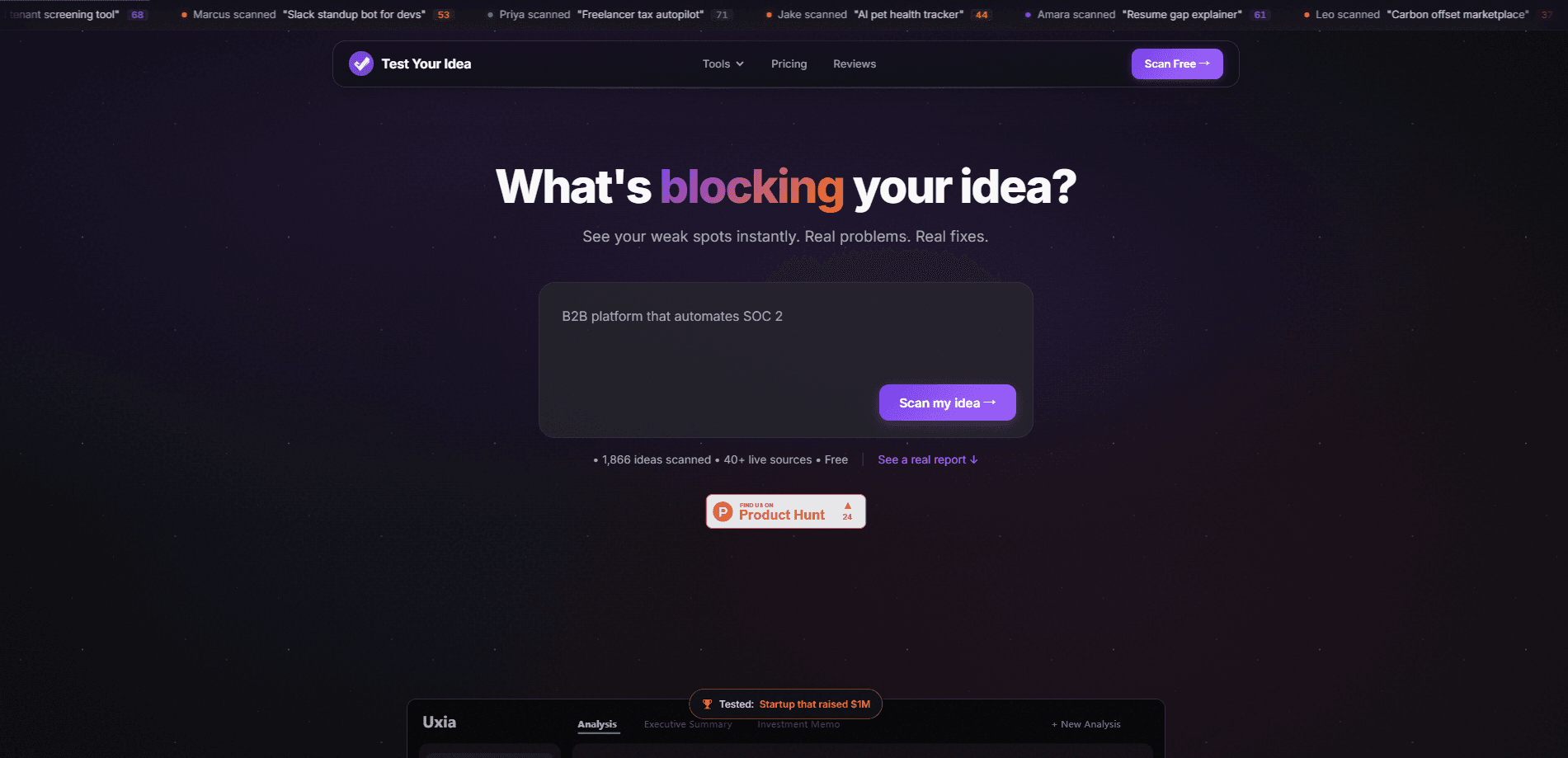
Test Your Idea is a web app that pressure-tests a business idea before you sink months into it. You describe what the product does, who buys it, and how you plan to charge, then a free scan returns a 0 to 100 viability score with a verdict, a market size estimate, and the risks pulling the score down. In 2026 the company renamed the product Preuve AI and moved it to preuve.ai. The old testyouridea.app address forwards there, so bookmarks still work.
The problem it targets is the friendly answer. Ask a general chatbot to validate a startup idea and it usually finds a reason to say yes. The reply comes from training data, not from this year's market. Most startup validation tools stop at that agreeable paragraph. Test Your Idea runs ten agents across live sources such as Crunchbase, Google Trends, Reddit, Product Hunt, G2, app stores, and public pricing pages before it writes a verdict. Every key claim in a paid report links to the page it came from, so you can check the work instead of trusting a paragraph.
The limits matter as much as the features. Startup idea validation is a research job, and a score is a model output, not a market test. It can miss demand that lives in a local language or an offline channel. The free tier allows two scans. A free report stays viewable for seven days. Paid reports are one-time purchases, and the buyer panel inside them is simulated, so treat the buyer count as an upper bound rather than a forecast.
Getting Started
- Open preuve.ai in a browser. The testyouridea.app address redirects to the same app, so either entry point works.
- Describe the idea in plain language: the product, the buyer, and the price you have in mind. Answer the follow-up questions about region and business model. Detail sharpens the verdict.
- Wait about 60 seconds for the free Reality Check. It returns the score, the verdict, a market size read, two competitor previews, and the main blockers.
- Buy the $59 Founder Report if the result justifies it. Any section that got your persona or channel wrong has a refine action. A re-run costs no extra credits.
Product Information
A quick look at Test Your Idea's pricing, supported platforms, and performance.
Best for
The users, tasks, and scenarios where this tool fits best.
Users
- First-time founders
- Solo builders and vibe coders
- Consultants and accelerator coaches
Tasks
- Deciding whether a niche deserves a build sprint
- Sizing TAM, SAM and SOM for an investor conversation
- Testing a positioning change
Scenarios
- Weekend idea triage
- Pre-seed fundraising prep
- A pile of side projects
Key features
Free Reality Check in about a minute
The free scan returns a 0 to 100 viability score, a verdict band, a market size read, two competitor previews, and the main blockers, and it needs no card, which makes it usable as a first filter on any idea. Two scans come with a free account, and each free report stays open for seven days.
Ten agents reading 60+ live sources
Ten specialized agents work in parallel, including a market analyst, a competitor scout, a community researcher, a financial analyst, a news scanner, and a cross-validator that fact-checks claims. They read Crunchbase, Google Trends, Reddit, Product Hunt, G2, Capterra, app stores, SEC filings, and public pricing pages. The scoring model runs more than once. When runs disagree, the system repeats the analysis.
Competitor map with funding and pricing
A paid report maps up to 15 competitors and attaches funding, estimated users, live pricing, and a stated weakness to each one, so you see who is ahead and why. It also flags gaps you can sell into, such as a missing plan between free and an expensive tier. The company says look-alike domains and dead links get filtered out first.
A viability score that can say no
So what counts as good? The July 2026 benchmark of 6,000+ anonymized ideas put the median at 54 out of 100. Only 17.5% reached 70 or above. That distribution is the point. An AI idea validator that approves almost everything tells you nothing, which is why a low score here arrives with a fix list instead of a rejection letter.
Market sizing with sourced numbers
TAM, SAM and SOM are sized bottom-up, with the method shown and every figure linked. For a founder building a deck, that saves the part of the work where a market number gets copied from a blog post with no origin. The report marks estimates as estimates.
Three ranked pivots
Every Founder Report includes three pivot directions ranked by how much they lift the score. The company puts the average gain at 10 points. Each pivot comes with the reasoning behind it, so you can judge whether the new direction fits your skills and your runway before you spend another month on it.
Founder Report extras and MCP access
The $59 report adds a first-100-customers plan, a business plan PDF, and feedback from 50 simulated buyers. The $499 investor package adds a pitch deck, an investment memo, and an 18-month financial model, and the report connects to Claude, Cursor, Codex, and other MCP clients so you can query it while you build. Three months of Sentinel re-scans come with reports bought from October 2026.
Pros and cons
Pros
- The free scan needs no card and returns a score, a verdict, and two competitor previews in about a minute.
- Paid reports link each key claim to a source, so a funding figure or a pricing point takes one click to check.
- One-time pricing starts at $59 with no subscription. Packs bring the per-report cost to $39.80.
- Up to 15 competitors arrive with funding, pricing, and weaknesses. That beats a name list.
- The report feeds into Claude, Cursor, or Codex through MCP, so the research carries into the build.
Cons
- A score is a model output and can't replace conversations with real buyers, especially in narrow B2B markets.
- The free tier stops at two scans, and a free report closes after seven days. Comparison work needs a paid pack.
- Sources lean on English-language startup data from the US and Europe. Coverage thins out for local or offline businesses.
- The $499 investor package has no refund once delivered. It fits founders who already trust their report.
Frequently asked questions
It takes a written description of a business idea and returns a viability score with evidence, competitor data, and market sizing, while the free scan covers the score and two competitors. The paid Founder Report expands that into 21 sections, including risks, pivots, and a business plan.
Related content
Explore related tools, skills, and articles for Test Your Idea.
Test Your Idea Alternatives

Knocket
Knocket (Tencent RTC team) · Productivity · Business · ChatbotKnocket is a free live chat and contact page tool that lets visitors message you from your website, app, or a shareable link, with every reply handled from Telegram or one inbox.

shippedit.me
Krawlup · Marketing · Businessshippedit.me now redirects to Krawlup, a web platform that audits SEO, AEO and page speed every week, then hands the fixes to AI coding agents over MCP.

Ayven
Alknoma · Productivity · BusinessAyven is an AI control centre by Alknoma that turns a plain-language goal into a dated plan, hands the work to your people and AI agents, and asks for your approval only when the call is yours.