

The 2025 state of AI Development
Vellum · Writing · Business
The 2025 state of AI Development is a report by Vellum drawn from a survey of more than 1,250 AI developers and builders about what they shipped in 2024 and what comes next.
About The 2025 state of AI Development
What Is The 2025 state of AI Development
The 2025 state of AI Development is a research report published by Vellum, the AI development platform. It pulls together answers from more than 1,250 developers and builders who work with large language models, and turns them into a snapshot of how teams actually build with AI rather than how vendors say they should.
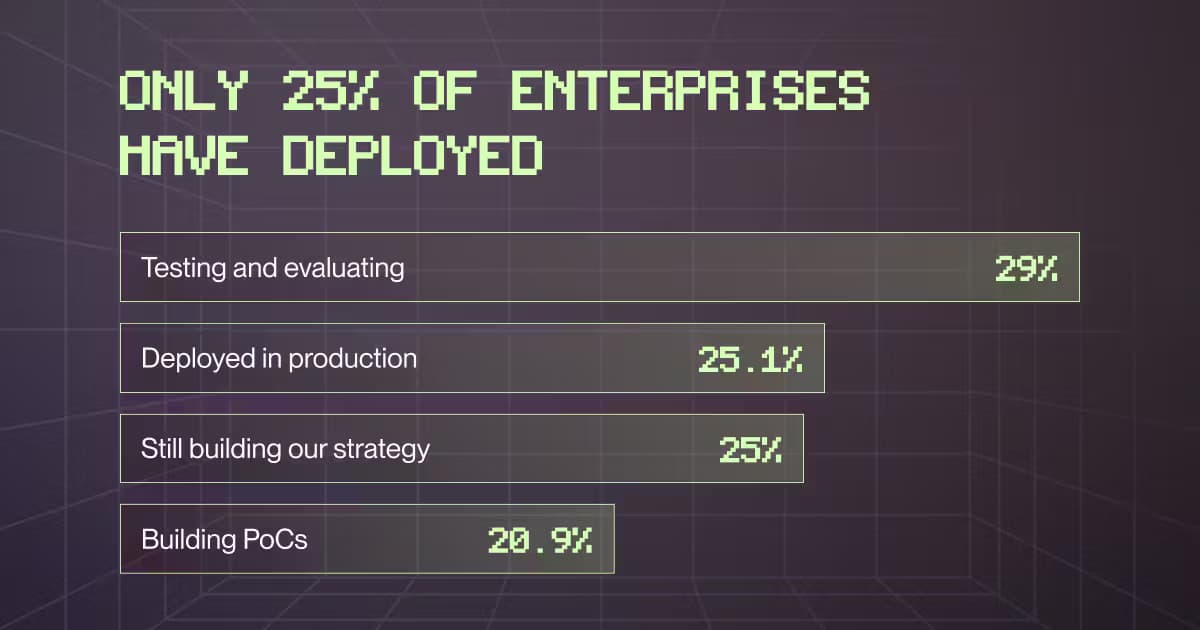
The report focuses on the gap between talk and practice. Around a quarter of companies had pushed an AI feature all the way to production by the end of 2024, and only a fraction of those could point to a measurable result. Most teams sat earlier in the pipeline, still drafting a strategy or running a proof of concept. That gap is the thread running through the whole document: tooling is young, use cases are still being picked, and the noise around AI outruns the deployments.
Vellum frames 2025 as the year tooling matures, with agentic workflows expected to move from demos into everyday products. The report is free to read on the web, has no signup gate, and is aimed at developers, product leads, and founders deciding where to invest their next quarter.
Getting Started
- Open the report on the Vellum website in any browser.
- Read the opening summary for the headline numbers on production adoption and model usage.
- Move through the sections on use cases, modalities, model providers, and tooling to compare them against your own stack.
- Check the evaluation and monitoring findings if you run models in production, since they cover where teams most often skip work.
- Use the closing predictions as a checklist for what to prioritize in 2025.
Product Information
A quick look at The 2025 state of AI Development's pricing, supported platforms, and performance.
Best for
The users, tasks, and scenarios where this tool fits best.
Users
- Developers choosing a stack
- Product leads scoping an AI feature
- Founders and investors sizing the market
- Anyone who wants a data-backed view of AI hype
Tasks
- Picking a model provider
- Deciding between RAG and fine-tuning
- Planning an evaluation setup
- Justifying a tooling budget
Scenarios
- Standing up a first AI feature
- Reviewing an existing pipeline
- Preparing a 2025 roadmap
- Briefing a non-technical stakeholder
Key features
Adoption stages from concept to production
The survey sorts teams by how far they've taken AI, from talking to users about needs up through a strategy and proof of concept, a beta, and finally a live production deployment. Roughly a quarter of companies had something in production, with the rest spread across earlier stages. The breakdown matters because it shows the field is not one wave but a spread, so a team that feels behind is often just at the same stage as most peers.
What teams actually build with AI
Document parsing and analysis came out on top as the most common use case, followed by customer service and chat assistants, then natural language analysis. Content generation, recommendation systems, code generation, and research automation filled out the list. The pattern points to work that involves reading and sorting existing text, not just producing new text, which is a useful signal about where the demand sits.
Model and provider usage
OpenAI held the largest share of usage, largely through GPT-4o and GPT-4o Mini, with Microsoft Azure, Anthropic, and AWS Bedrock close behind. Larger companies leaned more on cloud platforms, and Azure's share climbed with company size. Hosted open models from providers such as Groq, Fireworks AI, and Together AI picked up ground, which the report reads as a sign that teams want more than one option in the mix.
RAG over fine-tuning
Retrieval-augmented generation dominated the architectures teams described, with a majority using a vector database. Only about a third fine-tuned a model at all. The report ties the low fine-tuning figure to falling costs and rising model quality, since a good base model plus retrieval often covers the job without a custom training run.
Evaluation and monitoring gaps
Most developers said they evaluate their AI, but the methods skew manual, with test-and-review far outpacing automated evaluation tools. Monitoring split similarly, with in-house dashboards ahead of third-party tools. Managing hallucinations and prompt issues ranked as the top challenge, which lines up with how thin the automated checks still are.
Predictions for 2025
The report closes with a forward look, predicting that 2025 turns into a year of tooling and that agentic workflows move from experiments to shipped features. It also flags rising multi-model setups and continued cost pressure as forces that shape what teams build next.
Pros and cons
Pros
- The sample of more than 1,250 developers is large enough to show patterns rather than one team's experience.
- Numbers on model usage, architectures, and evaluation come from practitioners, not vendor marketing.
- The stage-by-stage adoption data gives a realistic benchmark for teams planning their first release.
- The use-case breakdown points to concrete jobs worth building, like document analysis and support chatbots.
- Free to read with no signup, so it works as a quick reference during planning.
Cons
- The findings reflect a moment in late 2024, so fast-moving model shares and tooling names date quickly.
- Survey answers are self-reported, which means reported impact can overstate what teams measured.
- There is no public dataset or API behind it, so you cannot pull the numbers into your own analysis.
- Coverage leans on the kind of teams that answer developer surveys, which may undercount quiet or internal projects.
Frequently asked questions
It is a research report from Vellum built on a survey of more than 1,250 AI developers and builders. It covers what teams built with AI in 2024, which models and architectures they used, and where they expect the field to go in 2025.
Related content
Explore related tools, skills, and articles for The 2025 state of AI Development.
The 2025 state of AI Development Alternatives

Google EmbeddingGemma 2
Google DeepMind · Writing · Image · CodingGoogle EmbeddingGemma 2 is a 740M-parameter open model that turns text, code, images, audio, and video frames into vectors in one 768-dimension space, running on phones and laptops.

MePersona
MePersona, Inc. · Writing · Productivity · MarketingMePersona is an AI unified inbox for creators. It learns your voice, drafts replies to fan messages from 12 platforms, and sends only what you approve.

Fluence
Yay Software (Yannick Huchard) · Writing · Voice & Language · ProductivityFluence is an Android app that reads PDFs, EPUBs, Word files and web articles aloud, follows each sentence as it speaks, and answers questions about the text on the phone itself.