

AI Compliance Auditing
AI Compliance, Inc. · Other
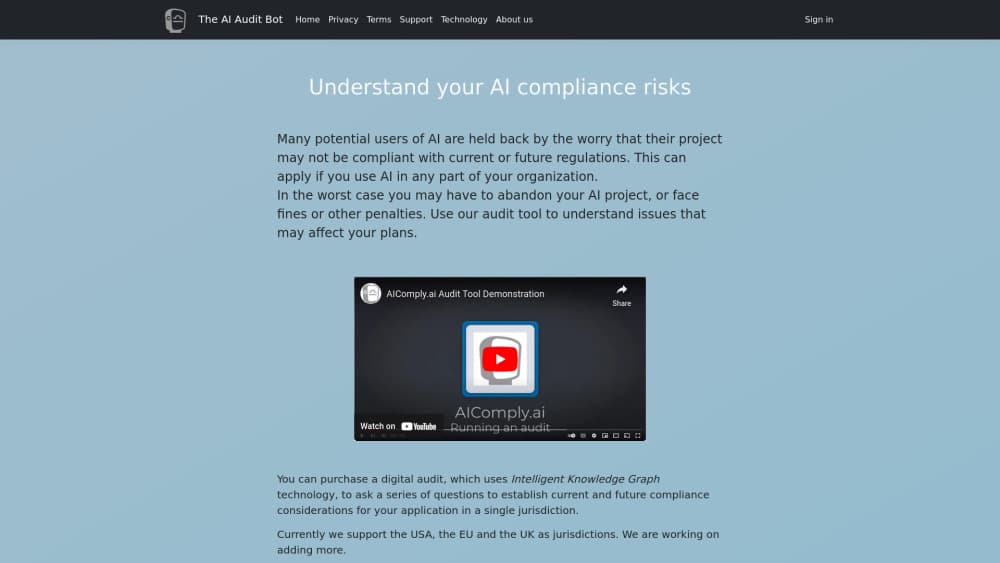
The AI Audit Bot is a chat based AI compliance tool from AI Compliance, Inc. It checks an AI project against UK, EU and US rules, gives it an AI risk score and exports a PDF audit report.
About AI Compliance Auditing
What Is The AI Audit Bot
The AI Audit Bot is a web tool that walks you through a compliance review the way a good interviewer would. You describe what your AI system does, who it touches and which technologies sit inside it. The bot maps those answers onto regulation texts for the UK, the EU and the US, including state and city rules.
Two things come back. A risk score built from the technologies you listed, and a written summary that points at the sections of law that matter for your case. Both land on screen and in a PDF you can download, which is usually what a client or an internal reviewer asks for first.
The engine isn't a large language model guessing at statutes. AI Compliance built it on a knowledge graph, so the same answers produce the same result and every claim traces back to a rule. That design also lets the vendor update the graph as regulations change and email you when a change touches a system you already audited.
One limit worth stating up front: the bot can't test your application. The verdict is only as good as what you type in, and the follow through, meaning the policy writing and the product changes, stays with your team.
Getting Started
- Pick the jurisdiction you need to check. One audit covers one jurisdiction, so a product sold in the UK and Germany means two separate runs.
- Open the chat and describe the system: what it does, who uses it, what data it handles, which models or vendors are involved.
- Answer the follow up questions. The bot asks about automated decisions, transparency, biometrics and high risk uses, because those answers change the verdict.
- Read the risk score and the linked requirements on screen, then download the PDF for your records or your client.
- Keep the portal entry current. When new regulation affects your audit, the service emails you and asks for the details it needs to stay accurate.
Product Information
A quick look at AI Compliance Auditing's pricing, supported platforms, and performance.
Best for
The users, tasks, and scenarios where this tool fits best.
Users
- Founders and product managers building a first AI feature
- In house legal and compliance teams
- Agencies shipping AI for clients
Tasks
- Screening a concept before the build
- Checking a system that's already live
- Preparing evidence for a client review or a procurement questionnaire
Scenarios
- A startup planning to sell into the EU and the UK
- A team facing a US state level question
- A vendor whose model stack changed after an audit
Key features
Chat Interview Instead of a Long Form
The review runs as a conversation. You describe the system in your own words, the bot picks the next question from what you said, and it skips branches that don't apply. Most people finish faster than they would with a 60 page questionnaire, and the language stays in business terms rather than statute terms.
AI Risk Score Tied to Technologies Used
Each audit ends with a score built from the technologies you reported. Biometrics, automated decisions about people and generative output push it up. The score isn't a legal opinion, but it gives a team one number to argue about, which is often the first honest conversation about scope anyone has had.
PDF Audit Report
The PDF pulls a whole session into one document: system description, score, applicable regulations and recommendations. You can file it, send it, or paste sections into a security review. The AI audit report is the artifact most buyers ask for, and producing it takes one click.
Coverage of UK, EU and US Rules
The knowledge base holds UK guidance, the EU AI Act, and US federal, state and city rules. That range matters because one product often gets three different answers. For a team starting EU AI Act compliance work, the article level mapping saves a week of reading. Treat it as an AI regulation checker for the markets you actually sell into, since each audit covers one jurisdiction.
Change Alerts When Regulation Moves
Rules get amended, and an audit from last quarter can quietly go stale. The service watches for changes that affect what you told it, then emails you and asks for the extra details through the portal. You end up with a living record instead of a one time PDF in a shared folder.
Knowledge Graph Engine, Not a Guessing Model
Answers come from a rule graph rather than open ended text generation. Two people with identical inputs get identical results, and each requirement points back to source text. For a compliance artifact, repeatable beats fluent.
Runs in the Browser and in Microsoft Teams
The same graph powers a website chat and a Teams app, so a team that lives in Microsoft 365 doesn't need a second tool. Audit history stays with the organisation either way.
Pros and cons
Pros
- Results are repeatable and explainable, so you can defend an answer to a reviewer instead of shrugging at a chatbot.
- One audit covers one market, which matches how products actually ship.
- The PDF is ready for a client file or a procurement pack with no extra formatting work.
- Change alerts stop an old audit from becoming a quiet liability.
Cons
- It can't inspect your code or test the model, so the verdict depends on how accurately you describe the system.
- Multi market products need several audits, and the price is quoted per audit rather than published.
- The tool points at the relevant rules but leaves the remediation work to you.
- Coverage stops at the UK, EU and US. Teams selling in Canada, Brazil or Japan have nothing to run yet.
Frequently asked questions
It interviews you about an AI system, matches your answers to regulation texts, and returns a risk score plus a PDF report. The point is finding out early whether a product faces a ban, extra obligations or nothing unusual in a given market.
Related content
Explore related tools, skills, and articles for AI Compliance Auditing.
AI Compliance Auditing Alternatives

Odyssey 3
Odyssey · OtherOdyssey-3 is Odyssey's foundation world model. It simulates physics in real time, turns a prompt into an interactive environment, and adapts to robots, cars and games.

JarvisCore
Prescott Data · Coding · Productivity · OtherJarvisCore is an open source Python runtime where AI agents work as equal peers on an agent mesh, claim tasks from a shared ledger, and reach external services through a zero-trust broker.
Clef
Cloudflare · Business · OtherClef is Cloudflare's open-source decision model for Workers AI. It returns calibrated probabilities for typed questions, not generated text, so agents can classify, route, and act fast.