

THEO
THEO Growth · Coding · Leaning
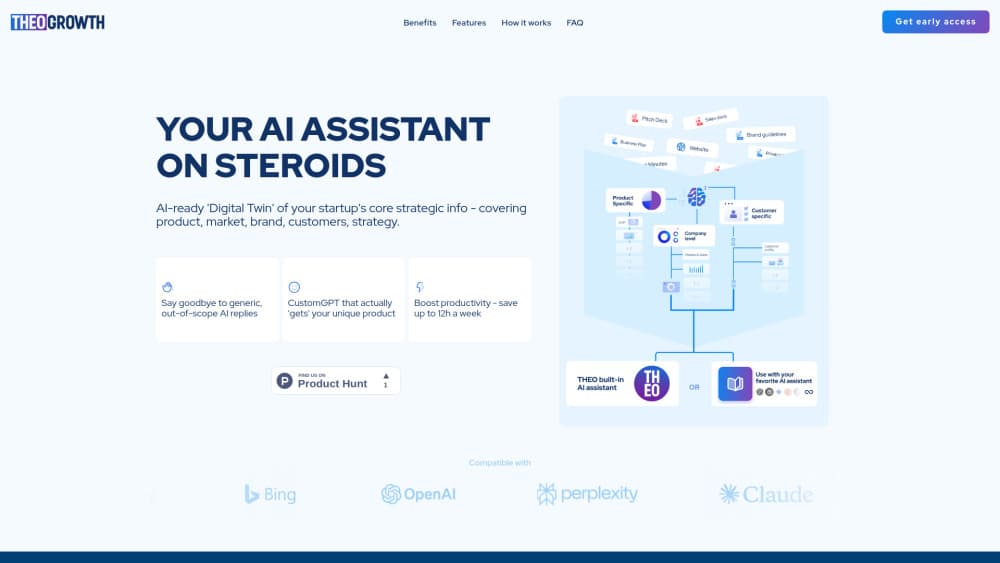
THEO is THEO Growth's positioning intelligence platform. It reads a category and its competitors, then delivers a sourced positioning brief you can query inside ChatGPT or Claude.
About THEO
What Is THEO
THEO is a positioning intelligence platform made by THEO Growth. You point it at your website and a region, and it works out who your competitors are, how each one is positioned, and where the open space sits. It's a brand positioning tool for strategists, and the output is a structured brief rather than a folder of raw pages.
The product grew out of the team's earlier work on customer discovery and context engineering, where they ran strategic analysis across thousands of companies and learned how much the result depends on feeding a model the right information at the right time. That idea, giving an AI the business context it needs to reason about a market, is what "context-powered" refers to here.
The pitch fits strategists and agencies who would otherwise spend a week on manual desk work. The catch is that THEO is a service with per-report pricing, and the standard brief covers the whole category as THEO reads it, so it suits work that starts from a broad view more than a one-off question you could answer in a single chat.
Getting Started
- Open app.theogrowth.com and start a project with your website URL and target region.
- Choose whether you supply the competitor list yourself or let THEO discover the full set of rivals for you.
- Wait for the brief to build, which the team quotes in hours rather than weeks, and review the category structure, competitor profiles, and territory map.
- Connect the report to ChatGPT or Claude through the MCP option if you want to pull and reshape sections from a normal chat.
- Take the scored competitor matrix and white space notes into your strategy or pitch.
Product Information
A quick look at THEO's pricing, supported platforms, and performance.
Best for
The users, tasks, and scenarios where this tool fits best.
Users
- Brand strategists who need a category read before a workshop
- Independent consultants walking into a new client in a fresh market
- Agencies that run many pitches
- Founders preparing a launch or a rebrand
Tasks
- Mapping a competitive category
- Spotting positioning white space
- Comparing markets before expansion
- Building a positioning brief for a creative team
- Pulling report sections into an AI chat
Scenarios
- A pitch lands next week and the team has no competitor map
- A brand feels lost in a crowded category
- An analyst is asked "who is really a threat"
- A rebrand needs a defensible story
Key features
The CLEAR methodology
Every report is built on THEO Growth's CLEAR methodology, a structured framework for reading a category through messaging, visual identity, credibility, and demand signals. Instead of one long AI answer, you get a fixed set of sections scored the same way on every run. That consistency is the point: comparing two markets, or the same market twice, holds the structure steady.
Structured positioning brief
A standard report runs through sections such as positioning territories, clusters, visual identity analysis, category frame, credibility archetypes, messaging convergence, buyer segments, and a positioning north star. Each section is meant to reveal a pattern you can act on, and the whole thing reads like a strategist's brief, not a data dump. The homepage lists 15 sections, while the about page describes a 10-section brief, so the exact count depends on the tier you buy.
Competitor discovery and scoring
You can either send your own competitor URLs or let THEO find the rivals. When it discovers them, it profiles each one across a long list of dimensions and gives alignment scores, so obvious rivals and less obvious threats sit on the same scale. That makes it a competitor analysis tool rather than a search box, since the threat map ranks competitors by how closely they overlap with your position rather than by how well known they are.
Positioning territories
The brief categorises the space into owned, unoccupied, contested, and indefensible territory. Owned means a competitor already holds it, unoccupied means it is open, contested means several players are fighting for it, and indefensible means it looks appealing but cannot be held. This is the section most strategists open first, because it answers where a brand can still make a stand.
MCP connector for ChatGPT and Claude
The MCP add-on, from €49 a month, links your reports to ChatGPT and Claude. Once connected, you can ask either assistant to pull a section, compare two reports, or reshape the findings into whatever format your team uses. It is the "context-powered" side of the product in practice: the output is AI-ready research that an assistant can work with directly, not just a file for a person to read.
Sourced and traceable findings
THEO's own guarantee is that every claim traces back to observable evidence, such as competitor messaging, visual patterns, or pricing signals. If you find a false claim, the team re-runs the report free. For a strategist who has to defend a recommendation, cited evidence is the difference between an opinion and a working document.
Pros and cons
Pros
- The brief format is structured and repeatable, so two reports on the same category a month apart can be compared line by line.
- Competitor discovery can be handed to THEO, which surfaces threats a quick search would miss.
- Every claim is cited, and the false-claim re-run guarantee pushes the team to keep the sourcing honest.
- The MCP connector means the output feeds straight into ChatGPT or Claude, matching how many teams already work.
- Deliverables come back in hours, which fits deadlines that a week of manual research would miss.
Cons
- There is no free plan, so testing the output means paying for at least one report.
- Per-report pricing starting at €149 suits project work, and teams doing ongoing research will lean on the €2,500-plus custom tier or the €49 a month MCP add-on.
- The brief is built around a whole category, so a narrow one-off question is more than the product is designed for.
- The section count differs between what the homepage and the about page describe, so confirm the scope of the tier you buy before you commit.
Frequently asked questions
THEO is a positioning intelligence platform from THEO Growth. You give it your website and a target region, and it maps the competitive category, profiles each competitor, and returns a structured positioning brief with sourced evidence.
Related content
Explore related tools, skills, and articles for THEO.
THEO Alternatives

Base Code
Base44 (Wix) · Coding · ProductivityBase Code is a shared cloud development environment from Base44. Teammates describe changes to an existing GitHub codebase in chat, preview them live and send them back as pull requests.

Google EmbeddingGemma 2
Google DeepMind · Writing · Image · CodingGoogle EmbeddingGemma 2 is a 740M-parameter open model that turns text, code, images, audio, and video frames into vectors in one 768-dimension space, running on phones and laptops.

GitGlow
GitGlow · Coding · ProductivityGitGlow is a local-first desktop Git client that lets independent developers review their own code and their AI agents' changes in one place before shipping.