

TherapistAI
TherapistAI · Other
TherapistAI is a free, browser-based AI mental health companion that applies CBT principles to everyday stress and anxiety, with support available around the clock.
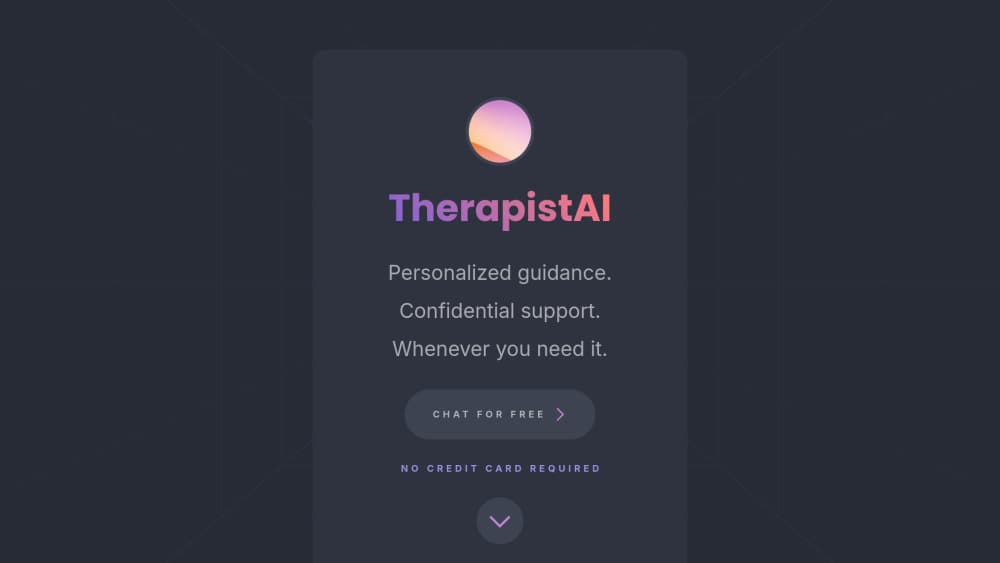
About TherapistAI
What Is TherapistAI
TherapistAI is an AI mental health companion that runs in a web browser. You type what's bothering you, and it answers with questions and suggestions built on cognitive behavioral therapy, the approach that ties a thought to the feeling and the action that follows. The product bills itself as a private space to work through stress, anxiety, and the ordinary bad week, without an appointment or a waitlist.
Its selling point is timing. Most people don't spiral at 2pm on a Tuesday with a therapist on speed dial. They spiral at 1am, or on a train, or the night before a presentation. TherapistAI positions itself for those hours, and it costs nothing to open.
The limits matter more than the pitch. This is self-help software with a CBT script behind it, not a clinician who can diagnose, prescribe, or notice when a situation turns dangerous. Nobody is on the other end to escalate a crisis. And there's a practical problem worth stating up front: as of late October 2026, the therapistai.co domain no longer serves the product. The root URL returns a 404, and other paths on the domain carry unrelated pages. Treat the description below as a record of what TherapistAI offered, not as a service you can sign into today.
Getting Started
- Open therapistai.co in a modern browser. There's nothing to install, and the tool runs on desktop or phone through the browser.
- Enable JavaScript and cookies, then complete the short identity check the site puts in front of the chat.
- Describe what's going on. A first message of two or three sentences works better than a single word, because the replies build on what you give it.
- Work through the follow-up questions. A CBT-style session asks you to name the thought, the evidence for it, and a more balanced version.
- Close the tab when you're done. There's no account history to manage beyond what the session keeps.
Product Information
A quick look at TherapistAI's pricing, supported platforms, and performance.
Best for
The users, tasks, and scenarios where this tool fits best.
Users
- People in a rough patch who want to talk now
- Students and shift workers
- First-timers weighing real therapy
Tasks
- Talking down a spike of anxiety
- Practicing a thought record
- Preparing for a real session
Scenarios
- A bad night with no one to call
- The gap between appointments
- Traveling or sharing a flat
Key features
CBT-Guided Conversations
Sessions follow the structure of cognitive behavioral therapy rather than free-form chat. The assistant asks what happened, what you told yourself about it, and what evidence sits on each side, then offers a reframe you can test. That structure is the reason a CBT app can feel more useful than a generic chatbot for anxious thinking: it has a route to follow.
Personalized Guidance From Your Answers
Replies are shaped by what you report, so two people describing the same event get different follow-ups. The product describes its guidance as tailored to your responses and behavior, which in practice means the questions narrow toward whatever you keep returning to. You get more out of it when you're specific.
Round-the-Clock Access
There's no schedule, no queue, and no session limit. The tool is available whenever the browser is open, which is the whole argument for an AI mental health companion over a human one. It doesn't get tired at 4am, and it doesn't charge by the hour.
Stress and Anxiety Support
Sessions center on stress, anxiety, and low mood, and the suggestions lean practical: breathing, reframing, small next actions, and questions to sit with. It isn't built for complex trauma or diagnostic work, and it doesn't pretend to be. Think of it as stress and anxiety support you can reach in ten seconds.
Browser-Only Access With Quick Verification
Nothing gets installed. You open the site, pass a short identity check, and start typing. The tradeoff is that it depends on JavaScript and cookies, so a locked-down work laptop or a browser with strict tracking protection may not load it. A phone browser works fine, and there's no separate iOS or Android build to keep updated.
Free Access, No Subscription
The tool costs nothing to use, with no card and no trial clock. That changes how people use it. You can open it for five minutes, decide the questions are annoying, and close the tab without a sunk cost. For a category where subscriptions run $10 to $20 a month, free is the differentiator most people notice first.
Pros and cons
Pros
- Free to use with no card, no trial window, and no subscription to cancel.
- Available at any hour, which covers the gap that appointments and office hours leave open.
- The CBT structure gives each session a path, so you're not staring at an empty box wondering what to type.
- Runs in a browser on desktop or phone, so there's no install and no update cycle.
- Low commitment by design: a five minute session is a valid session.
Cons
- It cannot replace a licensed therapist. There's no diagnosis, no prescription, and no human who notices when a conversation turns toward self-harm.
- The site is unreachable as of late October 2026. The domain returns a 404 and other paths carry unrelated content, so new users can't sign in.
- Public documentation is thin. There's no published pricing page, privacy policy, or changelog in reach, which makes data handling hard to verify for a product about mental health.
- Browser-only with JavaScript and cookies required. Strict privacy settings or corporate machines may block it entirely.
Frequently asked questions
TherapistAI is an AI mental health companion that runs in a web browser and structures its replies around cognitive behavioral therapy. You describe what's on your mind, and it responds with questions and reframes meant to help you see a situation more clearly.
Related content
Explore related tools, skills, and articles for TherapistAI.
TherapistAI Alternatives

JarvisCore
Prescott Data · Coding · Productivity · OtherJarvisCore is an open source Python runtime where AI agents work as equal peers on an agent mesh, claim tasks from a shared ledger, and reach external services through a zero-trust broker.
Clef
Cloudflare · Business · OtherClef is Cloudflare's open-source decision model for Workers AI. It returns calibrated probabilities for typed questions, not generated text, so agents can classify, route, and act fast.

iFixAi
iFixAi · Business · OtheriFixAi is an open-source auditor for AI agents. It runs your agent through a simulation of your business, grades every reply, and returns an A to F scorecard backed by evidence.